Charged Particles Detector
 SPUTNIX
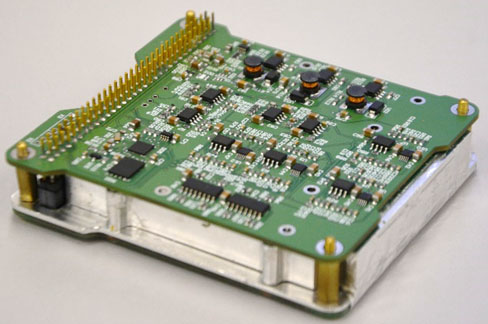
A charged particles detector developed by Sputnix and SINP for mid-size satellites, capable of monitoring and measuring single event parameters of gamma and electron particles.
Key figurescomparable across the catalogue
- Mass
- 0.24 kg
- Power
- 0.75 W
- Largest dimension
- 95 mm
- Design life
- 1 years
- Lead time
- 6 months
Normalised to common units so this product can be compared with others in its category. The supplier's own wording is below.
As published by the supplier
- Purpose
- Charged particles researches, spectrometry.
- Year of release
- 2017
- Design life
- 1 years
- Lead time
- 6 months
- Flight qualification of the product
- Yes
- Brief history of flight qualification
- In the composition of the satellites SiriusSat-1.2 (launched on 15.08.18.).
- Possibility to adapt the product to customer requirements
- No
- Dimensions
- 95 × 89 × 22 mm
- Mass
- 240 g
- Supply voltage
- 6.0 – 9.0 V
- Power consumption (analog+digital subsystems)
- 750 mW
- Data interface
- CAN 2.0B
- Detected particles type
- Gamma, electrons
- Particle energy, mev
- 0.3 – 3
- Sensor effective area
- 4 cm²
- Time resolution, μs
- 20
- Memory size, mb
- 8
About
The Charged Particles Detector is designed for charged particles research and spectrometry. Developed by Sputnix in collaboration with scientists from SINP (Moscow State University), it provides simultaneous monitoring and measurement of single event parameters. The recorded data can be accessed via the satellite data bus. Key features include its suitability for mid-size satellite designs in a light and small package, ultra-low power consumption as a CAN device, and a built-in DC converter for constant power consumption. It detects gamma and electron particles with an energy range of 0.3 – 3 MeV and has a sensor effective area of 4 cm². The detector has a time resolution of 20 µs and 8 MB of memory. It was released in 2017, has a guaranteed service life of 1 year, and an estimated production/delivery time of 6 months. The product is flight qualified, with heritage on the SiriusSat-1.2 satellites launched on August 15, 2018. It cannot be adapted to customer requirements.
Documentation
No public datasheet yet — request the datasheet / ICD from the supplier.