Software Defined Radio (SDR)
 Plan-S (Connecta)
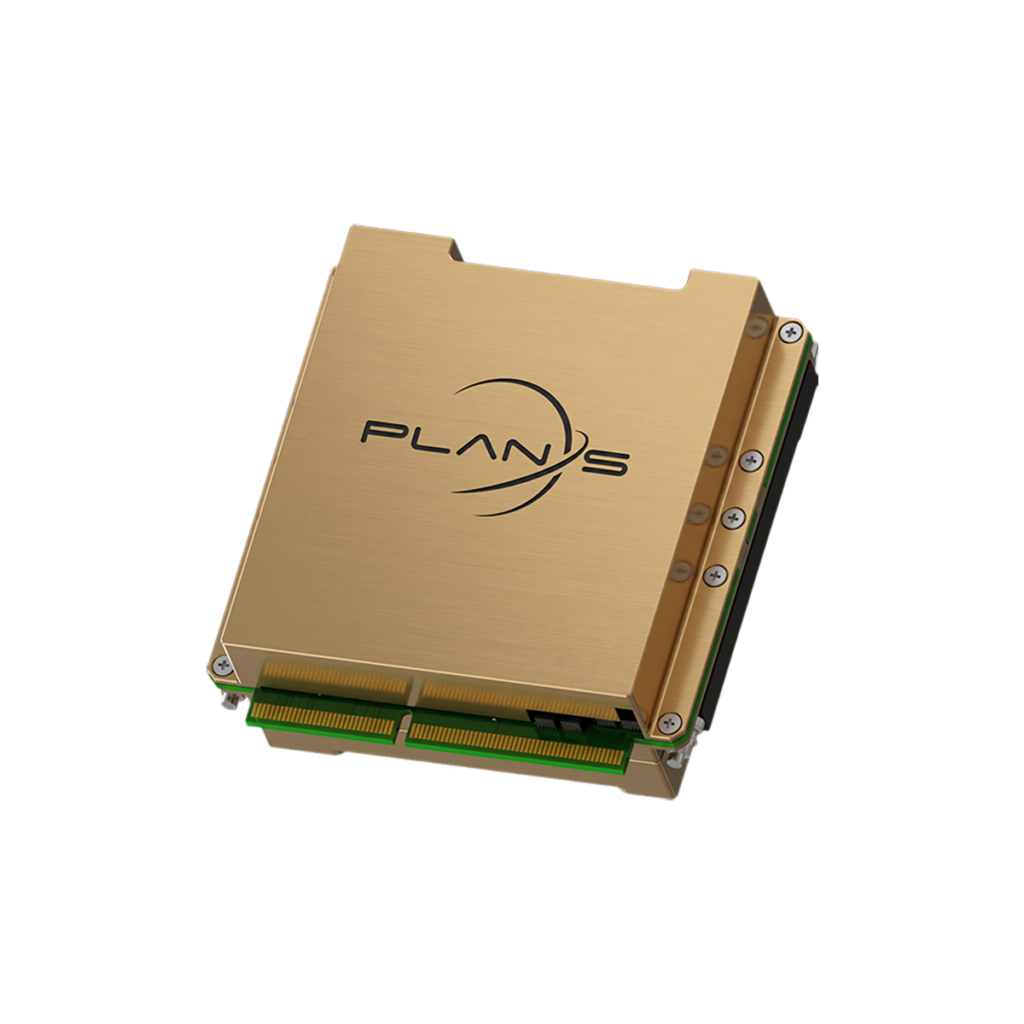
The SDR is a compact, high-performance, and modular radio subsystem designed for small spacecraft, offering scalable processing and multi-application support.
Typed specifications42 values
Discloses 6 of 13 fields engineers filter by in this category (category median 5).
- Mass
- 280 g max · datasheet p.2 280 g max · printed as <280 gr
- Link protocols and waveforms
- CSP Plan-S CSP (CubeSat Space Protocol v1.6) networking stack · datasheet p.2 CSP v1.6 fully compliant
- Frequency range
- 70 MHz min · datasheet p.2 70 MHz min · RX/TX: 70 MHz - 6 GHz | 6 000 MHz max | 6 000 MHz max · RX/TX: 70 MHz - 6 GHz
- Supply voltage
- 6 V min · SDR_PWR · datasheet p.2 15 V max · SDR_PWR | 6–15 V SDR_PWR; FE_PWR depends on RF FE
- Power consumption
- 7 W max · without RF_FE · datasheet p.2
- Data interface
- LVDS datasheet p.2 other 0.8mm Pitch Edge Type Connector | JTAG | I2C | UART +4
- Operating temperature
- -40 °C min · Thermal Cycling Test · datasheet p.3 85 °C max · Thermal Cycling Test
- Function
- SDR platform (user waveforms) datasheet p.1
- Frequency band
- UHF flexible RF frontend · datasheet p.1 UHF RX/TX | S flexible RF frontend | S RX/TX
- Instantaneous bandwidth
- 56 000 kHz channel bandwidth · datasheet p.1
- Board format
- custom datasheet p.2
- Waveform development
- other customizable embedded Linux BSP (ADI Linux) with IIO framework · datasheet p.2 user FPGA bitstream PL bitstream updates, FPGA-accelerated signal processing
- Connector
- 0.8mm Pitch Edge Type Connector (compatible with Samtech HSEC8-DV) datasheet p.2
- Random vibration
- 12 g RMS random vibration qualification, axial, 20Hz 1s · datasheet p.2 16.88 g RMS random vibration qualification, lateral, 20 Hz 1s
- Flight heritage
- Flight heritage demonstrated on 16 satellites with 32 units datasheet p.3
- Satellite class
- CubeSat datasheet p.3
- Missions flown
- 16 satellites, with 32 units · datasheet p.2 32 units
- Quasi-static load
- 12 g Axial · datasheet p.3 16.88 g Lateral
- FPGA / SoC
- Zynq UltraScale+ XCZU4EV or XCZU6EG or XCZU15EG datasheet p.1
Each value is typed with its unit and measurement condition and cites the datasheet page it was taken from. Nothing is guessed: a field that is absent here has not been published by the manufacturer. machine-extracted ✓ checked by NewSpace Market ✓ manufacturer confirmed by the manufacturer.
As published by the supplier14 lines, in the manufacturer's own wording
- Frequency range
- 70 MHz - 6 GHz
- Memory
- 4 Mbit /8 Mbit SPI FRAM
- Memory (2)
- 128 Gbit SD Memory
- Mass
- <280 gr
- Power consumption
- < 7 W
- Frequency
- 70 MHz - 6 GHz
- Channel Bandwidth
- 56 MHz
- Memory (PS)
- 1 GB / 2 GB DDR4 RAM
- Memory (PL)
- 512 MB / 1 GB / 2 GB DDR4 RAM
- Memory (QSPI)
- 32 MB
- Memory (eMMC)
- 16 GB, 32 GB, 64 GB
- Supply voltage
- 6-15 V
- Interfaces
- LVDS, JTAG, I2C, UART, SPI, USB, CAN, ETHERNET
- Operating temperature
- –40 °C to +85 °C
About
Designed for small spacecraft, the SDR provides scalable processing capability and multi-application support within a single, modular radio subsystem. This compact, high-performance SDR platform enables flexible satellite communication from 70 MHz to 6 GHz. It supports multiple RF frontends and offers in-orbit reconfigurability through an embedded Linux system. The SDR features a software-defined architecture with multiple RF frontend, bringing flight-proven reliability, flexible RF configuration, and in-orbit reconfigurability into a compact radio subsystem designed for evolving satellite missions. From single-spacecraft operations to constellation-scale deployments, it provides the adaptable communication architecture needed to support stable, scalable, and future-ready space applications. It is part of the Radios & Antennas portfolio, which delivers flight-ready communications hardware for LEO missions, offering resilient TT&C links with band and configuration options in compact, integration-friendly form factors.
Documentation
Need the full ICD, test reports or a specific revision? Ask the supplier directly.