Space Platform 50
 Glavkosmos
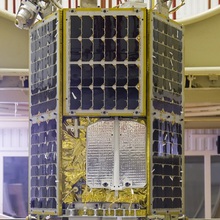
Small-satellite bus (up to ~70 kg) for technological, scientific and educational missions in low circular orbit.
Key figurescomparable across the catalogue
- Mass
- 30 kg
- Payload capacity
- 40 kg
- Power
- 30 W
- Design life
- 1 years
- Lead time
- 12 months
- TRL
- 9
Normalised to common units so this product can be compared with others in its category. The supplier's own wording is below.
As published by the supplier
- Purpose
- Small spacecraft for technological, scientific and educational purposes in low circular orbits
- Year of release
- 2012
- Design life
- At least 1 year (SAS extendable to 5 years)
- Lead time
- 12 months
- Flight heritage
- Prototype flew as part of ICA "MIR", launched 28 July 2012
- Customization
- Can be adapted to customer requirements
- Working orbits
- Low circular orbit, 400-1500 km, associated launch
- Mass
- Up to 30 kg (platform)
- Payload mass
- Up to 40 kg
- Power
- 30 W average / 90 W peak (up to 10 min)
- Attitude control
- Three-axis, active
- Pointing accuracy
- ±10 deg
- Supply voltage
- 27±0.5 V
- Battery
- Nickel-metal hydride, cells integrated into single onboard control system
- Thermal control
- Passive, heat pipes and heaters
- Propulsion
- Hydrazine or gas, installed on demand
- TRL
- 9 (flight-proven)
About
Space Platform 50 is designed and manufactured for small spacecraft used in technological, scientific and educational missions in low circular orbits (400-1500 km) launched as a rideshare payload. The platform is untight (unpressurized), uses a nickel-metal-hydride battery whose cells are integrated into a single onboard control system, and features a passive thermal control system based on heat pipes and heaters. Attitude/motion control is performed using electromagnetic devices, with an optional hydrazine (or gas) propulsion system installable on demand. A single onboard control system manages the spacecraft. First released in 2012; a platform prototype flew as part of the ICA “MIR” satellite launched 28 July 2012, giving it flight heritage.
Documentation
No public datasheet yet — request the datasheet / ICD from the supplier.