Test Bench to Examine Radio-Technical Performance of Antennas
 Glavkosmos
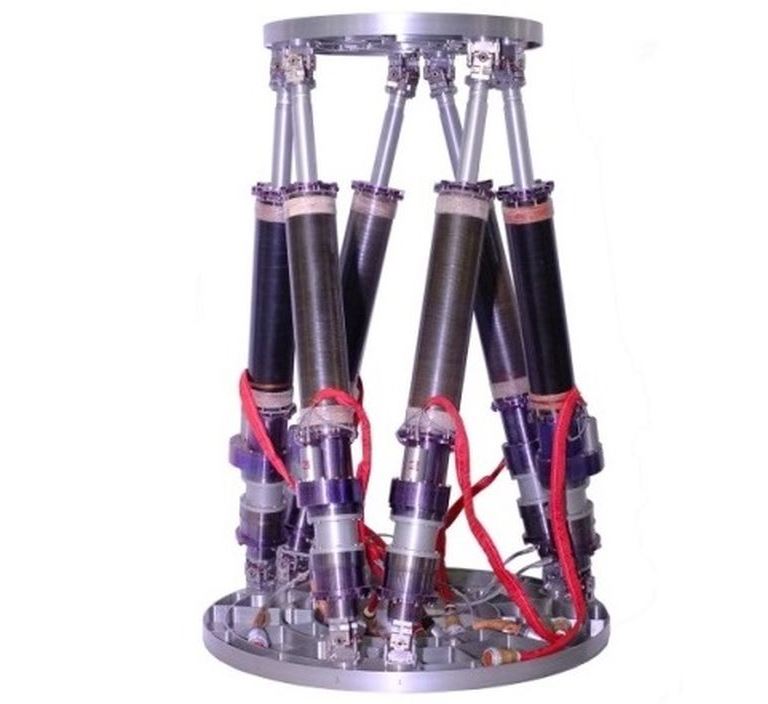
A six-degree-of-freedom precision positioning mechanism (hexapod) used as a component of a testbed for examining the radio-technical performance of antennas under ground conditions.
Key figurescomparable across the catalogue
- Mass
- 21 kg
- Largest dimension
- 673 mm
- Design life
- 10 years
- Lead time
- 4 months
Normalised to common units so this product can be compared with others in its category. The supplier's own wording is below.
As published by the supplier
- Purpose
- High precision transfer and rotation of the target object in the 3 linear and 3 angle directions of intrinsic frame of reference within the working paths
- Year of release
- 2012
- Design life
- 10 years
- Lead time
- 4 months
- Flight qualification of the product
- No
- Possibility to adapt the product to customer requirements
- Yes
- Rotation angle around frame of reference axes range
- ±7 °
- Linear motion along frame of reference axes okh and oy range
- ±100 mm
- Linear motion along frame of reference axis oz (vertical axis of the mechanism) range
- ±25 mm
- Angular rotation around frame of reference axes increment, ''
- 25
- Linear motion along frame of reference axes increment, μm
- 10
- Angular rotation around frame of reference axes error, ''
- ±30
- Linear motion along frame of reference axes error
- ±0.01 mm
- Overall dimensions of the device
- diameter 530, height 673 mm
- Mass of the mechanism
- 21 kg
About
This product is a six-degree-of-freedom mechanism designed for high precision transfer and rotation of a target object in 3 linear and 3 angular directions within its intrinsic frame of reference, across defined working paths. It serves as a component of a testbed used to test antenna radio engineering performance in ground conditions. The mechanism provides rotation around the frame of reference axes within a range of ±7°, with an angular rotation increment of 25” and an angular rotation error of ±30”. Linear motion along the OX and OY axes of the frame of reference has a range of ±100 mm, while linear motion along the vertical OZ axis has a range of ±25 mm; the linear motion increment is 10 μm with a linear motion error of ±0.01 mm. The device has overall dimensions of 530 mm in diameter and 673 mm in height, with a mechanism mass of 21 kg. It was released in 2012, has a guaranteed service life of 10 years, and an estimated production/delivery time of 4 months. The product has not undergone flight qualification, but it can be adapted to customer requirements, and development of a space version based on this solution is available.
Documentation
No public datasheet yet — request the datasheet / ICD from the supplier.