Excelsior
 Terran Orbital
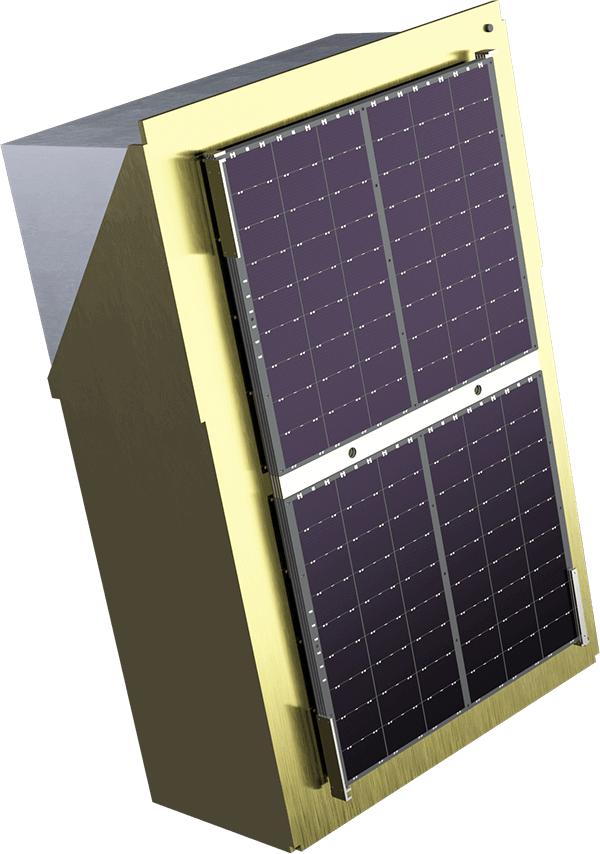
Entry-level ESPA-class microsatellite bus enabling two spacecraft per single 15-inch ESPA port for efficient constellation build-out.
Typed specifications40 values
Discloses 4 of 7 fields engineers filter by in this category (category median 3).
- Mass
- 50 kg product page
- Form factor
- ESPA Configuration Half-ESPA; two spacecraft from a single 15-inch… · datasheet p.2 custom Half-ESPA
- Orbit
- LEO Applications LEO; native orbits 400km-1200km · datasheet p.2
- Max payload mass
- 50 kg Available Payload Mass · datasheet p.2
- Regulated voltages for the payload
- 12 V 12V rail available · datasheet p.2 28 V 28V rail available | 9 V 9V rail available | 12 V | 9 V
- Unregulated bus for the payload
- 66 V nom. · 66V sys power · datasheet p.2 66 V 66V system power | 66 V Battery Modules
- Power generation (orbit average)
- 500 W max · peak (Max Solar Array Power) · datasheet p.2
- Pointing accuracy
- 0.003–0.014 ° 10 to 50 arcseconds; higher accuracy available · datasheet p.2
- Propulsion
- included 400s Isp standard; propulsion bay accommodating EP, Hydrazine… · datasheet p.2
- Payload data downlink rate
- 2 000 kbps S-band downlink (uplink 125 Kbps) · datasheet p.2 650 000 kbps X-Band downlink
- Radio band
- S datasheet p.2 X
- Subsystems included
- propulsion 400s Isp standard; bay for EP, Hydrazine or mix · datasheet p.2 battery 66V Battery Modules (2-4) | EPS 66V MPPT (1-2), 66V Load Controller, 28V Low-power and High-p… | other Backplane; LDRR (2); MDR (2) | ADCS Coarse Sensors (2), Gyro Assembly, Star Trackers (3), Magneto… +6
- Max satellite wet mass
- 125 kg datasheet p.2 125 kg max · Launch Mass (Wet), up to; maximum mass may not be supported o…
- Separation interface diameter
- 381 mm 15-inch ESPA or similar interface, shared by two spacecraft (… · datasheet p.1 381 mm two spacecraft from a single 15-inch ESPA or similar interface
- Rail standard
- ESPA Half-ESPA · datasheet p.2
- Flight heritage
- Based on hardware with significant flight heritage datasheet p.1
- Satellite class
- microsat 10-100 kg entry-level microsat platform · datasheet p.1 ESPA-class Half-ESPA | ESPA-class
Each value is typed with its unit and measurement condition and cites the datasheet page it was taken from. Nothing is guessed: a field that is absent here has not been published by the manufacturer. machine-extracted ✓ checked by NewSpace Market ✓ manufacturer confirmed by the manufacturer.
As published by the supplier11 lines, in the manufacturer's own wording
- Configuration
- Half-ESPA
- Applications
- LEO
- Native orbits
- 400 km - 1200 km
- Launch mass (Wet, max)
- Up to 125 kg
- Available payload mass
- 50 kg
- Max solar array power
- 500 W (3rd-party solar array included)
- Redundancy
- Single-string
- Power system
- 66 V system power; 28 V, 12 V, and 9 V rails available
- Communication data rate
- S-band: 125 Kbps uplink, 2 Mbps downlink; X-band: 650 Mbps downlink
- Propulsion
- 400s ISP standard
- Pointing accuracy
- 10 to 50 arcseconds, higher accuracy available
About
Excelsior shares a common EPS architecture with the larger spacecraft in the product line while providing redundancy in key components. The Excelsior allows maximum payload volume and a large solar array while providing low launch costs, giving it a power advantage over the nano platforms. It includes a propulsion bay accommodating electric propulsion, hydrazine, or a mix of propulsion systems.
Key benefits: build out constellations faster with the ability to launch two satellites per ESPA port; delivers a higher power-to-payload ratio than nano-class platforms; based on hardware with significant flight heritage.
Baseline modules included: Watchdog Backplane, Flight Computers (2), 66V Battery Modules (2-4), 66V MPPT (1-2), 66V Load Controller, 28V Low-power Point-of-Load (varies), 28V High-power Point-of-Load (varies), Coarse Sensors (2), Gyro Assembly, Star Trackers (3), GPS (2), Magnetorquers (3), Reaction Wheels (3), LDRR (2), MDR (2).
Documentation
Need the full ICD, test reports or a specific revision? Ask the supplier directly.