Flamingo Satellite Constellation
 Vyoma GmbH
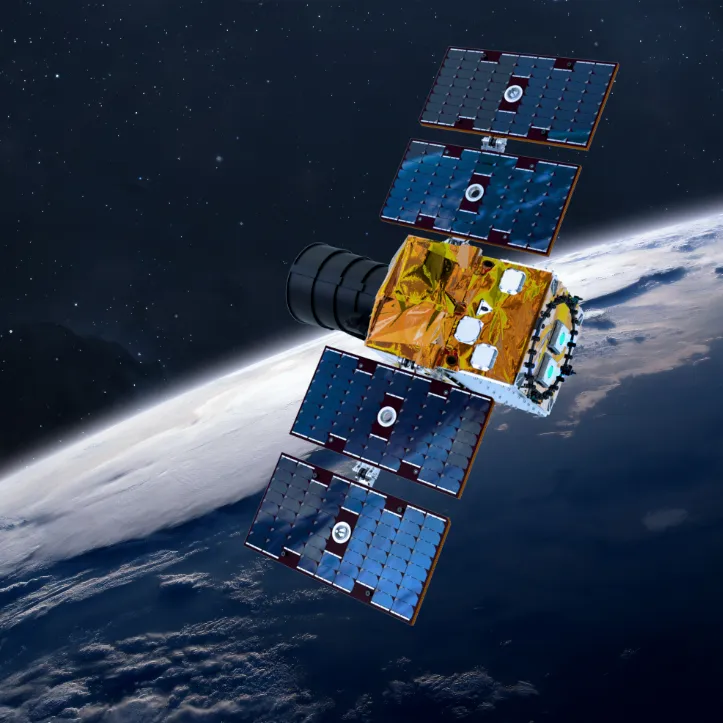
The Flamingo satellite constellation, owned and operated by Vyoma, provides Space Surveillance & Tracking (SST) data for Space Safety and Space Intelligence services, enabling cataloguing and tracking of space objects.
Typed specifications1 values
Discloses 0 of 11 fields engineers filter by in this category (category median 1).
- Design lifetime
- 5 years product page
Each value is typed with its unit and measurement condition and cites the datasheet page it was taken from. Nothing is guessed: a field that is absent here has not been published by the manufacturer. machine-extracted ✓ checked by NewSpace Market ✓ manufacturer confirmed by the manufacturer.
As published by the supplier8 lines, in the manufacturer's own wording
- Status
- AIT (Assembly, Integration and Testing)
- Launch
- Q4 2026
- Orbit
- SSO 10:30 AM
- Payload
- Optical camera for SSA
- Class
- Microsatellite
- Design life
- 5 years
- Propulsion
- Electric
- Attitude
- Full-axis control
About
The Flamingo satellites, owned and operated by Vyoma, form the backbone of Vyoma’s Space Safety and Space Intelligence services. Their primary function is to generate Space Surveillance & Tracking (SST) data. This includes surveillance for cataloguing space objects and detecting events, as well as tracking for rapid follow-up on objects of interest. The first satellite, Flamingo-1, already provides critical follow-up capabilities and observations of orbital regions that are otherwise difficult to attain. With the full constellation of 12 satellites online, the revisit time for observations of all Low Earth Orbit (LEO) targets will reduce to below 1 hour, allowing the constellation to maintain custody of prime targets in LEO. The Flamingo satellites produce images of the star background and space objects of interest, which are recorded as streaks in each frame. Vyoma’s Data Processing system recognizes these, associates targets across images, performs astrometric reduction, and processes unassociated Tracking Data Messages (TDMs). A time-series approach enables the production of data points with subpixel accuracy. Parallel implementations of classical and machine-learning based methods further enhance sensitivity and enable on-the-edge image processing directly on the satellite. Vyoma’s ambition is to build and maintain a fully independent catalogue of space objects, based on a multitude of services including time-bias estimation, initial orbit determination, track-to-track, track-to-orbit, and orbit-to-orbit association, to provide the most accurate orbital information on both catalogued and uncatalogued objects.
Documentation
No public datasheet yet — request the datasheet / ICD from the supplier.