Space Surveillance & Tracking Service
 Vyoma GmbH
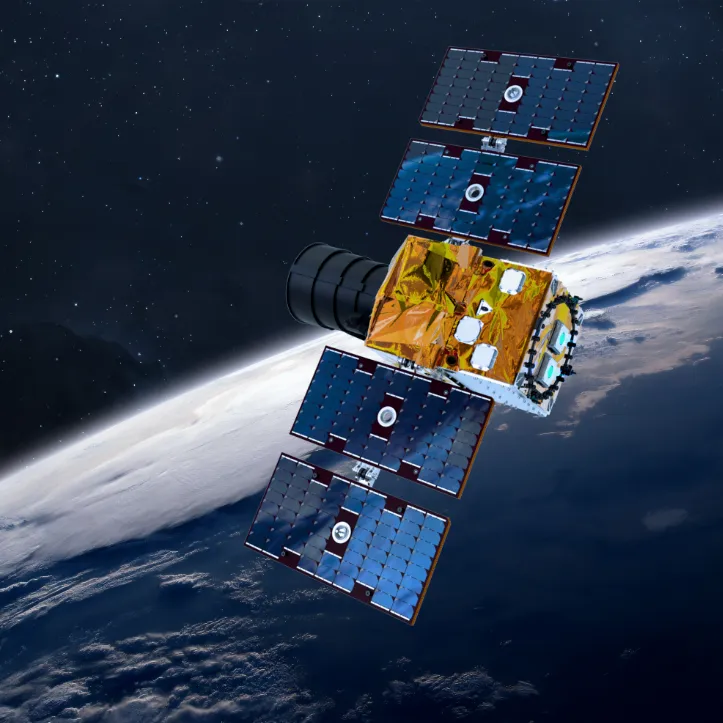
Data-as-a-service providing on-demand and scheduled SST observations via a globally distributed ground and Flamingo space-based sensor network for government and defence customers.
Technical specifications
- Delivery model
- Data-as-a-Service subscription
- Sensor network
- Distributed ground-based sensors + Flamingo space-based optical constellation
- Flamingo-1 status
- Operational (launched 11 January 2026, SSO dusk-dawn)
- Flamingo-2 planned launch
- Q1 2027
- Full constellation
- 12 satellites planned (Flamingos 3–12 in 2028–2029)
- LEO revisit time (full constellation)
- Below 60 minutes
- Payload accuracy
- Sub-pixel astrometric reduction via time-series methods
- Output formats
- Tracking Data Messages (TDMs), raw observations on request
About
Vyoma’s Space Surveillance & Tracking (SST) Service delivers observation data on space objects through a globally distributed network of ground-based sensors augmented by the company’s own Flamingo optical satellite constellation. The service is designed primarily for government, defence, and intelligence customers who require sovereign access to independent, reliable SST data for space domain awareness, threat assessment, and critical infrastructure protection.
Operators can schedule surveillance campaigns covering broad orbital regimes or commission dedicated tracking campaigns focused on specific objects of interest. The service provides observations of catalogued satellites, uncatalogued debris, and actively manoeuvring objects, with near real-time data capture and guaranteed observation latency for high-priority targets.
The space-based layer of the sensor network — the Flamingo constellation — uses optical cameras in Sun-synchronous orbit to observe LEO objects. Flamingo-1 launched on 11 January 2026 and is operational; Flamingo-2 is planned for Q1 2027, with Flamingos 3–12 planned for 2028–2029. The full constellation is designed to achieve revisit times below 60 minutes for all LEO targets, with inter-satellite links on later satellites reducing latencies to seconds for high-interest objects. The optical payload supports sub-pixel accuracy astrometric reduction via time-series methods, generating Tracking Data Messages (TDMs).
Documentation
No public datasheet yet — request the datasheet / ICD from the supplier.