Saturn-200
 Blue Canyon Technologies
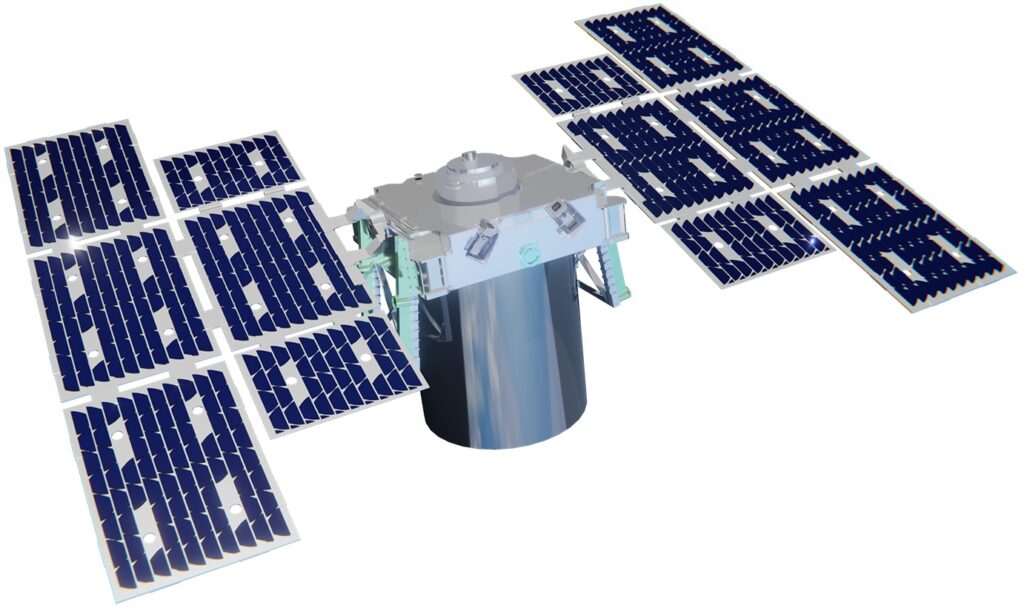
The Saturn-200 is a flight-proven minisatellite bus platform supporting diverse missions from LEO to deep space, featuring autonomous mission resume and hardware-encrypted TT&C.
Typed specifications18 values
Discloses 5 of 7 fields engineers filter by in this category (category median 3).
- Design lifetime
- 2 years min · orbit lifetime, Deep Space (> 2 years) · datasheet p.1 2 years min · orbit lifetime, GEO (> 2 years) | 5 years min · orbit lifetime, LEO (> 5 years)
- Form factor
- ESPA Class: ESPA-Grande or Equivalent · datasheet p.1
- Orbit
- LEO datasheet p.1 GEO | deep space
- Max payload mass
- 200 kg standard rideshare · datasheet p.1 350 kg max · specialty applications and options (up to); CG and MOI dependent
- Payload envelope (L × W × H)
- 30.0" x 30.0" x 40.0" available payload volume (typical); stowed, within bus payloa… · datasheet p.1
- Power generation (orbit average)
- 1 082 W solar array power (BOL); orbit average or peak not stated · datasheet p.1
- Attitude control
- 3-axis stabilised pointing accuracy given for 3 axes, 2 trackers · datasheet p.1
- Pointing accuracy
- 0.002 ° ±, 1-sigma, 3 axes, 2 trackers · datasheet p.1
- Propulsion
- optional Multiple electric and chemical propulsion systems available · datasheet p.2
- Separation interface diameter
- 609.6 mm datasheet p.1
- Satellite class
- ESPA-class Class: ESPA-Grande or Equivalent · datasheet p.1 smallsat 100-500 kg printed: Minisatellite
- Missions flown
- 6 product page
Each value is typed with its unit and measurement condition and cites the datasheet page it was taken from. Nothing is guessed: a field that is absent here has not been published by the manufacturer. machine-extracted ✓ checked by NewSpace Market ✓ manufacturer confirmed by the manufacturer.
As published by the supplier7 lines, in the manufacturer's own wording
- Class
- ESPA-Grande or equivalent 24” launch interface standard, other options available
- Available payload volume
- 30.0” X 30.0” X 40.0” (typical); Larger volume available within rideshare envelope and in dedicated launch vehicle fairings
- Pointing accuracy
- ±.002° (1-sigma), about all axes, using 2 Trackers
- Orbit altitude / orbit lifetime
- LEO (> 5 years), GEO (> 2 years), Deep Space (> 2 years)
- Units launched
- 06
- Units in-work
- 02
- Units delivered
- 01
About
Saturn-200 is Blue Canyon Technologies’ reliable, high-performing, and flight-proven minisatellite bus platform, currently operating on-orbit supporting diverse applications. It is part of BCT’s suite of spacecraft solutions that feature autonomous mission resume, hardware encryption on TT&C radio subsystems, and industry-leading guidance, navigation and control systems. The bus uses an ESPA-Grande or equivalent 24-inch launch interface standard, with other options available, and supports a typical available payload volume of 30.0 x 30.0 x 40.0 inches, with larger volumes available within the rideshare envelope or in dedicated launch vehicle fairings. It achieves pointing accuracy of ±0.002° (1-sigma) about all axes using 2 star trackers, and supports LEO orbits (mission lifetime greater than 5 years), GEO orbits (greater than 2 years), and deep space missions (greater than 2 years). Flight heritage includes 6 units launched, 2 units in-work, and 1 unit delivered. Notable missions include DARPA’s Blackjack program, which selected the Saturn-class bus for a constellation of four connected satellites in low-Earth orbit to demonstrate persistent global coverage replacing traditional GEO national security assets; the Netherlands Ministry of Defence’s PAMI-1 Earth observation demonstration mission; and NASA Goddard/Lawrence Livermore National Laboratory’s PANDORA mission studying exoplanet atmospheres via transmission spectroscopy, for which BCT also provided System Integration and Test.
Documentation
Need the full ICD, test reports or a specific revision? Ask the supplier directly.