Venus-100
 Blue Canyon Technologies
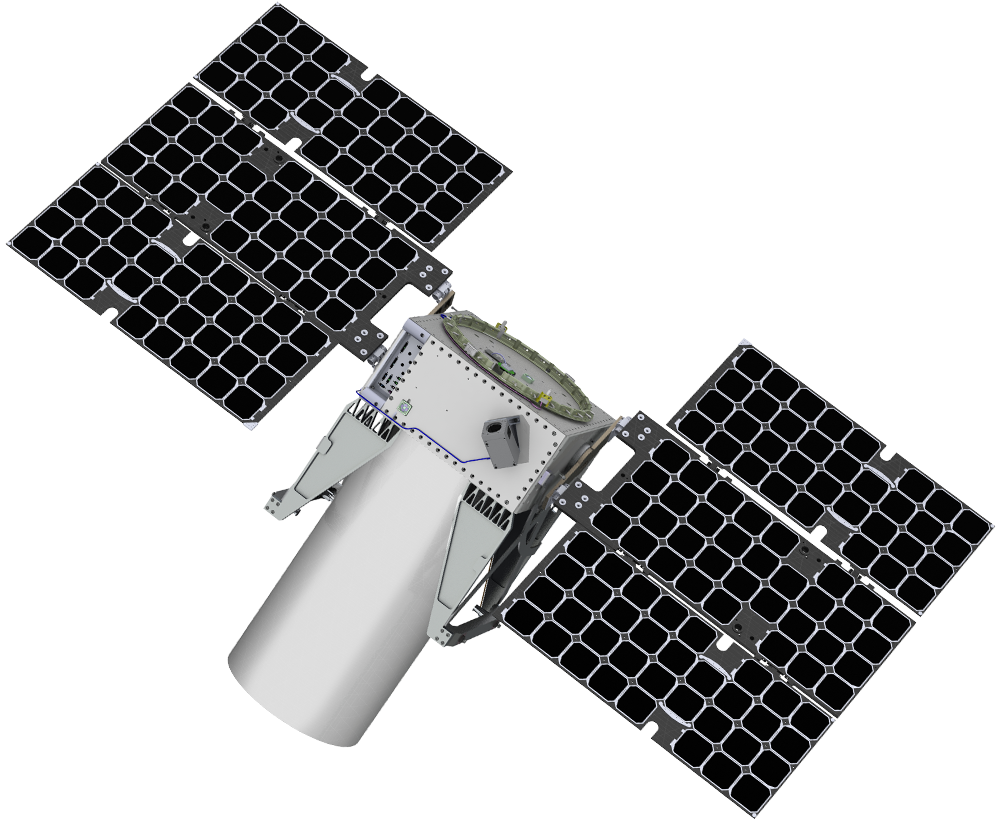
Venus-100 is a flight-proven, ESPA-class microsatellite bus from Blue Canyon Technologies offering high-precision pointing and support for LEO, GEO, and deep space missions.
Typed specifications19 values
Discloses 5 of 7 fields engineers filter by in this category (category median 3).
- Design lifetime
- 2 years min · orbit lifetime, Deep Space (> 2 years) · datasheet p.1 2 years min · orbit lifetime, GEO (> 2 years) | 5 years min · orbit lifetime, LEO (> 5 years)
- Form factor
- ESPA Class: ESPA-Standard or large · datasheet p.1
- Orbit
- LEO datasheet p.1 GEO | deep space
- Max payload mass
- 70 kg payload mass capability · datasheet p.1
- Payload envelope (L × W × H)
- 17.0" x 16.4" x 27.0" available payload volume, 2 array; stowed, within bus payload… · datasheet p.1 20.5" x 16.4" x 27.0" payload volume, 1 array; stowed
- Power generation (orbit average)
- 222 W solar array power (BOL), one wing; orbit average or peak not … · datasheet p.1 444 W solar array power (BOL), two wing; orbit average or peak not …
- Attitude control
- 3-axis stabilised pointing accuracy given for 3 axes, 2 trackers · datasheet p.1
- Pointing accuracy
- 0.002 ° ±, 1-sigma, 3 axes, 2 trackers · datasheet p.1
- Propulsion
- optional Multiple electric and chemical propulsion systems available · datasheet p.2
- Separation interface diameter
- 381 mm datasheet p.1
- Satellite class
- ESPA-class Class: ESPA-Standard or large · datasheet p.1 microsat 10-100 kg printed: Microsatellite
- Missions flown
- 5 product page
Each value is typed with its unit and measurement condition and cites the datasheet page it was taken from. Nothing is guessed: a field that is absent here has not been published by the manufacturer. machine-extracted ✓ checked by NewSpace Market ✓ manufacturer confirmed by the manufacturer.
As published by the supplier7 lines, in the manufacturer's own wording
- Class
- ESPA-Standard or large 15" launch vehicle interface
- Available payload volume
- 20.5" X 16.4" X 27.0" (1 array) or 17.0" X 16.4" X 27.0" (2 array); larger volume available depending on launch vehicle
- Pointing accuracy
- ±0.002° (1-sigma), 3 axes, 2 Trackers
- Orbit altitude / orbit lifetime
- LEO (> 5 years), GEO (> 2 years), Deep Space (> 2 years)
- Units launched
- 05
- Units in-work
- 07
- Units delivered
- 02
About
Venus-100 is a reliable, high-performing, flight-proven ESPA-class microsatellite bus platform currently operating on-orbit and supporting diverse applications. It is part of Blue Canyon Technologies’ suite of spacecraft solutions, featuring autonomous mission resume, hardware encryption on TTC (telemetry, tracking, and command) radio subsystems, and industry-leading guidance, navigation and control (GN&C) systems. The bus interfaces with ESPA-Standard or large 15″ launch vehicle mounts and offers an available payload volume of 20.5″ x 16.4″ x 27.0″ (single array configuration) or 17.0″ x 16.4″ x 27.0″ (two array configuration), with larger volumes available depending on the launch vehicle. It achieves pointing accuracy of ±0.002° (1-sigma) across 3 axes using 2 star trackers, and supports orbit lifetimes of greater than 5 years in LEO, greater than 2 years in GEO, and greater than 2 years for deep space missions. Flight heritage includes 5 units launched, 7 units in-work, and 2 units delivered. Notable missions include supporting DARPA and Northrop Grumman in space-qualifying a Kapton membrane reflectarray antenna by managing GN&C for controlling a large deployable structure on the smaller Venus-100 spacecraft; the INCUS mission for NASA’s Jet Propulsion Laboratory and Colorado State University, using a constellation of three Venus-100 buses flying in tandem coordination with atmospheric radar and microwave radiometer payloads to study tropical convective storm dynamics; Mission 2.5 Lunar Communications Relay with ispace-U.S., providing communications and positioning services for Argo Space Corp.’s in-space transportation vehicle; and Mission 5 ULTRA Lander Communications Relay with ispace-U.S., accompanying a lunar lander to relay data between Earth and the far side of the Moon.
Documentation
Need the full ICD, test reports or a specific revision? Ask the supplier directly.