Saturn-400
 Blue Canyon Technologies
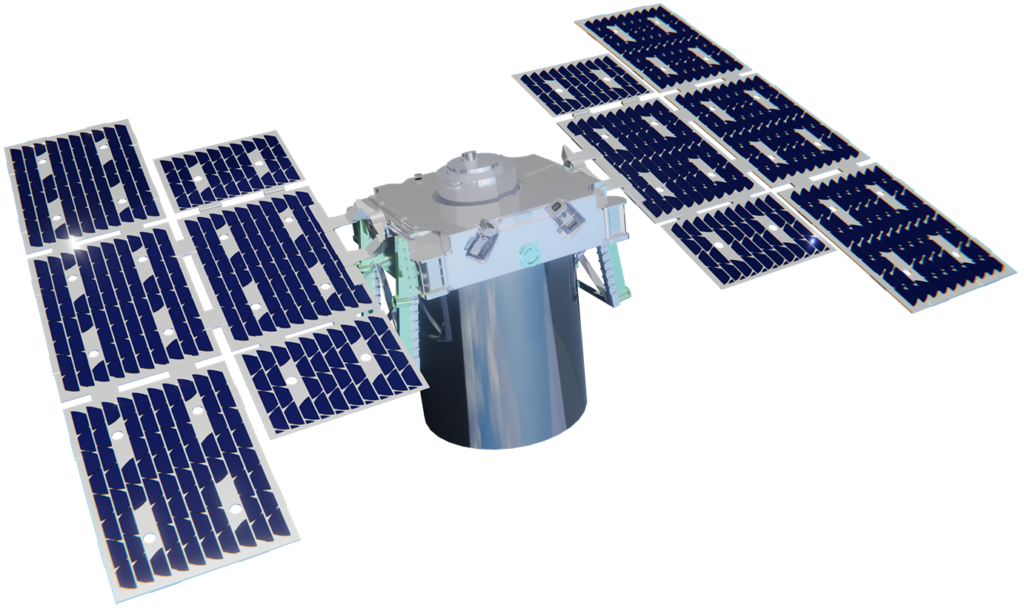
Saturn-400 is a small satellite platform from Blue Canyon Technologies offering high payload capacity, scalable power, and multiple reaction wheel or CMG attitude control options for complex missions.
Typed specifications19 values
Discloses 5 of 7 fields engineers filter by in this category (category median 3).
- Mass
- 250 kg product page 600 kg
- Power consumption
- 1 876 W product page
- Design lifetime
- 2 years min · orbit lifetime, Deep Space (> 2 years) · datasheet p.1 2 years min · orbit lifetime, GEO (> 2 years) | 5 years min · orbit lifetime, LEO (> 5 years)
- Form factor
- custom Class: Rideshare compatible (no ESPA class stated) · datasheet p.1
- Orbit
- LEO datasheet p.1 GEO | deep space
- Max payload mass
- 600 kg Cake-Topper (objective); CG and MOI dependent · datasheet p.1 250 kg standard rideshare (objective); CG and MOI dependent
- Payload envelope (L × W × H)
- 40.0" x 40.0" x 45.0" available payload volume (objective); stowed, within bus payl… · datasheet p.1
- Power generation (orbit average)
- 1 876 W solar array power (BOL); orbit average or peak not stated · datasheet p.1
- Attitude control
- 3-axis stabilised pointing accuracy given for 3 axes, 2 trackers · datasheet p.1
- Pointing accuracy
- 0.002 ° ±, 1-sigma, 3 axes, 2 trackers · datasheet p.1
- Propulsion
- optional Multiple electric and chemical propulsion systems available · datasheet p.2
- Satellite class
- ESPA-class product page smallsat 100-500 kg printed: Small Satellite; Class: Rideshare compatible
Each value is typed with its unit and measurement condition and cites the datasheet page it was taken from. Nothing is guessed: a field that is absent here has not been published by the manufacturer. machine-extracted ✓ checked by NewSpace Market ✓ manufacturer confirmed by the manufacturer.
As published by the supplier8 lines, in the manufacturer's own wording
- Class
- ESPA-Grande or equivalent four-point mount launch vehicle interface, compliant to SpaceX rideshare
- Available payload volume
- 40.0” x 40.0” x 45.0” (objective); Larger volume available depending on launch vehicle allowable payload volume
- Pointing accuracy
- ±.002° (1-sigma), three axes, two trackers
- Orbit altitude / orbit lifetime
- LEO (> 5 years), GEO (> 2 years), Deep Space (> 2 years)
- Energy storage
- 75 Ah
- Solar array power (BOL)
- 1876 W
- Payload mass capability
- 250 kg
- Payload mass capability (Cake-Topper)
- 600 kg
About
The Saturn-400 is a small satellite platform offered by Blue Canyon Technologies. It offers three different reaction wheel options — the trusted RW4 and RW8 reaction wheels, plus the newest and largest reaction wheel, the RW16. It is also compatible with a first-of-its-kind smallsat control moment gyroscope (CMG), boosting spacecraft agility performance metrics to new heights. The spacecraft features increased payload capacity allowing for more instruments, larger sensors, or multiple payloads for complex missions, up to 600 kg, depending on configuration and launch vehicle. The Saturn-400 maintains rideshare capability via a four-point separation system, using an ESPA-Grande or equivalent four-point mount launch vehicle interface compliant with SpaceX rideshare requirements. It offers higher power and volume scaling through larger solar arrays and scalable power subsystems, up to two kilowatts. Available payload volume is 40.0″ x 40.0″ x 45.0″ (objective), with larger volume available depending on the launch vehicle’s allowable payload volume. Pointing accuracy is ±.002° (1-sigma) on three axes using two star trackers. The platform supports LEO orbits (lifetime greater than 5 years), GEO orbits (lifetime greater than 2 years), and Deep Space missions (lifetime greater than 2 years).
Documentation
Need the full ICD, test reports or a specific revision? Ask the supplier directly.