FoX NavRIX GEO GNSS Receiver
 Beyond Gravity (ex-RUAG Space)
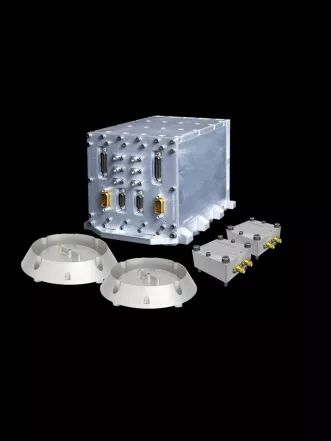
Cost-efficient, optionally redundant software-defined GNSS receiver for commercial GTO/GEO missions, accurate to below 10 m 3D rms.
Typed specifications58 values
Discloses 10 of 12 fields engineers filter by in this category (category median 5).
- Mass
- 4 000 g 2 GNSSR, 2 antennas, 2 LNAs · datasheet p.2
- Position accuracy
- 10 m 3D typ. · datasheet p.2 10 m max · position 3D rms < 10 m 3D typ.
- Envelope (L×W×H)
- 217 x 148 x 131 mm (box incl. feet) datasheet p.2 217x148x131mm3 box incl. feet
- Time to first fix, cold start
- 900 s Warm start typ. (GEO) · datasheet p.2
- Constellations
- GPS L1 C/A datasheet p.2 Galileo E1 B/C
- Supply voltage
- 28 V nom. · primary power input 28 V unregulated · datasheet p.2 28 V nom. · Primary power input unregulated | 28 V nom. · unregulated
- Power consumption
- 10 W max · datasheet p.2 10 W max · power consumption < 10 W
- Data interface
- RS-422 PPS outputs · datasheet p.2 RS-422 PPS outputs, per redundant half | UART RS-422 | UART TC/TM (RS-422), per redundant half | RS-422 TC/TM and PPS outputs +1
- Operating temperature
- -30 °C min · datasheet p.2 70 °C max | -30–70 °C qual.
- Radiation tolerance (TID)
- 36 krad datasheet p.2 36 krad total ionisation dose (TID)
- Design lifetime
- 10 years box shielding allowing lifetime of 10 years in GEO · datasheet p.2 10 years in GEO | 15 years max · mission durations of up to 15 years
- Operating regime
- GEO commercial GTO/GEO missions · datasheet p.1 other GTO
- Signals and bands
- E1 Galileo E1 B/C · datasheet p.2 L1 GPS L1 C/A | E1
- Works in orbit (no COCOM limit)
- yes GNSS receiver for commercial GTO/GEO missions · datasheet p.1
- Velocity accuracy
- 0.01 m/s 3D rms · datasheet p.2 0.01 m/s max · velocity 3D rms < 1 cm/sec (printed cm/sec)
- Flight heritage
- TEMPO (NASA) datasheet p.2 Biomass (ESA) | FLEX (ESA) | KOMPSAT-6,-7 (KARI) | CAS-500 (KARI/KAI) +9
- Satellite class
- GEO GTO/GEO missions · datasheet p.1
- Missions flown
- 100 min · more than 100 flight models of GNSS receivers delivered · datasheet p.2
- PPS output
- yes 2 PPS signals synchronized to GPS/Galileo; PPS: 2 outputs (RS… · datasheet p.2
- Antenna included
- no datasheet p.2 yes weight quoted for 2 GNSSR, 2 antennas, 2 LNAs
- Timing accuracy (PPS)
- 500 ns max · time 1 sigma < 0.5 µsec · datasheet p.2
- Time to first fix, warm start
- 900 s max · warm start typ. < 15 min (GEO) · datasheet p.2
- Onboard orbit filter
- yes advanced dynamically filtered navigation solution, performanc… · datasheet p.2
- Antenna inputs
- 2 2 antenna inputs per redundant half · datasheet p.2
Each value is typed with its unit and measurement condition and cites the datasheet page it was taken from. Nothing is guessed: a field that is absent here has not been published by the manufacturer. machine-extracted ✓ checked by NewSpace Market ✓ manufacturer confirmed by the manufacturer.
As published by the supplier18 lines, in the manufacturer's own wording
- Constellations
- GPS, Galileo
- Target orbits
- GTO / GEO
- On-board navigation accuracy
- Below 10 m 3D rms
- Mission duration
- Up to 15 years
- Architecture
- Software-defined radio (SDR); redundant or non-redundant configuration
- Mass
- 4 kg
- Dimensions
- 217x148x131mm3
- Power consumption
- < 10 W
- Supply voltage
- 28 V
- Lifetime
- 10 years
- Position Accuracy
- < 10 m 3D typ.
- Velocity Accuracy
- < 1 cm/sec 3D rms
- Time Accuracy
- < 0.5 µsec 1 sigma
- Interfaces
- 2 antenna inputs
- Interfaces (2)
- 2 UARTs (RS-422)
- Interfaces (3)
- 2 outputs (RS-422)
- Total Ionisation Dose
- 36krad
- Time-to-first fix
- < 15 min
About
FoX NavRIX GEO, Beyond Gravity’s cost-efficient, redundant (or non-redundant), multi-constellation (GPS, Galileo) GNSS receiver for commercial GTO/GEO missions provides an outstanding on-board real-time navigation performance with accuracy below 10 meter (3D rms). It is specifically designed for use in harsh space environments also for mission durations of up to 15 years. Due to its SDR design the receiver provides the maximum amount of resilience, availability, and flexibility.
It belongs to Beyond Gravity’s next generation of spaceborne GNSS receivers, which are purely based on commercial components and deliver the same performance standards as traditional space receivers with a more cost-effective and mass-producible design.
Documentation
Need the full ICD, test reports or a specific revision? Ask the supplier directly.