BIG CAT 100
 Space Inventor ApS
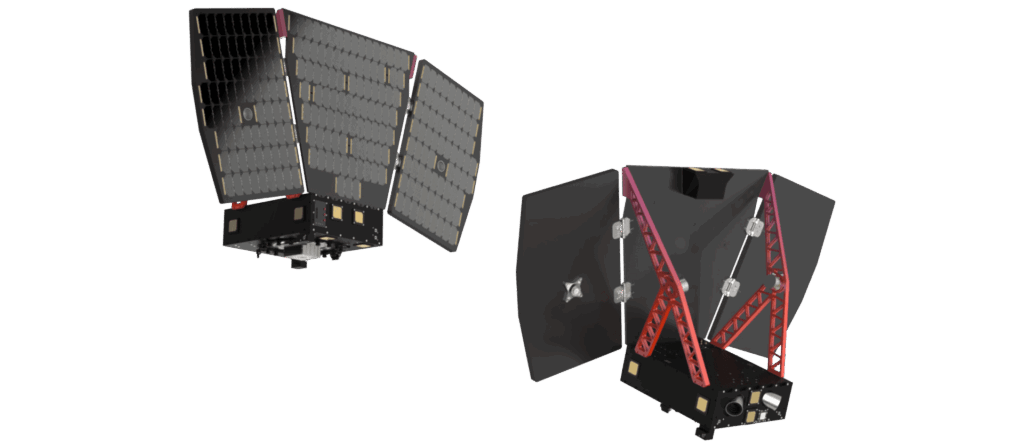
ESPA-class microsatellite platform (up to 100 kg) built from flight-proven, in-house modules for a quarter-plate payload adapter.
Typed specifications10 values
Discloses 3 of 7 fields engineers filter by in this category (category median 3).
- Mass
- 50 kg product page 20–45 kg
- Envelope (L×W×H)
- W:33 x L:47 x H:37 cm product page
- Design lifetime
- 7 years product page
- Max payload mass
- 20–45 kg product page
- Power available to payload
- 130 W min · product page
- Onboard storage for payload data
- 64 GB product page
- Attitude control
- 3-axis stabilised product page
- Propulsion
- included product page
- Flight heritage
- First flight June 2025 (BIFROST) product page
Each value is typed with its unit and measurement condition and cites the datasheet page it was taken from. Nothing is guessed: a field that is absent here has not been published by the manufacturer. machine-extracted ✓ checked by NewSpace Market ✓ manufacturer confirmed by the manufacturer.
As published by the supplier23 lines, in the manufacturer's own wording
- Redundancy
- Dual-redundant avionics and AOCS
- Power options
- Solar power
- Platform mass (incl. basic propulsion)
- 50 kg
- Total spacecraft mass (incl. payload + propulsion)
- Max 100 kg
- Design life
- 7 years
- S-band RF uplink
- 2025-2110 MHz
- S-band RF downlink
- 2200-2290 MHz, up to 10 Mbps
- Attitude control system
- 3-Axis active determination and control
- GNSS
- Redundant GNSS receivers, multi-band support
- Propulsion
- Electric propulsion thruster baselined for space debris mitigation
- Security
- 256 bit encryption on uplink and downlink
- Space debris mitigation
- Compliant with applicable space debris mitigation requirements, including controlled or natural de-orbit within required post-mission lifetime
- Flight heritage
- First flight June 2025 (BIFROST)
- Payload mass
- 20-45 kg
- Payload envelope
- W:33 x L:47 x H:37 cm
- Payload power
- >130 W orbit average
- Standard payload interfaces
- CAN bus
- Payload data storage
- 64 GB built-in
- Maximum read/write rate
- Up to 1 Gbps with Ethernet
- Optional RF interfaces
- X-Band: 8.025 - 8.4 GHz, 250 Mbps
- Optional solar panel configuration
- Single deployable
- Optional propulsion
- RCS options available
- Optional star trackers
- Single, double, or 3-axis configuration
About
BIG CAT 100 is Space Inventor’s smallest ESPA-class microsatellite bus, engineered for maximum agility and mission-specific configurability using a quarter-plate payload adapter. It is built from Space Inventor’s in-house, modular avionics and is designed for missions with a lifespan of up to 7 years across LEO, MEO and GEO.
The platform features standard, fully redundant, radiation-tolerant avionics with advanced single-event mitigations based on ECSS guidelines. Its electrical power system delivers a continuous orbital average power of 120 W with up to 400 W peak, with body-mounted, single or double deployable solar panel configurations available to match the mission’s orbital profile.
3-axis attitude control provides pointing knowledge better than 16 arcsec using star trackers, fine sun sensors and gyroscopes across multiple default pointing modes. Baseline electric propulsion supports orbit/de-orbit transfers and collision avoidance. Data flows over a standard CAN bus with CSP 2.0, supported by RS-422 and high-speed Ethernet, LVDS and SpaceWire interfaces. Baseline S-band RF keeps the platform connected to the ground segment, with optional X- and Ka-band links for high-volume payload data downlink.
Documentation
No public datasheet yet — request the datasheet / ICD from the supplier.