BIG CAT 300
 Space Inventor ApS
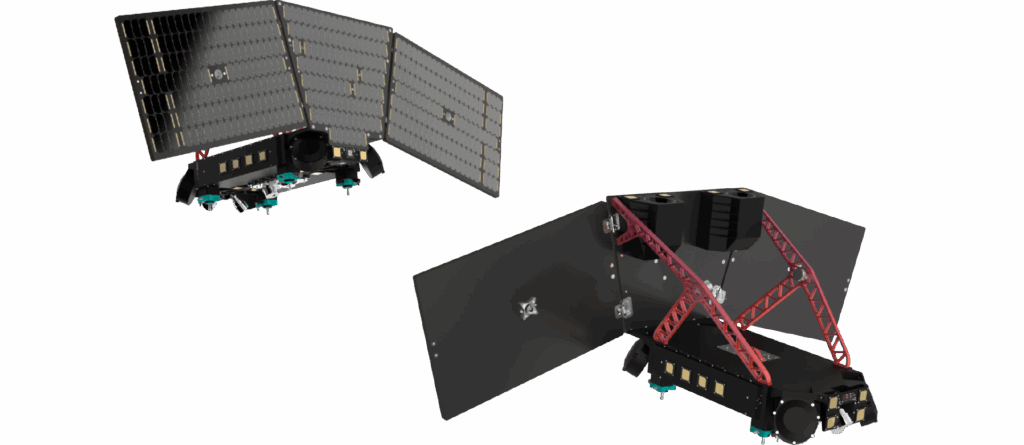
ESPA-class microsatellite platform (up to 300 kg) with half-plate payload adaptor for high-demand missions.
Typed specifications9 values
Discloses 3 of 7 fields engineers filter by in this category (category median 3).
- Mass
- 170 kg product page 300 kg
- Envelope (L×W×H)
- W:45 x L:100 x H:60 cm product page
- Design lifetime
- 7 years product page
- Max payload mass
- 110 kg max · product page
- Power available to payload
- 500 W max · product page
- Onboard storage for payload data
- 4 GB product page
- Attitude control
- 3-axis stabilised product page
- Propulsion
- included product page
Each value is typed with its unit and measurement condition and cites the datasheet page it was taken from. Nothing is guessed: a field that is absent here has not been published by the manufacturer. machine-extracted ✓ checked by NewSpace Market ✓ manufacturer confirmed by the manufacturer.
As published by the supplier22 lines, in the manufacturer's own wording
- Redundancy
- Dual-redundant avionics and AOCS
- Power options
- 28 V unregulated bus
- Platform mass (incl. basic propulsion)
- 170 kg
- Total spacecraft mass (incl. payload + propulsion)
- 300 kg
- Design life
- 7 years
- S-band RF uplink
- 2025-2110 MHz
- S-band RF downlink
- 2200-2290 MHz, up to 10 Mbps
- Attitude control system
- 3-Axis active determination and control
- GPS
- Position accuracy: 2.0 m
- Propulsion
- Chemical and electrical
- Security
- 256 bit encryption on uplink and downlink
- Space debris mitigation
- Compliant with applicable space debris mitigation requirements, including controlled or natural de-orbit within required post-mission lifetime
- Payload mass
- Up to 110 kg
- Payload envelope
- W:45 x L:100 x H:60 cm
- Payload power
- Up to 500 W orbital average power
- Standard payload interfaces
- CAN bus
- Payload data storage
- 4 GB SLC flash-based file system storage with EDAC
- Maximum read/write rate
- Up to 1 Gbps with Ethernet
- Optional x-band
- Frequency: 8.025 - 8.4 GHz
- Optional KA-band
- Frequency: 7.8 - 20.2 GHz
- Optional solar panel configuration
- Single deployable
- Optional star trackers
- < 16 arcsec attitude knowledge
About
BIG CAT 300 is an ESPA-class satellite bus using a half-plate payload adaptor, built from Space Inventor’s flight-proven, in-house modules to deliver a versatile architectural foundation for demanding missions.
The platform features standard, fully redundant, radiation-tolerant avionics designed for a lifespan of up to 7 years across LEO, MEO and GEO, with advanced single-event effect mitigations per ECSS guidelines. Its flexible electrical power system provides multiple conditioning options, delivering a continuous orbital average power of 160 W and surging to over 500 W at peak, with body-mounted, single or double deployable solar panel options.
3-axis attitude control offers pointing knowledge better than 16 arcsec using star trackers, fine sun sensors and gyroscopes. The platform uniquely accommodates both chemical and electrical propulsion for rapid orbit transfers, agile maneuvering and collision avoidance. Data flows through a standard CAN with CSP 2.0 layer, integrated with RS-422 and high-speed Ethernet, LVDS and SpaceWire interfaces, with baseline S-band RF and optional X- and Ka-band links.
Documentation
No public datasheet yet — request the datasheet / ICD from the supplier.