BHT-1500
 Busek Co.
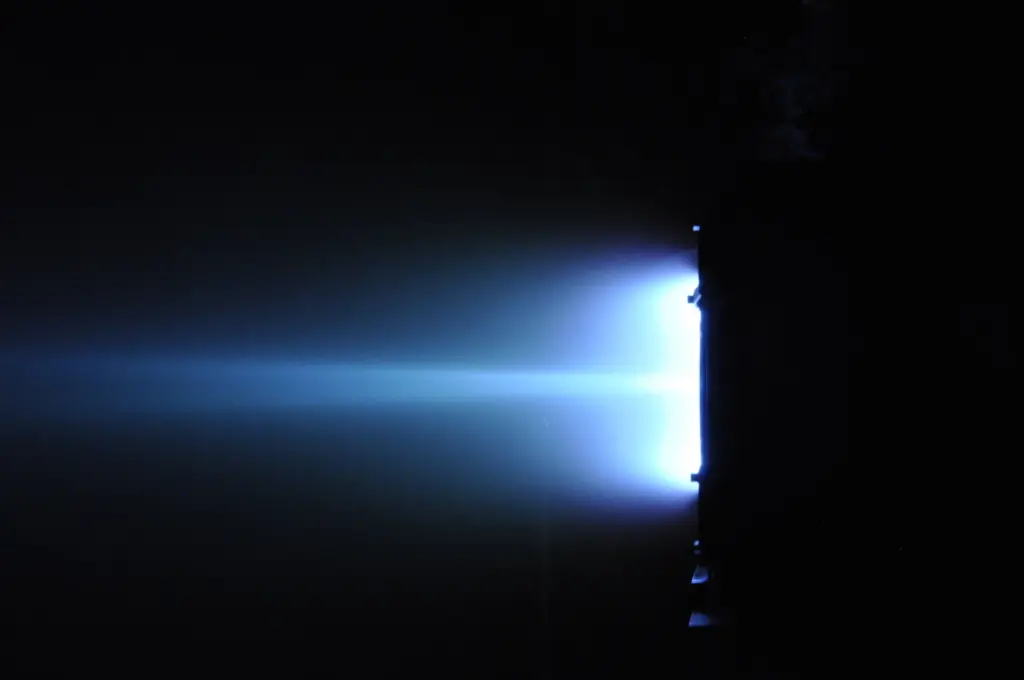
The BHT-1500 is a 2kW-class Hall Effect thruster featuring an innovative center-mounted cathode, designed for efficient and high-performance propulsion using xenon, krypton, or iodine propellants.
Typed specifications115 values
Discloses 8 of 10 fields engineers filter by in this category (category median 3).
- Propulsion family
- electric Hall Effect Thruster · datasheet p.1
- Mass
- 300 g Cathode Mass · datasheet p.1 6.3 kg Thruster Mass
- Thrust
- 101 mN Nominal Thrust · datasheet p.1 58 mN High Isp Mode (1000 W) | 87 mN High Isp Mode (1500 W) | 103 mN High Isp Mode (1800 W) | 118 mN High Isp Mode (2000 W) +35
- Specific impulse
- 1 710 s Nominal Specific Impulse · datasheet p.1 1 860 s High Isp Mode (1000 W) | 1 895 s High Isp Mode (1500 W) | 1 940 s High Isp Mode (1800 W) | 1 915 s High Isp Mode (2000 W) +36
- Total impulse
- 6 500 000 N·s min · predicted (> 6.5) · datasheet p.1 6.5 N·s min · Predicted Total Impulse
- Propellant
- Xenon datasheet p.1 Krypton | Iodine
- Power consumption
- 1 500 W Discharge Power · datasheet p.1 1 000 W High Isp Mode | 1 000 W High Thrust Mode | 1 800 W orbit-raising mode | 1 000 W min · Throttle Range +11
- Thruster technology
- Hall effect datasheet p.1
- Power at thrust
- 1 500 W nom. · discharge power · datasheet p.1 1 500 W Discharge Power | 2 700 W max | 1 000 W min | 1 800 W orbit-raising mode +3
- PPU output power
- 2 000 W datasheet p.1
Each value is typed with its unit and measurement condition and cites the datasheet page it was taken from. Nothing is guessed: a field that is absent here has not been published by the manufacturer. machine-extracted ✓ checked by NewSpace Market ✓ manufacturer confirmed by the manufacturer.
As published by the supplier12 lines, in the manufacturer's own wording
- Nominal discharge power
- 1,500 W
- Discharge power range
- 1,000-2,700 W
- Nominal thrust
- 101 mN (Xe)
- Propellants
- Xenon, Krypton, Iodine
- Nominal specific impulse
- 1710 seconds
- Demonstrated impulse
- Pending
- Predicted total impulse
- >6.5 MN⋅s
- Orbit-raising mode thrust
- over 120 milliNewtons (mN)
- Orbit-raising mode specific impulse
- 1,700 seconds
- Orbit-raising mode power
- 1,800 Watts (W)
- Station-keeping mode thrust
- more than 100 mN
- Station-keeping mode specific impulse
- 1,900 seconds
About
Busek’s BHT-1500 is a 2kW-class Hall Effect thruster that incorporates an innovative center-mounted cathode. This propulsion system is designed for high efficiency and performance, utilizing xenon, krypton, and iodine propellants. Key design features include a two-piece “composite” anode and a shortened dielectric channel, differentiating it from other SPT designs. The internally mounted cathode offers several advantages, such as improved performance, reduced sensitivity of performance to cathode flow rate, and more efficient cathode-plume coupling. Additionally, the thruster exhibits less sensitivity to vacuum facility background pressure and reduced plume divergence. The BHT-1500 provides class-leading efficiency across a wide range of throttle points, with ample thermal and magnetic margin for high-power operation, making it a flexible solution for small to medium class satellites. Its design minimizes erosion through a virtual magnetic field wall, extending its life beyond the typical requirements of GEO satellites. The BHT-1500 thruster system operates in two distinct modes: an orbit-raising mode, which produces over 120 mN of thrust with 1,700 seconds of specific impulse at 1,800 Watts of power, and a station-keeping mode, delivering more than 100 mN thrust and 1,900 seconds of specific impulse. Independent testing at The Aerospace Corporation demonstrated that the thruster achieves 10% higher specific impulse and 15% higher thrust efficiency compared to its nearest competitive HET product, potentially leading to significant launch mass savings for medium-class GEO communications satellites or increased revenue through added mass capabilities.
Documentation
Need the full ICD, test reports or a specific revision? Ask the supplier directly.