Electrospray Thrusters
 Busek Co.
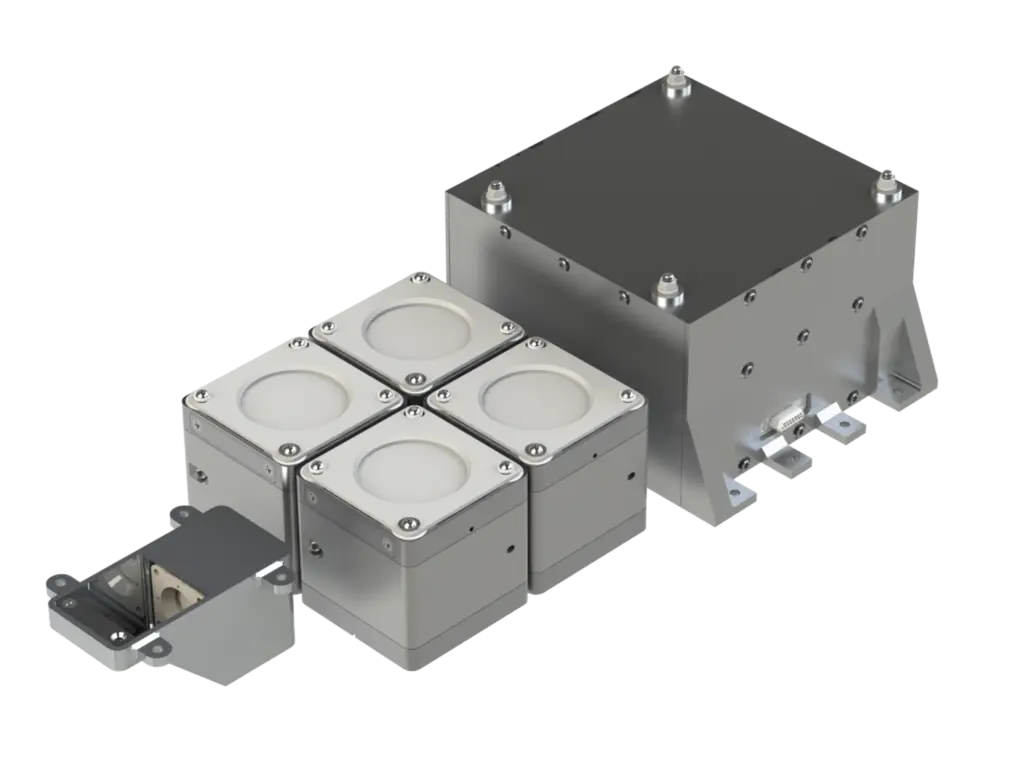
Enabling unique missions in space-based science, from detecting gravity waves to stabilizing large observatories, these thrusters offer precise thrust control and efficient operation.
Typed specifications30 values
Discloses 8 of 10 fields engineers filter by in this category (category median 3).
- Propulsion family
- electric datasheet p.1
- Mass
- 166 g BET-300-P thruster wet mass, Configuration A and B · datasheet p.2 800 g system mass BOL
- Thrust
- 0.055 mN nom. · Configuration A · datasheet p.2 0 mN max | 0.15 mN max · Configuration A | 0.1 mN max · Configuration B | 0.001–0.15 mN per thruster, throttled continuous, <1 µN up to 150 µN +1
- Specific impulse
- 850 s Configuration A · datasheet p.2 2 300 s Configuration B
- Total impulse
- 92 N·s Configuration A, per thruster, demonstrated · datasheet p.2 250 N·s Configuration B, per thruster, pending (50Ns demonstrated to …
- Propellant
- ionic liquid EMI Im · datasheet p.2
- Supply voltage
- 28 V nom. · customizable · datasheet p.1
- Power consumption
- 0.85 W nom. · per thruster, Configuration A · datasheet p.2 2.25 W max · per thruster, Configuration A | 2.5 W max · per thruster, Configuration B | 1.38 W nom. · per thruster, Configuration B
- Data interface
- RS-485 Interface (spec table) · datasheet p.1 RS-422 PPU to spacecraft
- Thruster technology
- electrospray (FEEP or colloid) electrospray · datasheet p.1
- Thrusters in the unit
- 4 max · up to four BET-300-P thrusters per PPU · datasheet p.1
- Min impulse bit
- 0.002 mN·s min · Configuration A and B · datasheet p.2
- Power at thrust
- 12 W nom. · system nominal power, Configuration A · datasheet p.2 24 W max · system max power, Configuration A | 24 W max · system max power, Configuration B | 14 W nom. · system nominal power, Configuration B
- Satellite class
- CubeSat platforms as small as 3U · datasheet p.1
- Power processing unit included
- yes datasheet p.3
Each value is typed with its unit and measurement condition and cites the datasheet page it was taken from. Nothing is guessed: a field that is absent here has not been published by the manufacturer. machine-extracted ✓ checked by NewSpace Market ✓ manufacturer confirmed by the manufacturer.
As published by the supplier5 lines, in the manufacturer's own wording
- System Power
- 12 W - 14 W (24 W max)
- Propellant
- Ionic Liquid
- Thrust
- <1uN-150uN range per thruster
- Thrust Noise
- <0.2uN/rtHz
- Specific Impulse
- 850 seconds - 2300 seconds
About
Busek’s Electrospray Thrusters are characterized by precise thrust control (on the order of nano-Newtons) and extremely efficient operation (over 80%). This makes them the superior solution for ultra-precise spacecraft pointing, with pointing accuracy exceeding that of reaction wheels alone by approximately two orders of magnitude. The BET-MAX Electrospray Thruster System offers ultra-precision, highly throttleable electric propulsion with an integrated propellant delivery system, available in high impulse and high thrust configurations. Since 1998, Busek has been a recognized leader in electrospray physics, developing the world’s first flight-qualified electrospray thruster systems for NASA’s Jet Propulsion Laboratory. These systems included custom power management, digital control interface, and propellant storage and management systems. The extreme precision required the development of new miniature valves and a novel propellant-less carbon nanotube cathode. Busek delivered eight electrospray thruster clusters to NASA’s JPL in 2008 for the NASA/ESA LISA Pathfinder mission, ST7, which successfully launched in 2015 and met 100% of its mission goals, accumulating an average of 2,500 hours of operation per thruster.
Documentation
Need the full ICD, test reports or a specific revision? Ask the supplier directly.