SADM-200
 Comat
Comat
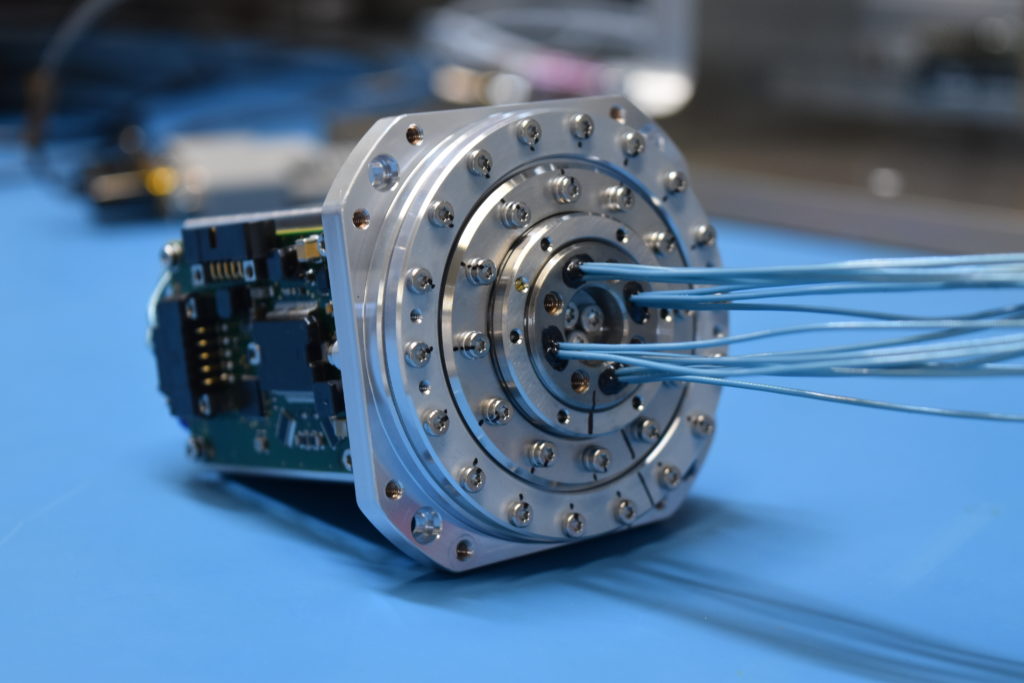
The SADM-200 is a compact Solar Array Drive Mechanism (SADM) developed by COMAT for small satellites, capable of handling up to 200W per solar array wing with integrated slip rings and plug & play electronics.
Typed specifications37 values
Discloses 9 of 13 fields engineers filter by in this category (category median 2).
- Mass
- 465 g datasheet p.2
- Slip-ring tracks
- 1 Ground track · datasheet p.2 16 Power/Signal tracks | 16 power/signal tracks (all tracks compatible with both power an…
- Envelope (L×W×H)
- Ø80, length 85 mm datasheet p.2
- Power transfer
- 400 W datasheet p.2 400 W Up to | 400 W max · up to 400W; 7 power pairs under 28V/1.02A
- Output torque
- 350 000 mN·m datasheet p.2
- Rotation speed
- 0.1 rpm Nominal · datasheet p.2 1.3 rpm Max | 1.3 rpm max · ground testing; 0.14 rad/s | 0.1 rpm nom. · ground testing; 0.01 rad/s
- Supply voltage
- 14 V nom. · datasheet p.2 10 V min | 18 V max | 10–18 V 14 V [10 V; 18 V]
- Power consumption
- 3.5 W MAX TORQUE · datasheet p.2
- Data interface
- RS-485 Full duplex RS 485 · datasheet p.2
- Operating temperature
- -20–50 °C datasheet p.2 -20–50 °C operational
- Radiation tolerance (TID)
- 24 krad max · datasheet p.2 24 krad max · < 24 Krad, electronic board level
- Design lifetime
- 5 years datasheet p.2
- Continuous rotation
- yes 360° unlimited · datasheet p.2
- Travel range
- 360 deg 360° unlimited - Slip Ring · datasheet p.2
- Step size
- 0.03 deg per motor step · datasheet p.2
- Positioning accuracy
- 3 ° accuracy · datasheet p.2
- Power and signal transfer
- other Slip Ring (brush type not stated) · datasheet p.2
- Current per track
- 1.02 A per power pair, under 28V · datasheet p.2
- Life, revolutions
- 100 000 revolutions · datasheet p.2
- Survival temperature
- -40–60 °C datasheet p.2 -40–60 °C non-operational, at satellite interface
- Random vibration
- 20.8 g RMS random · datasheet p.2
- Quasi-static load
- 25 g QSL · datasheet p.2
- Shock qualification
- 1 000 g 1,000 g / 2,000 Hz · datasheet p.2
- Voltage per track
- 28 V power pairs 28V/1.02A · datasheet p.2
Each value is typed with its unit and measurement condition and cites the datasheet page it was taken from. Nothing is guessed: a field that is absent here has not been published by the manufacturer. machine-extracted ✓ checked by NewSpace Market ✓ manufacturer confirmed by the manufacturer.
As published by the supplier18 lines, in the manufacturer's own wording
- Power (qualified)
- 200 W at 28 V
- Power (transfer capability)
- 400 W at 50 V
- Torque
- 350 mNm
- Pointing accuracy
- 3°
- Communication interface
- RS 485
- Design life
- 5 years LEO
- Qsl
- 25 g
- Random vibration
- 20.8 g
- Shock
- 1,000 g/2,000 Hz
- Communication protocol
- NSP
- Voltage range
- 14 V [10 V;18 V]
- Supply voltage (max)
- up to 28 V
- Power (under 14V)
- 100 W
- Power (under 28V)
- 200 W
- Power (under 50V)
- 400 W
- Power lines
- 14 independent (+2 data and 1 ground)
- Radiation tolerance
- 20Krad
- Tests
- Vibration, Thermal cycling
About
The SADM-200 (Solar Array Drive Mechanism) is a compact mechanism developed by COMAT specifically for small satellites. It is designed to accommodate solar array wings with a power output of up to 200W, and it features an integrated slip ring. The equipment is delivered with embedded plug & play electronics, simplifying integration. While qualified for 200W at 28V, it can transfer up to 400W at 50V. This SADM is presented as the only European off-the-shelf solution for satellite platforms requiring higher power. A second version, SADM 1500, is currently under development, aiming to handle 1500W per solar array wing, with qualification expected for S1 2025. The SADM-200 optimizes the exposure of solar panels, particularly benefiting Earth observation platforms. Its development leverages existing ‘bricks’ developed by COMAT. Key features include a torque of 350 mNm, a pointing accuracy of 3 degrees, RS 485 communication, and a design life of 5 years in LEO. It is qualified for various environmental conditions including QSL (25g), Random vibration (20.8g), and Shock (1,000g/2,000Hz). It uses the NSP communication protocol and supports 14 independent power lines (+2 data and 1 ground). Radiation tolerance is 20Krad. The product has undergone vibration and thermal cycling tests.
Documentation
Need the full ICD, test reports or a specific revision? Ask the supplier directly.