SADM
 Comat
Comat
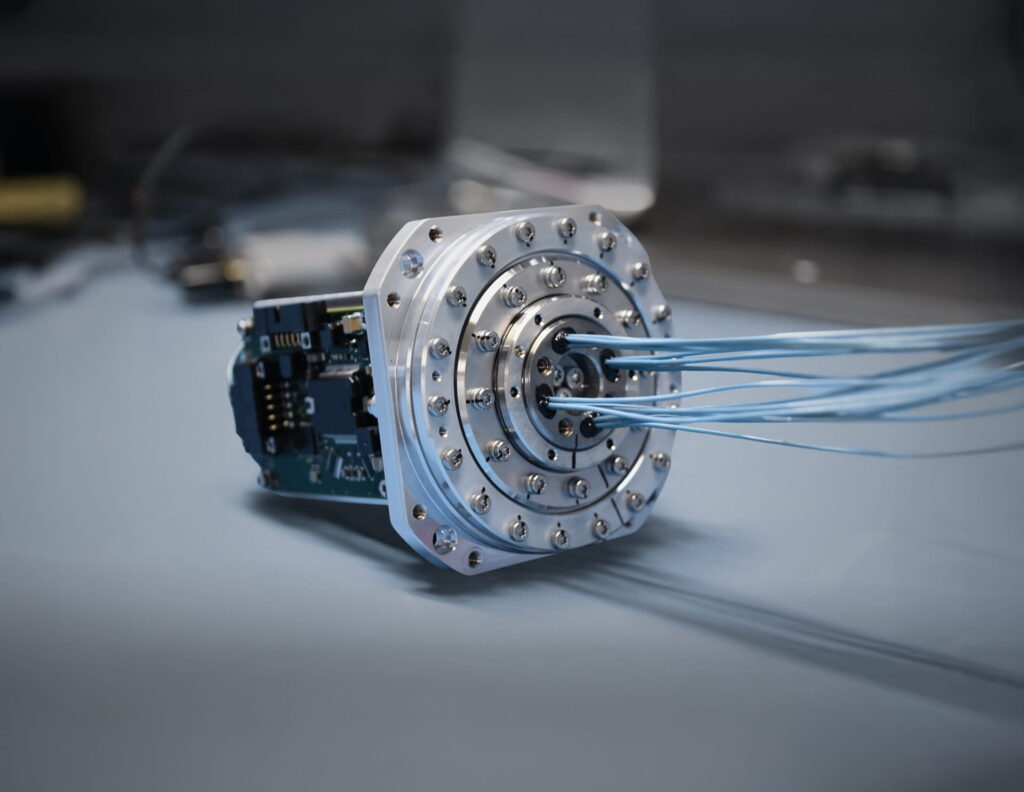
Comat's Solar Array Drive Mechanisms (SADM) ensure precise and continuous solar array orientation toward the Sun, maximizing spacecraft power generation throughout the mission.
Typed specifications90 values
Discloses 9 of 13 fields engineers filter by in this category (category median 2).
- Mass
- 4 700 g SADM-1500 · datasheet p.2 465 g SADM-200
- Slip-ring tracks
- 1 ground track (both models) · datasheet p.2 1 SADM-1500 Ground track | 28 SADM-1500 Power/Signal tracks | 28 SADM-1500; power/signal tracks | 1 SADM-200 Ground track +2
- Envelope (L×W×H)
- Ø167, length 235 mm SADM-1500 · datasheet p.2 Ø80, length 85 mm SADM-200
- Power transfer
- 400 W per wing · description 4 000 W SADM-1500 | 400 W SADM-200 | 400 W Up to | 4 000 W max · SADM-1500; up to 4000W; 13 power pairs under 100V/3.08A +1
- Output torque
- 350 mN·m datasheet p.2 350 mN·m Maximum | 10 000 mN·m SADM-1500 | 350 000 mN·m SADM-200
- Rotation speed
- 0.17 rpm SADM-1500 nominal · datasheet p.2 2 rpm SADM-1500 max | 1.3 rpm SADM-200 max | 0.1 rpm SADM-200 nominal | 2 rpm max · SADM-1500, ground testing; 0.21 rad/s +3
- Supply voltage
- 28 V nom. · SADM-1500 · datasheet p.2 10 V min | 18 V max | 22–38 V SADM-1500 | 22–38 V SADM-1500; 28 V [22 V ; 38 V] +3
- Power consumption
- 7.5 W SADM-1500 MAX TORQUE · datasheet p.2 7.5 W SADM-1500, max torque | 3.5 W SADM-200 MAX TORQUE | 3.5 W SADM-200, max torque
- Data interface
- RS-485 Full duplex RS 485 (both models) · datasheet p.2 RS-485 SADM-1500 | CAN SADM-1500: Full duplex RS 485 or CAN | RS-485 SADM-200 | CAN SADM-1500
- Operating temperature
- -20 °C min · datasheet p.2 50 °C max | -20–50 °C operational (both models) | -20–50 °C SADM-1500 | -20–50 °C SADM-200
- Radiation tolerance (TID)
- 30 krad max · SADM-1500 ELECTRONIC BOARD LEVEL · datasheet p.2 30 krad max · SADM-1500; < 30 Krad, electronic board level | 24 krad max · SADM-200 ELECTRONIC BOARD LEVEL | 24 krad max · SADM-200; < 24 Krad, electronic board level
- Design lifetime
- 5 years minimum in LEO · description 10 years SADM-1500 | 10 years SADM-1500; assessed under mission conditions similar to quali… | 5 years SADM-200 | 5 years SADM-200; assessed under mission conditions similar to qualif…
- Continuous rotation
- yes datasheet p.2 yes 360° unlimited
- Travel range
- 360 deg 360° unlimited - Slip Ring (both models) · datasheet p.2
- Step size
- 0.013 deg SADM-1500, per motor step · datasheet p.2 0.03 deg SADM-200, per motor step
- Positioning accuracy
- 3 ° accuracy (both models) · datasheet p.2
- Power and signal transfer
- other Slip Ring (brush type not stated) · datasheet p.2
- Current per track
- 3.08 A SADM-1500; per power pair, under 100V · datasheet p.2 1.02 A SADM-200; per power pair, under 28V
- Life, revolutions
- 220 000 SADM-1500, revolutions · datasheet p.2 100 000 SADM-200, revolutions
- Survival temperature
- -40 °C min · datasheet p.2 60 °C max | -40–90 °C SADM-1500 Non-operational | -40–90 °C SADM-1500, non-operational, at satellite interface | -40–60 °C SADM-200 Non-operational +1
- Random vibration
- 18.3 g RMS SADM-1500 Random · datasheet p.2 18.3 g RMS SADM-1500, random | 20.8 g RMS SADM-200 Random | 20.8 g RMS SADM-200, random
- Quasi-static load
- 25 g QSL (both models) · datasheet p.2 25 g SADM-1500 | 25 g SADM-200
- Shock qualification
- 1 400 g SADM-1500 · datasheet p.2 1 400 g SADM-1500; printed as "1.400 g / 2,000 Hz" | 1 000 g SADM-200 | 1 000 g SADM-200; 1,000 g / 2,000 Hz
- Voltage per track
- 100 V SADM-1500; power pairs 100V/3.08A · datasheet p.2 28 V SADM-200; power pairs 28V/1.02A
Each value is typed with its unit and measurement condition and cites the datasheet page it was taken from. Nothing is guessed: a field that is absent here has not been published by the manufacturer. machine-extracted ✓ checked by NewSpace Market ✓ manufacturer confirmed by the manufacturer.
As published by the supplier6 lines, in the manufacturer's own wording
- SADM-CP Power Transfer
- Up to 400 W per wing
- SADM-CP Maximum Torque
- 0.35 Nm
- SADM-CP Operational lifetime
- Minimum 5 years in LEO
- SADM-HP Power Transfer
- Up to 4000 W per wing
- SADM-HP Maximum Torque
- 0.35 Nm
- SADM-HP Operational lifetime
- Minimum 10 years in LEO
About
Comat’s SADM systems are designed to provide continuous power generation in orbit by ensuring precise and continuous solar array orientation toward the Sun. This maximizes spacecraft power generation throughout the mission. Built around a high-integrity slip ring system, these mechanisms enable unlimited rotation while reliably transferring power and signals. The SADM-CP (Compact Power) variant offers up to 400 W per wing power transfer, a maximum torque of 0.35 Nm, and an operational lifetime of a minimum of 5 years in LEO. The SADM-HP (High Power) variant provides up to 4000 W per wing power transfer, a maximum torque of 0.35 Nm, and an operational lifetime of a minimum of 10 years in LEO. These mechanisms are built with a focus on a compact yet robust design, minimizing mechanical footprint while maximizing the reliability of energy harvesting. They feature unlimited rotation for optimal solar tracking, advanced connectivity through integrated high-reliability slip ring technology, and a space-saving compact architecture for easy integration. Comat produces its SADMs with the same serial manufacturing precision as its reaction wheels, scaling production to meet the evolving demands of constellations with higher power requirements and longer durations.
Documentation
Need the full ICD, test reports or a specific revision? Ask the supplier directly.