C-RED One SWIR Camera
 First Light Imaging
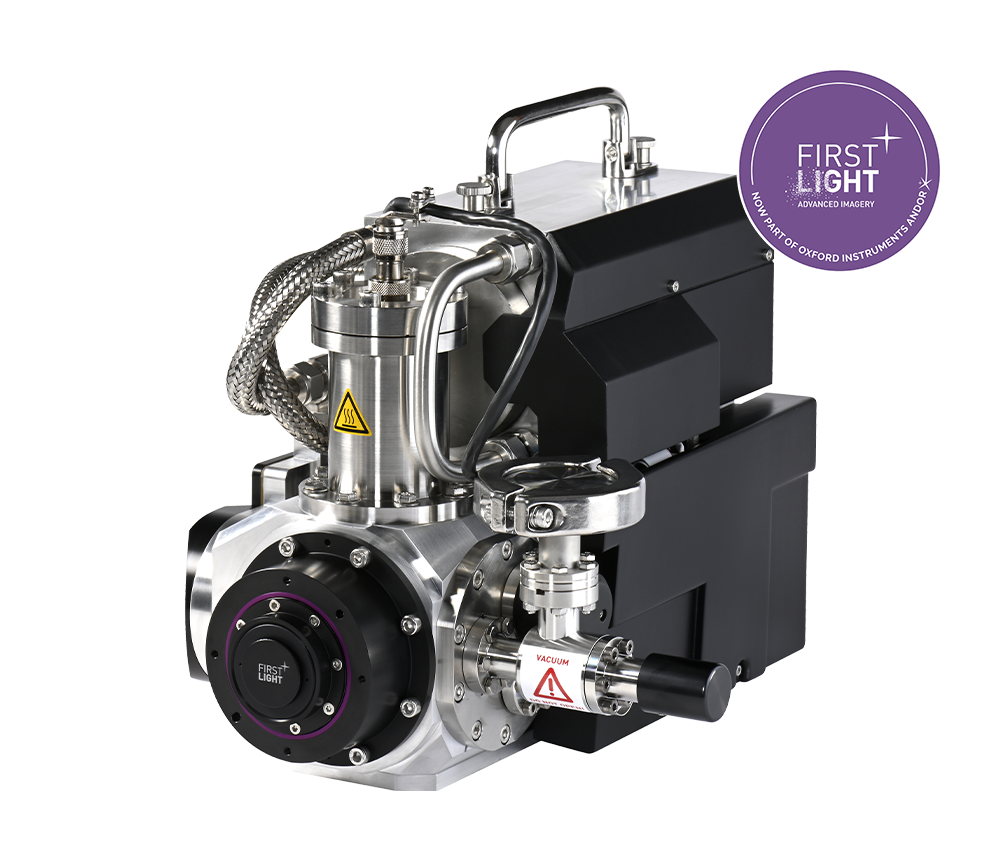
Ultra high-speed photon counting SWIR camera with 320x256 MCT e-APD array, sub-electron readout noise and up to 3500 fps full frame.
Typed specifications41 values
Discloses 5 of 14 fields engineers filter by in this category (category median 4).
- Mass
- 19 400 g nom. · datasheet p.5 19 400 g
- Spectral bands
- 3 J, H and K bands · datasheet p.2
- Supply voltage
- 24 V nom. · camera · datasheet p.5 24 V camera | 100 V power supply | 100 V min · Power supply | 240 V max · Power supply +1
- Power consumption
- 300 W nom. · during cooling · datasheet p.9 300 W average during cooling (~300 W) | 70 W average to keep the sensor cold (~70 W) | 300 W cooling (average) | 70 W keep sensor cold (average) +3
- Data interface
- Camera Link datasheet p.4 other Camera Link full (ultra low latency), mini connectors | Ethernet Ethernet port | Camera Link® full PC Interface | Ethernet
- Operating temperature
- 0 °C environment · datasheet p.9 0–25 °C environment; detector operating temperature 80 K
- Camera type
- SWIR Near and SWIR, J / H / K bands · datasheet p.1
- Spectral range
- 800–1 750 nm H band configuration with f/4 baffle · datasheet p.3 800–2 430 nm K band configuration with f/20 baffle | 800–2 430 nm Near and SWIR
- Connector
- Camera Link full (mini connectors), Ethernet port, power connector, trig in & out, clock in & out, liquid cooling coupling datasheet p.3
- Survival temperature
- -10 °C datasheet p.9 -10–35 °C storage temperature
- Flight heritage
- Proven track record in high-speed wavefront sensors (RISTRETTO, VLT/SPHERE SAXO+); showcased in visible/IR interferometers CHARA, MIRC-X, MYSTIC datasheet p.2
- Detector
- HgCdTe (MCT) 320 x 256 HgCdTe e-APD array · datasheet p.1
- Bit depth
- 16 bit quantization · datasheet p.3
- F-number
- 4 H band configuration, f/4 baffle · datasheet p.3 20 K band configuration, f/20 baffle
- Frame rate
- 3 500 fps full frame · datasheet p.3 3 500 fps max · full frame, single readout
- Sensor format (pixels)
- 320 x 256 datasheet p.1
- Pixel pitch
- 24 µm pixel pitch · datasheet p.1
- Lens mount
- custom optical interface: T-Mount · datasheet p.3
Each value is typed with its unit and measurement condition and cites the datasheet page it was taken from. Nothing is guessed: a field that is absent here has not been published by the manufacturer. machine-extracted ✓ checked by NewSpace Market ✓ manufacturer confirmed by the manufacturer.
As published by the supplier11 lines, in the manufacturer's own wording
- Spectral range
- SWIR 0.80 - 2.43 micrometres (J, H, K bands)
- Sensor
- 320 x 256 pixels MCT e-APD array
- Pixel pitch
- 24 micrometres
- Maximum speed full frame single readout
- 3500 fps
- Readout noise
- < 1 e- at 1720 fps CDS readout, gain x50, black body at 80 K
- Dark current
- < 80 e-/p/s at black body 80 K, e-APD gain x10
- Quantization
- 16 bit
- Detector operating temperature
- 80 K (no LN2)
- Flat quantum efficiency 1.1-2.4 um at 100 k
- > 60%
- Excess noise factor f
- < 1.25
- Pulse tube vibration at detector
- < 1 micrometre RMS along each detector axis
About
C-RED One is an ultra high-speed photon counting SWIR camera using a unique 320 x 256 pixels MCT e-APD array with 24 micrometre pixel pitch. The sensor allows sub-electron readout noise, taking advantage of the e-APD noise free multiplication gain and non-destructive readout ability.
The discovery of electron initiated avalanche photodiodes (e-APD) using mercury cadmium telluride (MCT) semiconductor materials permitted a significant breakthrough in SWIR imaging. C-RED One uses a unique 320 x 256 pixels MCT e-APD array with 24 micrometre pixel pitch, with a wide spectral response over J, H and K bands, and outstanding cosmetics.
C-RED One is capable of capturing up to 3500 full frames per second, without compromising on sub-electron readout noise or very low background. The camera can also capture multiple regions of interest (ROI) readout allowing faster image rate (tens of kHz) while maintaining sub-electron readout noise.
C-RED One is an autonomous system: the sensor is placed in a sealed vacuum environment and cooled down to cryogenic temperature (80 K) using an integrated pulse tube with high reliability. The vacuum regeneration is managed by the camera. A vibration control system option is available.
Documentation
Need the full ICD, test reports or a specific revision? Ask the supplier directly.