MiniRad
 WeatherStream (formerly Orbital Micro Systems)
MiniRad is a miniaturized passive microwave radiometer built by Orbital Micro Systems (OMS) that measures atmospheric temperature, humidity and precipitation from a 3U CubeSat, flown as the IOD-1 GEMS in-orbit demonstration payload.
Key figurescomparable across the catalogue
- Design life
- 0.5 years
Normalised to common units so this product can be compared with others in its category. The supplier's own wording is below.
As published by the supplier
- Mission type
- EO
- Agency
- Orbital Micro Systems Ltd.
- Mission status
- Mission complete
- Launch date
- 17 Apr 2019
- End of life date
- 17 Apr 2021
- Measurement domain
- Atmosphere
- Instrument type
- Atmospheric temperature and humidity sounders
- Instrument (payload) dimensions
- 10 x 10 x 15 cm
- Platform
- 3U CubeSat, manufactured by Clyde Space Ltd. (CSL)
- Nominal mission lifetime
- 6 months
- Deployment
- NanoRacks CubeSat Deployer (NRCSD) from the International Space Station
- Ground segment
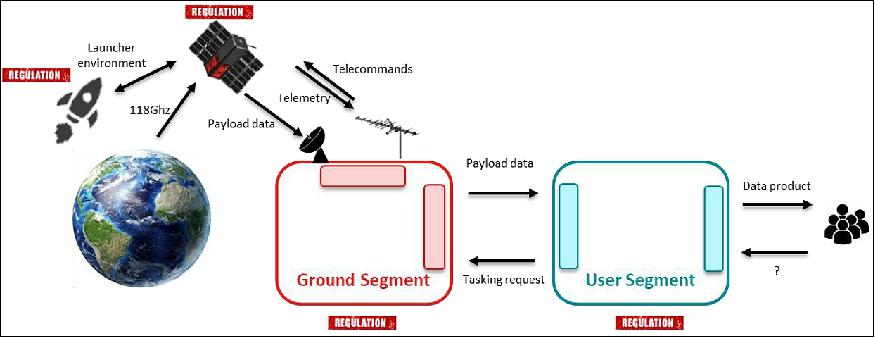
- Catapult's GHY-99 ground station at Goonhilly Earth Station, UK; Catapult's CEMS data infrastructure
- Planned constellation size
- Up to 35 (later reported up to 40) satellites
- Refresh rate (full constellation)
- 15 minutes for any point on the globe
- Resolution (full constellation)
- 16 km2
About
MiniRad is a spaceborne passive microwave radiometer developed by Orbital Micro Systems (OMS) for atmospheric temperature, humidity and precipitation sounding. It is housed in a 10 x 10 x 15 cm instrument package integrated into a 3U CubeSat platform built by Clyde Space Ltd. (CSL). The instrument employs microwave radiance assimilation, technology shown to have the largest positive impact on Numerical Weather Prediction (NWP) model accuracy of any assimilated observation type, due to its ability to penetrate clouds and characterize the atmospheric state in all weather conditions. From the soundings, MiniRad derives surface skin temperature/emissivity, sea ice edge/concentration, total precipitable water, hydrometeor products (non-precipitating cloud liquid, rain, cloud ice), and indirect detection of precipitation rate and phase distribution. The technology is based on techniques proven on larger weather platforms such as the ATMS (Advanced Technology Microwave Sounder) aboard JPSS-1. MiniRad reduces the footprint of weather satellites from platforms weighing up to 2,500 kg down to a shoebox-sized package, cutting weather satellite deployment costs by roughly 95%. It was demonstrated on the IOD-1 GEMS mission (first satellite of the OMS Global Environmental Monitoring Satellite constellation), deployed from the ISS via the NanoRacks CubeSat Deployer (NRCSD) under NanoRacks’ Space Act Agreement with NASA’s US National Lab, launched 17 April 2019 with a nominal mission lifetime of 6 months (mission ended 17 April 2021). OMS intended to scale the GEMS constellation to around 35 satellites, providing temperature, humidity and precipitation data at multiple atmospheric levels with a 15-minute global refresh rate and 16 km2 resolution, serving aerospace, maritime, agriculture, insurance and energy markets. A follow-on 6U satellite carrying a dedicated OMS payload was ordered from ÅAC Clyde Space in April 2020, transitioning GEMS to a commercial program, and OMS also announced a rideshare partnership with NanoAvionics using the M6P 6U satellite bus to fly another passive microwave sensor.
Documentation
No public datasheet yet — request the datasheet / ICD from the supplier.