XLink
 IQ Spacecom
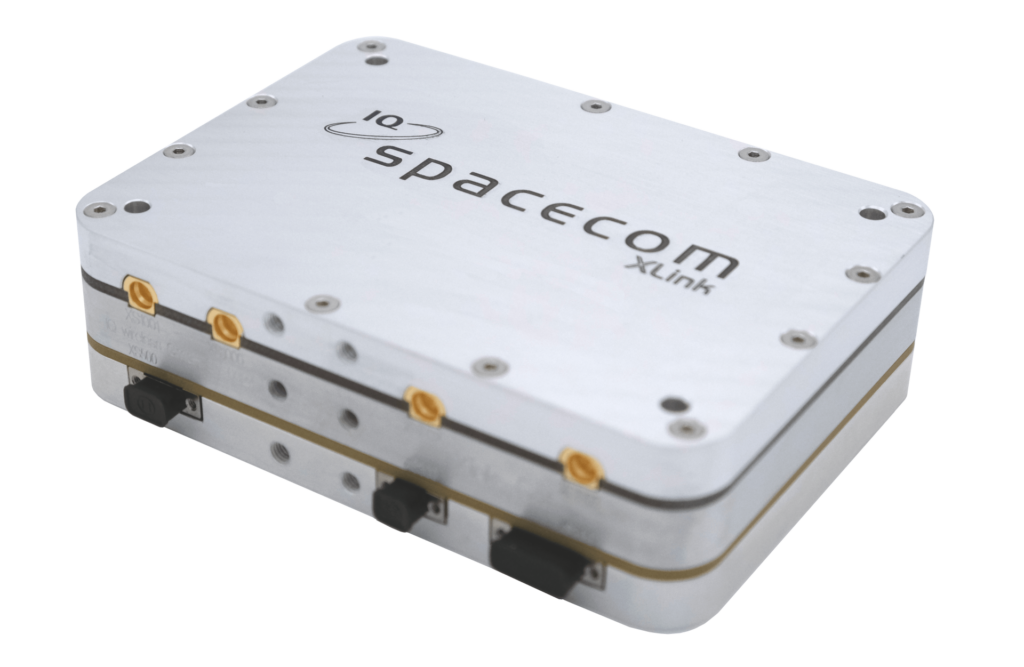
XLink is a flight-proven, software-defined radio (SDR) transceiver platform for small satellites, supporting X-, S-, L- and Ka-band links with CCSDS and DVB-S2 protocols.
Typed specifications115 values
Discloses 7 of 13 fields engineers filter by in this category (category median 5).
- Mass
- 200 g Default Configuration (incl. housing) · datasheet p.2 365 g incl. housing, High Radiation Tolerance | 365 g Optional Configuration (High Radiation Tolerance, incl. housing)
- Link protocols and waveforms
- CCSDS CCSDS 231.0-B, 132.0-B, 131.0-B, 401.0-B · datasheet p.2 DVB-S2 optional, via CCSDS 131.3-B | DVB-S2 | DVB-S2
- Frequency range
- 2 025–2 110 MHz Rx S band · datasheet p.2 2 025–2 110 MHz Rx S-Band | 7 145–7 250 MHz Rx X band | 7 145–7 250 MHz Rx X-Band | 2.025-2.110 GHz S-Band Rx (Default Configuration) +9
- Envelope (L×W×H)
- 90 x 65 x 25.3 mm³ Default Configuration · datasheet p.2 96 x 71 x 32 mm³ Optional Configuration (High Radiation Tolerance)
- TX RF output power
- +27 dBm Linear RF output power, 2 x up to · datasheet p.1 +30 dBm Linear RF output power, up to | +27 dBm RF Power Output, 2 Tx channels | +30 dBm RF Power Output, combined | 1 W max · 2 Tx channels combined +2
- Data rate
- 56 kbps nom. · Rx Payload Data (Default Configuration) · datasheet p.2 2 kbps min · Downlink (Sat2Ground) (Optional Configuration) | 56 kbps min · Ground2Sat | 3.5 kbps min · Rx Payload Data (Optional Configuration) | 3.5 kbps min · Rx payload data, optional configuration +10
- Modulation
- BPSK Rx (Default Configuration) · datasheet p.2 BPSK Tx (Default Configuration) | GMSK Tx (Optional Configuration) | QPSK Tx default | BPSK Tx default; Rx (with BCH coding) +15
- Supply voltage
- 28 V nom. · optional configuration · datasheet p.2 28 V Optional | 6 V min · Default Configuration | 28 V min · Optional Configuration | 18 V max · Default Configuration +1
- Power consumption
- 4 W nom. · Rx-S · datasheet p.1 4 W max · Rx-S only | 5.5 W max · Rx-X only | 16 W max · Tx + Rx | 5.5 W nom. · Rx-X +1
- Data interface
- Ethernet IEEE 802.3 1000BASE-T · datasheet p.2 SPI optional | UART optional, UART via RS422 | SPI via RS422 | SPI +4
- Operating temperature
- -20 °C min · datasheet p.2 60 °C max | -20–60 °C operating
- TRL
- 9 datasheet p.1
- Function
- SDR transceiver datasheet p.1
- Link use
- payload data downlink datasheet p.1 TT&C uplink telecommand, downlink TM
- Frequency band
- S Rx only · datasheet p.1 X Tx and Rx
- TX chains
- 2 2 Tx channels (optional application of two separate Tx channels) · datasheet p.2
- RF connector
- SMP datasheet p.2
- Power draw, receive
- 4 W max · Rx-S only · datasheet p.2 5.5 W max · Rx-X
- Connector
- 3 x Nano-D-Sub (Power, Ethernet, I/O) datasheet p.2 SMP, 50 Ω RF Connector Type
- Survival temperature
- -40 °C min · datasheet p.2 80 °C max | -40–80 °C non-operating
- Flight heritage
- Flight proven design (TRL 9) product page
- Satellite class
- CubeSat compatible with both CubeSats and larger satellites · datasheet p.1 microsat 10-100 kg
- TX/RX chains (as printed)
- 2 Tx channels datasheet p.2
- Channel coding (FEC)
- convolutional (Viterbi) Convolutional code k = 7 · datasheet p.2 Reed-Solomon optional configuration | BCH Rx | convolutional (Viterbi) Rx (Optional Configuration) | convolutional (Viterbi) Rx optional, Convolutional (CCSDS 131.0-B)
- Duplex
- half datasheet p.1 full FDD/Full duplex
Each value is typed with its unit and measurement condition and cites the datasheet page it was taken from. Nothing is guessed: a field that is absent here has not been published by the manufacturer. machine-extracted ✓ checked by NewSpace Market ✓ manufacturer confirmed by the manufacturer.
As published by the supplier12 lines, in the manufacturer's own wording
- Flight heritage
- Flight proven design (TRL 9)
- Interfaces
- Gigabit Ethernet; RS422 (SPI, UART, CAN)
- Protocols
- CCSDS and DVB-S2
- Downlink/telemetry and payload data rate
- up to 200 Mbps
- Uplink/telecommand data rate
- up to 1024 kbps
- Frequency bands supported
- X-, S-, L- and Ka-band
- Xlink-x
- Optional two separate Tx channels and S-Band Rx channel, for increased transmit power or redundancy
- Xlink-s
- Optional two separate Tx and Rx channels, for increased transmit power or redundancy
- Xlink-s tm/tc
- Integrated receive-ready GPIO pin to notify connected satellite systems that data is being received from the ground
- Xlink-l
- Optional two separate Tx and Rx channels, for redundancy or connecting antennas on opposite sides
- Xlink-x power amplifier
- Output power up to +34 dBm, commanded and handled via XLink-X
- Xlink-ska payload downlink data rate
- up to 200 Mbps in newly available frequency bands
About
XLink is a fully featured bidirectional SDR transceiver platform built with cost-effective commercial-off-the-shelf (COTS) components to achieve high reliability at short delivery times. It is flight-proven (TRL 9) and supports multiple frequency bands – X-, S-, L- and Ka-band – making it suited for small satellites operating in LEO. XLink supports both CCSDS and DVB-S2 protocols and offers a Gigabit Ethernet interface for reliable telemetry and telecommand operations, with RS422 (SPI, UART, CAN) also available. It provides high bandwidth efficiency with data rates for downlink/telemetry and payload of up to 200 Mbps and uplink/telecommand of up to 1024 kbps. The platform is offered in several variants: XLink-X, which optionally supports two separate Tx channels plus an S-Band Rx channel for increased transmit power or redundancy; XLink-S, which optionally supports two separate Tx and Rx channels for increased transmit power or redundancy; XLink-S TM/TC, which adds an integrated receive-ready GPIO pin to notify other connected satellite systems that data is being received from the ground; XLink-L, which optionally supports two separate Tx and Rx channels for redundancy or connecting antennas on opposite sides of the spacecraft; and XLink-SKa, the latest development for SKa-band offering a payload downlink data rate of up to 200 Mbps in newly available frequency bands. An additional XLink-X Power Amplifier module, commanded and handled via XLink-X, enables an output power of up to +34 dBm. Various multi-band XLink architectures are available for enhanced operational flexibility.
Documentation
Need the full ICD, test reports or a specific revision? Ask the supplier directly.