IRES Infrared Earth Sensor
 Leonardo SpA (Space Division)
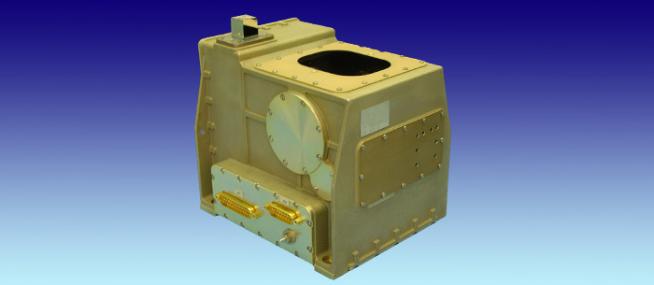
Two-axis infrared Earth horizon sensor for GEO/MEO 3-axis spacecraft: 14-16.25 um band, <0.05 deg accuracy, 10Hz, <2.5kg, <4W, 15-year lifetime. Installed on 300+ units including Galileo.
Key figurescomparable across the catalogue
- Mass
- 2.5 kg
- Power
- 4 W
- Largest dimension
- 169.9 mm
- Design life
- 15 years
- TRL
- 9
Normalised to common units so this product can be compared with others in its category. The supplier's own wording is below.
As published by the supplier
- Operating band
- 14-16.25 um (thermal IR)
- Earth acquisition range
- 15,300-53,000 km
- Operational altitude
- Up to 140,000 km
- Accuracy (random, 3-sigma)
- <0.05 deg
- Accuracy (bias)
- <0.02 deg
- Update rate
- 10 Hz
- Pointing range GEO (pitch/roll)
- +/-5.5 / +/-2.5 deg
- Acquisition range GEO (pitch/roll)
- +/-11 / +/-2.5 deg
- Dimensions
- 169.9 x 163.8 x 156 mm
- Mass
- <2.5 kg
- Supply voltage
- 24-50 V or 75-100 V
- Power
- <4 W
- Interface
- Digital serial 32/48-bit or MIL-STD-1553B
- Operating temperature
- -30 to +60 deg C
- Design lifetime
- >15 years GEO
- TRL
- 9 (~300 units sold, Galileo constellation)
About
The Leonardo IRES (Infrared Earth Sensor) is a two-axis infrared Earth horizon sensor providing accurate pitch and roll attitude measurement relative to Earth disk center. Operates in the 14-16.25 micrometer thermal IR band via electro-mechanical modulation. Designed for three-axis stabilized spacecraft in GEO and MEO orbits. Earth acquisition altitude range is 15,300-53,000 km; operational up to 140,000 km. Accuracy is less than 0.05 degrees random error (3-sigma) and less than 0.02 degrees bias. Data output at 10 Hz via 32/48-bit digital serial or MIL-STD-1553B. Mass less than 2.5 kg, power less than 4W, lifetime greater than 15 years. Latest generation IRES-N2 is ITAR-free. Approximately 300 units sold across multiple generations including Galileo navigation satellite constellation.
Documentation
No public datasheet yet — request the datasheet / ICD from the supplier.