PHM Passive Hydrogen Maser
 Leonardo SpA (Space Division)
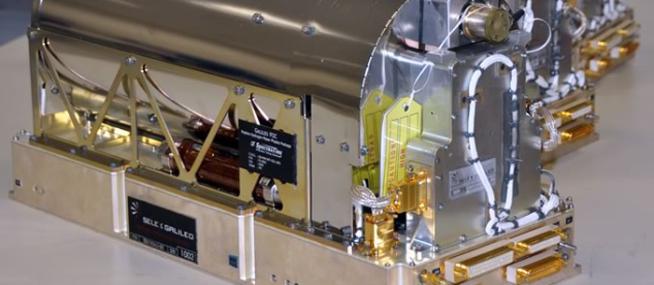
The Leonardo PHM (Passive Hydrogen Maser) is the master clock of the Galileo Navigation Satellite System and the most precise spaceborne atomic clock ever developed for an operational satellite program. Output frequency is 10.00285741 MHz (hydrogen hyperfine divided by 142) at +7 dBm. Frequency drift is less than 1e-14 per day after 1 week and […]
Key figurescomparable across the catalogue
- Mass
- 18.2 kg
- Power
- 70 W
- Largest dimension
- 500 mm
- Design life
- 12 years
Normalised to common units so this product can be compared with others in its category. The supplier's own wording is below.
As published by the supplier
- Output frequency
- 10.00285741 MHz (fH/142)
- Output level
- +7 dBm
- Frequency drift/day
- <=1e-14 (after 1 week); <1e-15 (after 30 days)
- Adev @ 1 s
- 1.8e-12
- Adev @ 100 s
- 7e-14
- Adev @ 10,000 s
- 7e-15
- Thermal sensitivity
- <2e-14/deg C
- Voltage sensitivity
- <=3e-15/V
- Dimensions
- 210 x 500 x 250 mm
- Mass
- 18.2 kg
- Supply voltage
- 50 V +/-1 V
- Power
- <=70 W @ -5 deg C; <=60 W @ +10 deg C baseplate
- Qualification temp
- -15 to +20 deg C
- Design lifetime
- >12 years MEO
- Flight heritage
- 40+ units in orbit; GIOVE-B (2008), Galileo IOV/FOC
About
The Leonardo PHM (Passive Hydrogen Maser) is the master clock of the Galileo Navigation Satellite System and the most precise spaceborne atomic clock ever developed for an operational satellite program. Output frequency is 10.00285741 MHz (hydrogen hyperfine divided by 142) at +7 dBm. Frequency drift is less than 1e-14 per day after 1 week and less than 1e-15 per day after 30 days. Allan deviation reaches 1.8e-12 at 1 second integration, 7e-14 at 100 seconds, and 7e-15 at 10,000 seconds. Two-module design: Electronic Package (Leonardo lead) and Physics Package/Ultra-Stable Oscillator (Orolia Switzerland). Mass 18.2 kg; power less than 70W. First flew on GIOVE-B in 2008; over 40 units in orbit on IOV and FOC Galileo satellites. Design lifetime greater than 12 years in MEO.
Documentation
No public datasheet yet — request the datasheet / ICD from the supplier.