Reflector Drive Mechanism
 Glavkosmos
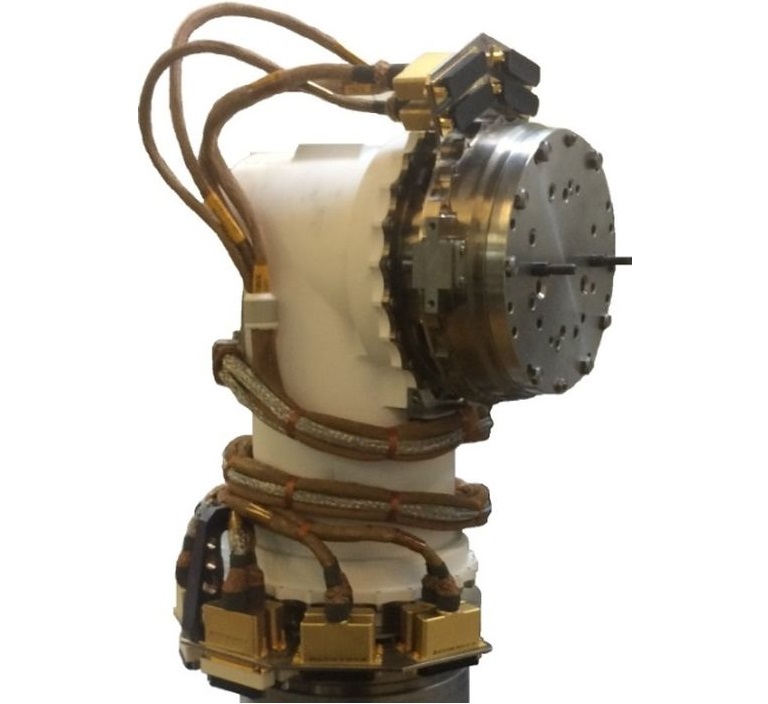
The Reflector Drive Mechanism is a two-degree-of-freedom electromechanical device designed to rotate a large deployable antenna reflector on a spacecraft from its transportation to operational position and for subsequent readjustment during orbital flight.
Key figurescomparable across the catalogue
- Mass
- 12 kg
- Largest dimension
- 410 mm
- Design life
- 10 years
- Lead time
- 6 months
Normalised to common units so this product can be compared with others in its category. The supplier's own wording is below.
As published by the supplier
- Design life
- 10 years
- Lead time
- 6 months
- Readjustment/rotation angle for each axis
- up to ± 25 °
- Rotation angle to the operating position
- up to 290 °
- Slew rate
- 0.009-7.0 °/min
- Measurement error of the rotation angle for each axis, arcmin, not exceeding
- 1
- Developed torque for each axis
- 60 N·m, not less than
- Self-braking torque in a de-energized state of the electric motors for each axis
- 100 N·m, not less than
- Load inertia moment
- 5310 kg·m2
- Operating temperature range
- -30 to +60 °C
- Overall dimensions
- 410 x 255 x 220 mm
- Mass
- 12 kg
About
The Reflector Drive Mechanism is an electromechanical device with two degrees of freedom, specifically engineered for spacecraft applications. Its primary purpose is to facilitate the rotation of a large deployable antenna reflector relative to its boom. This rotation serves two main functions: transitioning the reflector from its stowed transportation position to its operational position, and enabling precise readjustment of the reflector within a specified range of operating angles during the spacecraft’s orbital flight. The mechanism is designed for a guaranteed service life of 10 years and has an estimated production/delivery time of 6 months. It offers a readjustment/rotation angle of up to ±25° for each axis and a rotation angle to the operating position of up to 290°. The slew rate can vary from 0.009 to 7.0 °/min, with a measurement error of the rotation angle not exceeding 1 arcmin for each axis. It develops a torque of at least 60 N·m per axis and features a self-braking torque of at least 100 N·m per axis when the electric motors are de-energized. The mechanism can handle a load inertia moment of 5310 kg·m² and operates within a temperature range of -30 to +60 °С. Its overall dimensions are 410 x 255 x 220 mm, and it has a mass of 12 kg.
Documentation
No public datasheet yet — request the datasheet / ICD from the supplier.