RF Ion Thrusters
 Busek Co.
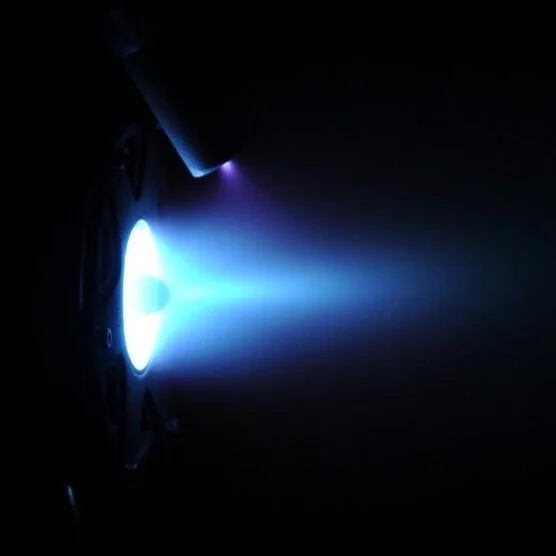
Extremely compact and versatile systems for spacecraft classes from small satellites to nanosatellites, featuring high performance and unprecedented efficiency at its size.
Typed specifications20 values
Discloses 6 of 10 fields engineers filter by in this category (category median 3).
- Propulsion family
- electric datasheet p.1
- Thrust
- 1.1 mN max · datasheet p.2
- Envelope (L×W×H)
- 180 x 88 x 102 mm datasheet p.2
- Specific impulse
- 2 150 s max · datasheet p.2
- Propellant
- iodine solid storage · datasheet p.2
- Supply voltage
- 28 V nom. · ambient temp. · datasheet p.2
- Power consumption
- 56–80 W product page
- Data interface
- RS-485 datasheet p.2
- Operating temperature
- -15–45 °C datasheet p.2
- Thruster technology
- gridded ion RF gridded ion thruster, iodine · datasheet p.1
- Propellant mass flow
- 52 mg/s datasheet p.2
- Propellant mass (full load)
- 1.5 kg max · datasheet p.2
- Power at thrust
- 56–75 W system power · datasheet p.2
- Satellite class
- CubeSat deep-space CubeSat missions · datasheet p.1
- Reference spacecraft mass for delta-v
- 14 kg CubeSat · datasheet p.2
- Power processing unit included
- yes datasheet p.2
- Dry mass
- 1.4 kg w/ gimbal · datasheet p.2 1.28 kg w/o gimbal
- Thrust vector control
- gimballed optional integrated gimbal, 2-axis, ±10° · datasheet p.2
- PPU efficiency
- 90 % nom. · ~90% efficient RF power supply · datasheet p.2
Each value is typed with its unit and measurement condition and cites the datasheet page it was taken from. Nothing is guessed: a field that is absent here has not been published by the manufacturer. machine-extracted ✓ checked by NewSpace Market ✓ manufacturer confirmed by the manufacturer.
As published by the supplier4 lines, in the manufacturer's own wording
- System Power
- 56-80 W
- Thrust
- Up to 1.25 mN
- Specific Impulse
- Up to 2300s
- Delta-V
- Up to 2.5 km/s (14 kg CubeSat)
About
Busek’s radio frequency (RF) gridded ion thrusters eliminate the use of internal cathodes, a life-limiting factor in DC ion engine designs. These systems have been designed from the ground-up to utilize iodine propellant, but are 100% reverse-compatible with xenon and krypton propellants. Busek is presently delivering BIT-3 systems in rapid fashion for a range of individual missions as well as smallsat constellations. In the sub-100W system range, scaling conventional EP Hall thrusters is prohibitively inefficient. The 6U CubeSat form factor is unfavorable for any pressure vessels. These systems tend to be small, power limited, and require a new type of thruster. Iodine is stored as a solid that allows for lightweight and configurable tanks (not constrained to high pressure tanks shapes). System is simple to operate: iodine sublimes with minimal heat input to form iodine vapor which is then fed to the EP device. Busek has shown with Hall thrusters that iodine provides almost identical performance as with xenon – possibly surpassing xenon in the presence of significant I2+heavy ions in the plume. RF ion is a perfect propulsion system for deep space CubeSat missions. For small spacecraft, RF ion engines enable incredible the same kind of incredible range that our Hall thrusters can deliver for larger spacecraft.
Documentation
Need the full ICD, test reports or a specific revision? Ask the supplier directly.