Solar Array Drive Mechanism. Type 2
 Glavkosmos
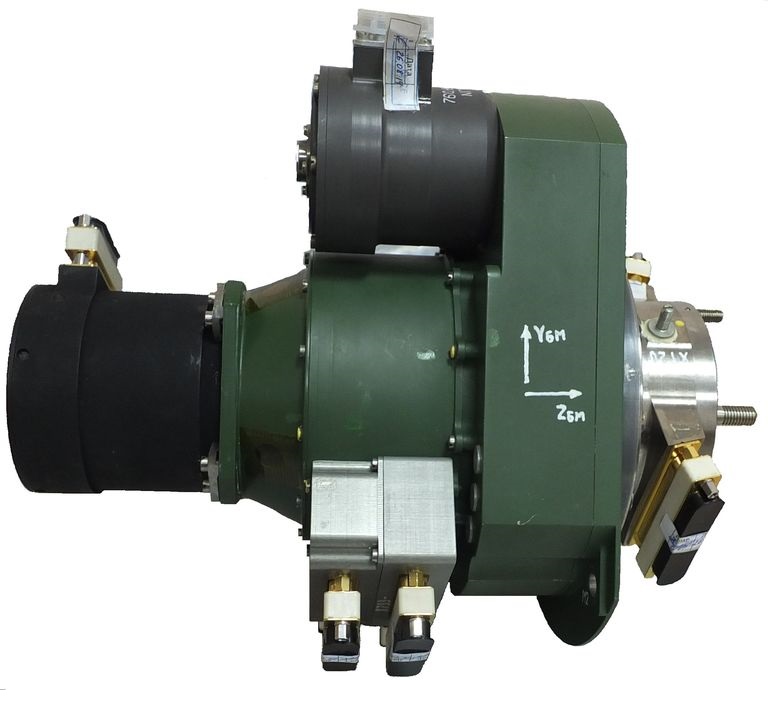
The Solar Array Drive Mechanism (SADM) Type 2 is an electromechanical device designed for the precise rotation of solar array wings on spacecraft, ensuring optimal power generation.
Key figurescomparable across the catalogue
- Mass
- 13.2 kg
- Largest dimension
- 300 mm
- Design life
- 13.5 years
- Lead time
- 15 months
- TRL
- 9
Normalised to common units so this product can be compared with others in its category. The supplier's own wording is below.
As published by the supplier
- Purpose
- Rotation of solar array wings at the specified rate; electrical power transmission from rotating solar panels; transmitting of control and telemetry signals; formation and output of signals of shaft rotation angle.
- Year of release
- 2013
- Design life
- 13.5 years
- Lead time
- 15 months
- Flight qualification of the product
- yes
- Possibility to adapt the product to customer requirements
- yes
- Output shaft rotation rate
- 0-8 deg/min
- Angle measurement error, not exceeding
- 0.083 °
- Total current of power current-collecting devices
- 84 A
- Number of power supply circuits
- 12 units
- Overall dimensions
- 240 × 160 × 300 mm
- Number of telemetry circuits
- 26 units
- Operational life defined by hours, not less than
- 100000
- Mass
- 13.2 ± 0.8 kg
- Operating regime
- continuous rotation
- Active lifetime
- 10 years
About
The Solar Array Drive Mechanism (SADM) Type 2 is an electromechanical device with the primary purpose of rotating solar array wings at a specified rate. Beyond mechanical rotation, it facilitates the electrical power transmission from the rotating solar panels to the spacecraft’s systems. It also handles the transmission of control and telemetry signals, and generates and outputs signals indicating the shaft’s rotation angle. This product was released in 2013 and boasts a guaranteed service life of 13.5 years, with an estimated production/delivery time of 15 months. It is flight-qualified and can be adapted to meet specific customer requirements. The mechanism operates in a continuous rotation regime and has an active lifetime of 10 years, with an operational life defined by 100,000 hours.
Documentation
No public datasheet yet — request the datasheet / ICD from the supplier.