VST-68M, VST-41M Star Trackers
 VECTRONIC Aerospace GmbH
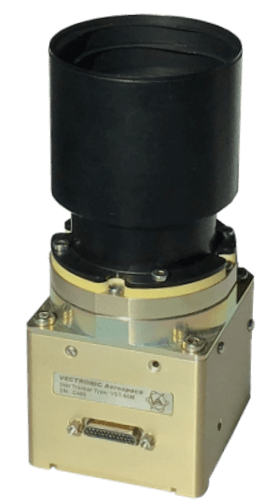
The VST-series star trackers are high-performance attitude determination sensors for small satellites, offering radiation tolerance and suitable for various orbital and interplanetary missions.
Typed specifications32 values
Discloses 8 of 12 fields engineers filter by in this category (category median 8).
- Accuracy, cross-boresight
- 5 arcsec x,y axis · datasheet p.1 5 arcsec x,y axis; 2 sigma
- Mass
- 470 g datasheet p.1
- Accuracy, about boresight (roll)
- 30 arcsec datasheet p.1 30 arcsec z axis; 2 sigma
- Envelope (L×W×H)
- 60mm x 60mm x 138 mm datasheet p.1 60mm x 60mm x 138 mm with baffle
- Update rate
- 5 Hz datasheet p.1
- Max tracking rate
- 3 °/s datasheet p.1 3 °/s max · max tracking rate
- Field of view
- 14° x 14° datasheet p.1 14 ° 14° x 14° (W x H) | 14 ° as stated: «14° x 14°»
- Lost-in-space acquisition time
- 1 s time to first acquisition, typ. · datasheet p.1 1 s Typ.
- Supply voltage
- 9–40 V input voltage range · datasheet p.1
- Power consumption
- 3 W nominal · datasheet p.1 3 W
- Data interface
- RS-422 datasheet p.1 CAN 2 x CAN, redundant CAN bus | RS-422 2 x RS422 | CAN
- Operating temperature
- -20–65 °C datasheet p.1
- Radiation tolerance (TID)
- 20 krad gt · datasheet p.1 20 krad min · >20 krad
- Connector
- MDM 25 male datasheet p.1
- Survival temperature
- -40–80 °C storage temp. range · datasheet p.1
- Random vibration
- 20 g RMS random 3 axis · datasheet p.2 20 g RMS random, 3 axis
- Flight heritage
- The predecessors of this sensor, the VST-41M series, have been successfully used in various small satellite missions. datasheet p.1
- Baffle
- optional datasheet p.1
- Detector
- CMOS 1024 x 1024 pixel rad-hard CMOS sensor · datasheet p.1
Each value is typed with its unit and measurement condition and cites the datasheet page it was taken from. Nothing is guessed: a field that is absent here has not been published by the manufacturer. machine-extracted ✓ checked by NewSpace Market ✓ manufacturer confirmed by the manufacturer.
As published by the supplier34 lines, in the manufacturer's own wording
- Dimensions (with baffle) vst-68m
- 60 mm x 60 mm x 138 mm
- Mass vst-68m
- 0.470 kg
- Mounting pattern vst-68m
- 4 x M4 50 mm x 90 mm
- Power consumption, max vst-68m
- 3.0 W
- Input voltage range (vcd) vst-68m
- 9 to 40
- Signal interface vst-68m
- 2 x RS422 / 2 x CAN
- Signal characteristics vst-68m
- Serial asynchronous / CAN
- Connector type vst-68m
- MDM-25
- Operating temp.range vst-68m
- -20°C to + 65°C
- Storage temp. range vst-68m
- -40°C to + 80°C
- Vibration vst-68m
- 20 g rms random 3 axis
- Radiation tolerance vst-68m
- > 20 krad
- Accuracy 2σ (x,y / z axis) vst-68m
- 5 arcsec / 30 arcsec
- Acquisition probability vst-68m
- > 99.7%
- Update rate vst-68m
- 5 Hz
- Field of view vst-68m
- 14° x 14°
- Time of first acquisition vst-68m
- typ. 1 sec
- Dimensions (with baffle) vst-41m
- 80 mm x 100 mm x 180 mm
- Mass vst-41m
- 0.7 to 0.9 kg
- Mounting pattern vst-41m
- 4 x M4 66 mm x 90 mm
- Power consumption, max vst-41m
- 2.5 W
- Input voltage range (vcd) vst-41m
- 9 to 18 or 18 to 40
- Signal interface vst-41m
- RS422 / RS485
- Signal characteristics vst-41m
- Serial asynchronous
- Connector type vst-41m
- SUB HD26 male, or MDM-25
- Operating temp.range vst-41m
- -20°C to + 65°C
- Storage temp. range vst-41m
- -40°C to + 80°C
- Vibration vst-41m
- 20 g rms random 3 axis
- Radiation tolerance vst-41m
- > 20 krad
- Accuracy 2σ (x,y / z axis) vst-41m
- 18 arcsec / 122 arcsec
- Acquisition probability vst-41m
- > 99.7%
- Update rate vst-41m
- 4 Hz
- Field of view vst-41m
- 14° x 14°
- Time of first acquisition vst-41m
- typ. 800 ms
About
The VST-series star trackers, including the VST-68M and VST-41M models, are high-performance sensors designed for small satellite applications. They consist of an optical head with a high-quality Leica lens system and a mission-dependent baffle, coupled with star tracker processing electronics that include an on-board star catalogue. These star trackers are radiation tolerant, making them suitable for LEO, GEO, and even interplanetary missions. Predecessors of this series have a successful flight heritage in various small satellite missions.
The VST-68M performs direct and autonomous measurement of spacecraft attitude relative to the celestial reference system J2000. Its core element is a 1024 x 1024 pixel rad-hard CMOS sensor, specifically developed for space applications. This sensor transforms star images into electrical information, which is then processed by a CPU using algorithms to eliminate noise, bright objects (like the Moon or planets), and determine star positions via a barycentric algorithm. With a 75 mm focal length, the VST-68M has a 14°x14° field of view, ensuring at least 16 visible stars regardless of attitude. Attitude information is provided as quaternions and/or Euler angles, along with status telemetry. Communication is via two independent asynchronous SCI’s (up to 1 Mbit baud rate) and a redundant CAN bus interface.
The VST-41M also performs direct and autonomous spacecraft attitude measurement relative to the inertially fixed celestial reference system. It features a 512 x 512 pixel rad-hard CMOS sensor, also developed for space applications. Similar to the VST-68M, it processes star images to eliminate noise and bright objects, determining star positions using a barycentric algorithm. With a 50 mm focal length, the VST-41M has a 14°x14° field of view, guaranteeing at least 10 visible stars. It achieves first acquisition typically in 800 ms and operates with a 4 Hz update rate, providing attitude information with a 2σ accuracy better than 18 arcsec per star frame. Attitude acquisition probability is over 99.7% at angular rates below 0.3 deg/sec. Attitude information is provided as quaternions and Euler angles. The communication interface includes two independent asynchronous SCI’s (up to 1 Mbit baud rate).
Documentation
- VAS-VST68M-DS2.pdf PDF source: www.vectronic-aerospace.com ↗
- VAS-VST41M-DS5.pdf PDF source: www.vectronic-aerospace.com ↗
Need the full ICD, test reports or a specific revision? Ask the supplier directly.