VRW Reaction Wheels
 VECTRONIC Aerospace GmbH
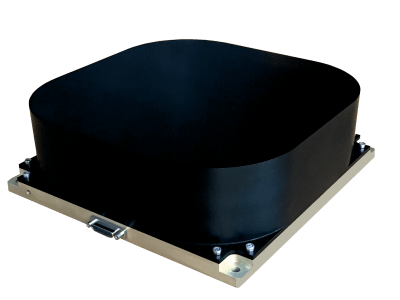
A modular family of space-qualified reaction wheels from VECTRONIC Aerospace, spanning 0.2 Nms to 8 Nms angular momentum, for small satellite attitude control.
Typed specifications19 values
Discloses 5 of 10 fields engineers filter by in this category (category median 5).
- Mass
- 1 000 g as published, mode unspecified · vendor page (catalogue a
- Envelope (L×W×H)
- 70 mm x 70 mm x 48 mm product page 96 mm x 96 mm x 52 mm | 140 mm x 140 mm x 60 mm | 180 mm x 180 mm x 60 mm
- Angular momentum storage
- 8 N·m·s as published, mode unspecified · vendor page (catalogue a
- Max torque
- 50 mN·m as published, mode unspecified · vendor page (catalogue a
- Speed range
- 0.1 rpm product page 0.1 rpm | 0.1 rpm
- Supply voltage
- 9–36 V as published, mode unspecified · vendor page (catalogue a
- Power consumption
- 1.1 W as published, mode unspecified · vendor page (catalogue a
- Operating temperature
- -20–70 °C as published, mode unspecified · vendor page (catalogue a
- Radiation tolerance (TID)
- 20 krad as published, mode unspecified · vendor page (catalogue a
- Design lifetime
- 5.1 years min · product page
- Connector
- MDM-9 / MDM-25 product page MDM-25 | MDM-25 | MDM-25
Each value is typed with its unit and measurement condition and cites the datasheet page it was taken from. Nothing is guessed: a field that is absent here has not been published by the manufacturer. machine-extracted ✓ checked by NewSpace Market ✓ manufacturer confirmed by the manufacturer.
As published by the supplier70 lines, in the manufacturer's own wording
- Angular momentum range (series)
- 0.2 Nms to 8 Nms
- Nominal in-orbit lifetime
- >45,000 hours
- Vrw-b-02 – dimensions
- 70 mm x 70 mm x 48 mm
- Vrw-b-02 – mass
- 1.0 kg
- Vrw-b-02 – moment of inertia (rotor)
- 3.4*10-4 kgm2
- Vrw-b-02 – mounting pattern
- 4x M4 62.5 mm x 62.5 mm
- Vrw-b-02 – power consumption @steady state, no speed
- <1.1 W
- Vrw-b-02 – power consumption @steady state, max speed
- <4.5 W
- Vrw-b-02 – power consumption @max. torque, max speed
- <45 W
- Vrw-b-02 – input voltage range
- 9 VDC to 36 VDC
- Vrw-b-02 – signal interface
- RS422 / RS485 / CAN
- Vrw-b-02 – connector type
- MDM-9 / MDM-25
- Vrw-b-02 – operating temp. range
- -20°C to +70°C
- Vrw-b-02 – storage temp. range
- -40°C to +80°C
- Vrw-b-02 – vibration
- 22 g rms random 3 axis
- Vrw-b-02 – radiation tolerance
- >20 krad
- Vrw-b-02 – max. speed
- ± 6000 rpm
- Vrw-b-02 – max. angular momentum
- 0.2 Nms
- Vrw-b-02 – max. torque
- ± 20 mNm
- Vrw-b-02 – speed control loop accuracy (2σ)
- 0.1 rpm
- Vrw-b-02 – unbalance static/dynamic
- < 1 gmm / 80 gmm²
- Vrw-c-1 – dimensions
- 96 mm x 96 mm x 52 mm
- Vrw-c-1 – mass
- 2.3 kg
- Vrw-c-1 – moment of inertia (rotor)
- 1.94*10-3 kgm2
- Vrw-c-1 – mounting pattern
- 4x M5 85 mm x 85 mm
- Vrw-c-1 – power consumption @steady state, no speed
- <1.1 W
- Vrw-c-1 – power consumption @steady state, max speed
- <4.5 W
- Vrw-c-1 – power consumption @max. torque, max speed
- <45 W
- Vrw-c-1 – input voltage range
- 9 VDC to 36 VDC
- Vrw-c-1 – signal interface
- RS422 / RS485 / CAN
- Vrw-c-1 – connector type
- MDM-25
- Vrw-c-1 – operating temp. range
- -20°C to +70°C
- Vrw-c-1 – storage temp. range
- -40°C to +80°C
- Vrw-c-1 – vibration
- 16 g rms random 3 axis
- Vrw-c-1 – radiation tolerance
- >20 krad
- Vrw-c-1 – max. speed
- ± 6000 rpm
- Vrw-c-1 – max. angular momentum
- 1.2 Nms
- Vrw-c-1 – max. torque
- ± 20 mNm
- Vrw-c-1 – speed control loop accuracy (2σ)
- 0.1 rpm
- Vrw-c-1 – unbalance static/dynamic
- < 1 gmm / 80 gmm²
- Vrw-d-2 – dimensions
- 140 mm x 140 mm x 60 mm
- Vrw-d-2 – mass
- 2.0 kg
- Vrw-d-2 – moment of inertia (rotor)
- 3.19*10-3 kgm2
- Vrw-d-2 – mounting pattern
- 4x M5 126 mm x 126 mm
- Vrw-d-2 – power consumption @steady state, no speed
- <1.3 W
- Vrw-d-2 – power consumption @steady state, max speed
- <9.0 W
- Vrw-d-2 – power consumption @max. torque, max speed
- <65 W
- Vrw-d-2 – input voltage range
- 28 VDC to 47 VDC
- Vrw-d-2 – signal interface
- RS422 / RS485 / CAN
- Vrw-d-2 – connector type
- MDM-25
- Vrw-d-2 – operating temp. range
- -20°C to +70°C
- Vrw-d-2 – storage temp. range
- -40°C to +80°C
- Vrw-d-2 – vibration
- 26 g rms random 3 axis
- Vrw-d-2 – radiation tolerance
- >20 krad
- Vrw-d-2 – max. speed
- ± 6000 rpm
- Vrw-d-2 – max. angular momentum
- 2.0 Nms
- Vrw-d-2 – max. torque
- ± 50 mNm
- Vrw-d-2 – speed control loop accuracy (2σ)
- 0.1 rpm
- Vrw-d-2 – unbalance static/dynamic
- < 3 gmm / 100 gmm²
- Vrw-d-4 – dimensions
- 180 mm x 180 mm x 60 mm
- Vrw-d-4 – mass
- 2.5 kg
- Vrw-d-4 – moment of inertia (rotor)
- 6.37*10-3 kgm2
- Vrw-d-4 – mounting pattern
- 4x M5 166 mm x 166 mm
- Vrw-d-4 – power consumption @steady state, no speed
- <1.3 W
- Vrw-d-4 – power consumption @steady state, max speed
- <9.0 W
- Vrw-d-4 – power consumption @max. torque, max speed
- <65 W
- Vrw-d-4 – input voltage range
- 28 VDC to 47 VDC
- Vrw-d-4 – signal interface
- RS422 / RS485 / CAN
- Vrw-d-4 – connector type
- MDM-25
- Vrw-d-4 – operating temp. range
- -20°C to +70°C
About
VRW reaction wheels are actuators that influence the rotational motion of a spacecraft by exploiting conservation of angular momentum: changing the wheel’s speed exerts a reaction torque on the satellite, with the acceleration ratio between wheel and spacecraft equal to the inverse ratio of their moments of inertia. Each VRW unit comprises a brushless DC motor, a rotor, wheel drive electronics, and a housing. Developed specifically for small satellite applications, the wheel speed is controlled by a model-supported PI loop running on a 32-bit microprocessor, using a low-noise, high-efficiency four-quadrant PWM method in the power stage. The wheel drive electronics include thermal and over-voltage protection circuits. The signal interface is a standard asynchronous SCI on RS422/RS485 level, usable in single full-duplex configuration or half-duplex bus architecture, with baud rate adjustable up to 1 Mbaud; a CAN bus interface is also available. The design is modular: rotor geometry, input voltage range, and communication protocol can be changed to adapt VRW characteristics to customer needs. Units support flexible operation in either torque control mode or speed control mode. Nominal in-orbit lifetime is more than 45,000 hours. The VRW series spans multiple design classes (B, C, D, A) offering maximum angular momentum from 0.20 Nms to 8.00 Nms, with dimensions from 70x70x48 mm up to 200x200x67 mm and masses from 0.9 kg to 3.5 kg, allowing rotor geometry and mass to be tailored within each class to specific mission requirements. Backed by over 25 years of experience and extensive space flight heritage, VRW wheels have been deployed across multiple satellite constellations worldwide and are produced in full series production for competitive pricing and fast lead times; VECTRONIC’s reaction wheels are featured in state-of-the-art reports year after year.
Documentation
No public datasheet yet — request the datasheet / ICD from the supplier.