AmbaSat-1 Satellite Rocket Kit including Launch
 AmbaSat
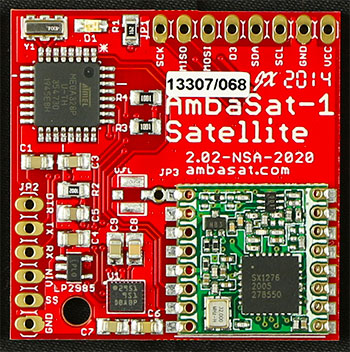
The AmbaSat-1 ROCKET KIT is a DIY satellite kit that includes a fully-assembled mainboard, a choice of sensor board, programming tools, and a launch into Low Earth Orbit.
Technical specifications
- Microcontroller
- ATMEGA 328
- Radio transceiver
- RFM95 LoRaWAN
- Radio range
- 700 kilometer+
- Sensor 01
- Humidity and Temperature (SHT3X)
- Sensor 01 interface
- I2C
- Sensor 01 communication speed
- up to 1 MHz
- Sensor 02
- Temperature (STS21)
- Sensor 02 size
- 3x3 mm
- Sensor 02 interface
- I²C
- Sensor 03
- Gas, Pressure, Temperature & Humidity (BME680)
- Sensor 03 type
- 4-in-1 multi-functional MEMS environmental sensor (VOC, temperature, humidity, barometer)
- Sensor 04
- Ambient Light (OPT3001)
- Sensor 05
- TVOC (Total Volatile Organic Compounds) (ZMOD4410)
- Sensor 05 assembly
- 12-pin LGA (3.0 x 3.0 x 0.7 mm)
- Sensor 06
- UV Sensor (Si1132)
- Sensor 06 interface
- I2C digital
- Sensor 07
- Carbon Emissions (CCS811)
- Sensor 07 interface
- I²C
- Sensor 08
- GPS (Teseo-LIV3R)
- Sensor 08 size
- 9.7x10.1 mm
- Sensor 08 supported GNSS
- GPS, Glonass, BeiDou & QZSS
About
The AmbaSat-1 ROCKET KIT provides a complete package for individuals to build and launch their own satellite into Low Earth Orbit. The kit includes a fully-assembled satellite mainboard featuring an ATMEGA 328 microcontroller, an RFM95 LoRaWAN radio transceiver with a 700 kilometer+ range, gyroscope, accelerometer, magnetometer, capacitors, resistors, clock crystal, voltage regulator, and LED. Users select one of several sensor boards, including options for Humidity and Temperature (SHT3X), Temperature (STS21), Gas, Pressure, Temperature & Humidity (BME680), Ambient Light (OPT3001), TVOC (ZMOD4410), UV Sensor (Si1132), Carbon Emissions (CCS811), or GPS (Teseo-LIV3R). The kit also comes with a 2xAA battery holder for portable power and an FTDI programmer for direct coding from Windows or Linux personal computers. Full example source code, a step-by-step assembly guide, and templates are supplied. Assembly requires basic soldering skills to attach the chosen sensor board, six connector pins, and the LoRaWAN radio transceiver antenna to the main board. The satellite is fully Arduino compatible, allowing programming via Arduino IDE or Microsoft Visual Studio Code, with open-source code examples available on GitHub. AmbaSat-1 uses LoRaWAN and ‘The Things Network’ (TTN) to send sensor data to a desktop or mobile device, with data viewable on the AmbaSat web Dashboard. The kit price includes the cost of the rocket launch. Power is delivered via the AmbaSat 3U CubeSat, eliminating the need for solar panels. Custom sensors can also be created if they conform to design specifications (size, power & safety), utilizing additional connectivity pins exposing the ATMEGA’s I2C bus, digital and analogue pins, MISO, MOSI, and power.
Documentation
No public datasheet yet — request the datasheet / ICD from the supplier.