Bipropellant Thruster 11d
 Glavkosmos
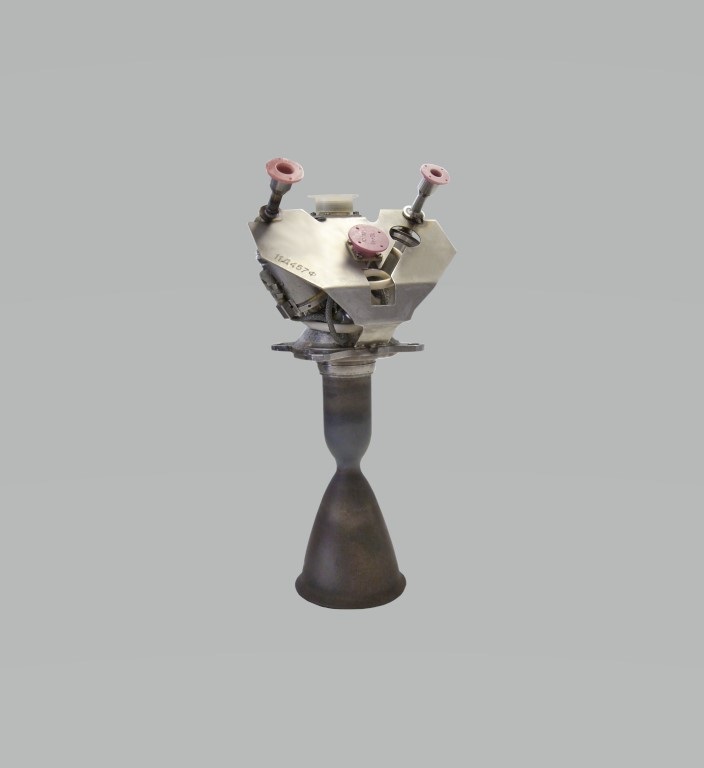
The Bipropellant Thruster 11d is a flight-qualified propulsion unit designed for spacecraft attitude control, utilizing UDMH/NTO propellants.
Key figurescomparable across the catalogue
- Mass
- 1.5 kg
- Thrust
- 53.9 N
- Specific impulse
- 289.8 s
Normalised to common units so this product can be compared with others in its category. The supplier's own wording is below.
As published by the supplier
- Purpose
- Phobos Sample Return Spacecraft
- Flight qualification of the product
- Letter "O", flight use
- Possibility to adapt the product to customer requirements
- Yes
- Propellants, fuel/oxidizer
- UDMH/NTO
- Nominal thrust
- 53.9 N
- Nominal specific impulse, steady state
- 2,842 m/s
- Nominal inlet pressure
- 1.18 MPa
- Inlet operating pressure
- 1.03…1.32 MPa
- Total firing time, up to
- 5,750 s
- Cycle life, number of starts-up, up to
- 100,000
- Nozzle expansion ratio
- 50
- Operating voltage
- 27 V
- Mass, not over
- 1.5 kg
About
The Bipropellant Thruster 11d is a flight-qualified propulsion system primarily intended for the Phobos Sample Return Spacecraft. Its main purpose is the formation of multiple impulses for attitude control of spacecraft in response to control system triggering commands. The thruster uses UDMH (Unsymmetrical Dimethylhydrazine) as fuel and NTO (Nitrogen Tetroxide) as oxidizer. A key design feature is its high-temperature Niobium alloy nozzle, which is equipped with a disilicide oxidation-resistant coating to ensure durability and performance in the harsh space environment. The product is adaptable to customer requirements, offering flexibility for various mission profiles. It boasts a nominal thrust of 53.9 N and a nominal specific impulse of 2,842 m/s in steady state operation. The thruster can operate with an inlet pressure range of 1.03 to 1.32 MPa and has a total firing time of up to 5,750 seconds, with a cycle life of up to 100,000 starts.
Documentation
No public datasheet yet — request the datasheet / ICD from the supplier.