NEPTUNE_100 / TRITON_4500 Launch Vehicles
 Interorbital Systems
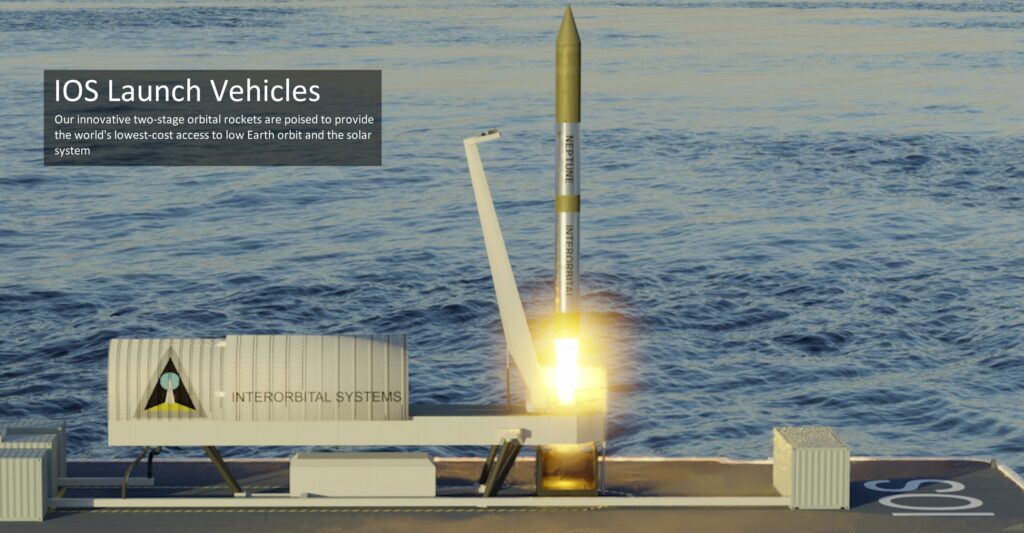
Small-lift and medium-lift two-stage orbital launch vehicles using storable bipropellant — NEPTUNE_100 (100kg payload) and TRITON_4500 (4,500kg payload) to 500km polar orbit.
Key figurescomparable across the catalogue
- Payload capacity
- 4,500 kg
Normalised to common units so this product can be compared with others in its category. The supplier's own wording is below.
As published by the supplier
- Neptune_100 payload
- 100 kg to 500 km polar orbit
- Triton_4500 payload
- 4,500 kg to 500 km polar orbit
- Propellants
- White Fuming Nitric Acid (WFNA) + Turpentine
- Engine cooling
- Ablative (filament-wound composite)
- Max engine burn time
- 40 minutes
- Propellant feed
- Pressure-booster system (proprietary)
- Launch platforms
- Land or sea
About
Interorbital Systems is developing the small-lift two-stage NEPTUNE_100 and medium-lift two-stage TRITON_4500 orbital launch vehicles, capable of launching 100 kg and 4,500 kg payloads respectively into a 500 km polar circular orbit, with more massive payloads possible into near-equatorial orbits. Both rockets are designed to launch from land or sea and are among the only bipropellant liquid rockets in the world using all-storable propellants — high-density White Fuming Nitric Acid (WFNA) and turpentine, which are non-hypergolic, safe, and easy to handle compared to hydrazine-based propellants. The rocket engines use ablative cooling, manufactured via a proprietary filament-winding process with high-temperature composite materials, allowing safe operation for up to 40 minutes. A proprietary pressure-booster propellant feed system reduces system weight and complexity compared to pump-fed alternatives.
Documentation
No public datasheet yet — request the datasheet / ICD from the supplier.