IOS TubeSat Kit
 Interorbital Systems
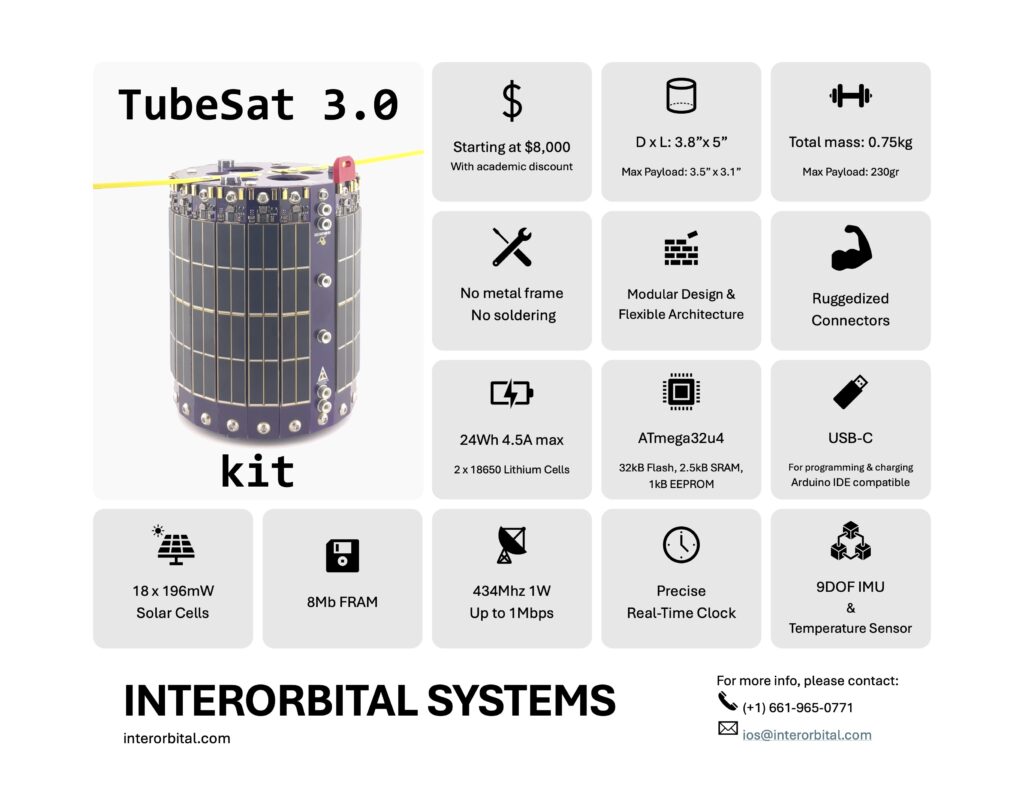
A low-cost, icosagon cross-section pico-satellite kit (up to 0.75-kg for 1U) from Interorbital Systems, designed for easy assembly and optional launch to a 310-km polar orbit aboard the NEPTUNE rocket.
Typed specifications2 values
Discloses 0 of 7 fields engineers filter by in this category (category median 3).
- Mass
- 750 g product page
- Flight heritage
- Tancredo Sat-1 launched to ISS on Japanese H-II rocket, deployed from Kibo module, January 2017 - first IOS TubeSat placed in orbit product page
Each value is typed with its unit and measurement condition and cites the datasheet page it was taken from. Nothing is guessed: a field that is absent here has not been published by the manufacturer. machine-extracted ✓ checked by NewSpace Market ✓ manufacturer confirmed by the manufacturer.
As published by the supplier9 lines, in the manufacturer's own wording
- Cross-section shape
- Icosagon
- Maximum mass (1U)
- 0.75 kg
- Mass allowance (2U)
- Double that of 1U TubeSat
- Mass allowance (3U)
- Triple that of 1U TubeSat
- Construction
- Custom-printed circuit boards and precision laser-cut aluminum components; all-circuit-board chassis (TubeSat 3.0)
- Assembly time (TubeSat 3.0)
- Under 15 minutes with just a screwdriver, no drilling, tapping, or soldering
- Optional launch orbit
- 310-km (192-mi) polar orbit
- Optional launch vehicle
- Interorbital NEPTUNE launch vehicle
- Flight heritage
- Tancredo Sat-1 launched to ISS on Japanese H-II rocket, deployed from Kibo module, January 2017 - first IOS TubeSat placed in orbit
About
The IOS TubeSat Kit is described as the lowest-cost professional-quality satellite kit available, positioned as a super low-cost alternative to the CubeSat. Instead of a cubic form factor, the TubeSat uses an icosagon-shaped cross section and has a maximum mass of 0.75-kg for the standard 1U version. It is built from high-quality, custom-printed circuit boards and precision laser-cut aluminum components. Target builders include engineering and science professionals conducting on-orbit research, educational institutions training students in spacecraft design, and hobbyist experimenters. It can also serve as a Personal Satellite for artists, musicians, advertisers, or individuals wishing to send items into space or transmit messages from space. Interorbital Systems and partners can provide design, development, training, and manufacturing services for an extra fee to those lacking the technical skills to build the spacecraft themselves. The next-generation TubeSat 3.0 kit incorporates changes based on customer feedback from the 1.0 and 2.0 versions, making it easier to assemble and repair, requiring no drilling, tapping, or soldering, and buildable in under 15 minutes with just a screwdriver. TubeSat 3.0 retains an all-circuit-board chassis construction, with solar PCB boards simply bolted into position, reducing satellite weight and increasing the mass allowance available for the builder’s experiment/payload. TubeSat 3.0 is available with or without launch to a 310-km (192-mi) polar orbit aboard an Interorbital NEPTUNE launch vehicle. 2U and 3U TubeSat variants offer double and triple the mass allowance of the standard 1U TubeSat. Customers who build their own standard-dimension TubeSats can arrange stand-alone launch services. Interorbital’s launch manifest lists more than 180 pre-paid customers, many using TubeSats/CubeSats as teaching aids in university space-technology and STEM courses. Flight heritage: the Tancredo Sat-1, a TubeSat kit built by students at Tancredo Middle School in Ubatuba, Brazil (supported by INPE, AEB, and Interorbital engineers), was launched to the ISS aboard a Japanese H-II rocket and deployed from the Kibo module in January 2017 — the first IOS TubeSat placed in orbit, carrying an audio-recording payload and an INPE simplified Langmuir probe that studied plasma bubble formation in the ionosphere.
Documentation
No public datasheet yet — request the datasheet / ICD from the supplier.