NanoCom ADS-B
 GomSpace
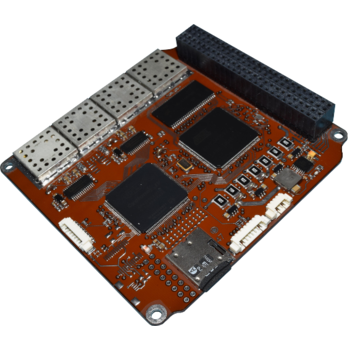
NanoCom ADS-B is a unique payload opportunity for small satellites, designed to track aircraft by receiving Automatic Dependent Surveillance – Broadcast (ADS-B) signals.
Typed specifications19 values
Discloses 2 of 13 fields engineers filter by in this category (category median 3).
- Envelope (L×W×H)
- 92.0 x 88.9 x 6.2 mm without stack connector · datasheet p.4
- Data rate
- 500 kbps USART · datasheet p.8
- RX sensitivity
- -103 dBm NB · datasheet p.4 -99 dBm WB | -10 dBm max
- Supply voltage
- 3.3 V product page -0.3 V
- Power consumption
- 170 W RX, typical · datasheet p.8 0.5 W | 400 W RX, max
- Data interface
- I2C datasheet p.4 UART console interface
- Operating temperature
- -40 °C product page -60 °C
- Connector
- SSMCX antenna connector datasheet p.4 SSMCX | PicoBlade
- Survival temperature
- -65 °C product page
- Flight heritage
- GOMX-1 mission datasheet p.9
Each value is typed with its unit and measurement condition and cites the datasheet page it was taken from. Nothing is guessed: a field that is absent here has not been published by the manufacturer. machine-extracted ✓ checked by NewSpace Market ✓ manufacturer confirmed by the manufacturer.
As published by the supplier12 lines, in the manufacturer's own wording
- Volume
- < 0.3U
- Power Consumption
- < 1 W
- Max ADS-B packages per second
- 800
- Sensitivity
- -103 dBm (NB) and -99 dBm (WB)
- Operating temperature
- -40 °C to +60 °C
- Dimensions
- 92.0 x 88.9 x 6.2 mm (without stack connector)
- Supply voltage
- 3.3 V
- Operating Temperature (2)
- -60 °C to 85 °C
- Storage Temperature
- -65 °C to 120 °C
- Junction Temperature
- 150 °C
- Voltage on I2C/USART/JTAG pins
- -0.3 V to 3.6 V
- Supply current RX
- 170 mA to 400 mA
About
The NanoCom ADS-B is a flight-proven receiver for tracking aircraft, specifically designed for small satellites. It utilizes Automatic Dependent Surveillance – Broadcast (ADS-B) technology, where aircraft determine their position via satellite navigation and periodically broadcast it. While typically received by ground stations and other aircraft, this system allows for tracking over large bodies of water where ground receivers are absent. Most civil passenger aircraft are equipped with ADS-B transponders operating at 1090MHz, transmitting information such as aircraft ID, position, and status. The NanoCom ADS-B features an on-board intelligent database that allows recorded data to be queried and searched, enabling tracking of specific flight IDs or providing regional overviews. It consists of a reconfigurable FPGA CubeSat kit compatible board, fits in less than a 0.3U volume in a nanosatellite/cubesat, and consumes less than 1 W of power. The FPGA is reconfigurable in-flight, and the system can process up to 800 ADS-B packages per second.
Documentation
Need the full ICD, test reports or a specific revision? Ask the supplier directly.