Common Space Vehicle Mechanisms
 Northrop Grumman Space Systems
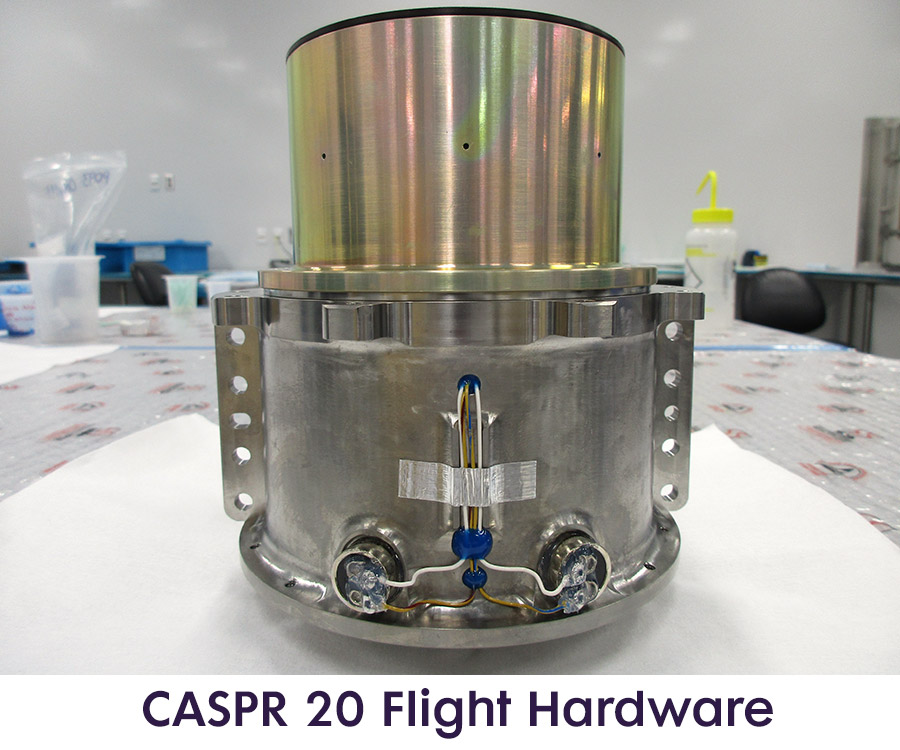
Northrop Grumman's Common Space Vehicle Mechanisms are modular actuators designed for stowing and articulating spacecraft payloads and solar arrays, with a focus on long-life, low disturbance, and precision pointing.
Typed specifications5 values
Discloses 1 of 17 fields engineers filter by in this category (category median 3).
- Mass
- 34.02–38.1 kg converted from lb · datasheet p.1
- Envelope (L×W×H)
- 3.6”dia. x 4” long CASPR 10 · datasheet p.1
- TRL
- 9 product page 9
- Flight heritage
- 40+ years, 100% mission success, over 50 missions product page
Each value is typed with its unit and measurement condition and cites the datasheet page it was taken from. Nothing is guessed: a field that is absent here has not been published by the manufacturer. machine-extracted ✓ checked by NewSpace Market ✓ manufacturer confirmed by the manufacturer.
As published by the supplier15 lines, in the manufacturer's own wording
- Flight heritage
- 40+ years, 100% mission success, over 50 missions
- Deployment actuators TRL
- 9
- Solar array drive assembly TRL
- 9
- Modular slip ring configurations
- 20 or 30 ring modules
- Modular slip ring maximum modules
- Up to four modules
- Modular slip ring maximum circuits
- 120 circuits
- Range of Travel
- <340 deg
- Mass
- 75-84 lbs
- Lifetime
- 30 (1x)(1x10^6 deg)
- Max Rate
- 1.60 deg/s
- Resolver Accuracy
- .026 deg
- Stiffness, Torsion
- 1.7 (1x10^6 in-lb/rad)
- Stiffness, Bending
- ~4.6 (1x10^6 in-lb/rad)
- Drive Torque
- 615 in-lb
- Motor Type
- 2 Phase
About
Northrop Grumman has over 40 years of experience delivering space mechanisms with 100% mission success, with their modular actuators represented on over 50 missions. These mechanisms are designed for stowing and articulating spacecraft payloads and solar arrays. Key design specializations include suitability for long-life or high-use missions, low disturbance (reducing induced vibrations for simultaneous payload operation), and precision pointing for higher altitude missions. The product line includes Deployment Actuators and Solar Array Drive Assemblies (SADA).
Deployment Actuators are mechanisms used to deploy structures or spool cables. They offer high torque output with current limit drive, or stepper motor (with micro-stepping for low disturbance) and continuous rotation. Cable winder mechanisms consist of two assemblies: a Cable Drive Module (CDM) and a Current Limiter Assembly (CLA).
Solar Array Drive Assemblies (SADA) provide transmission of solar power and electronic signals between the solar array and the spacecraft. They feature custom or modular slip ring designs for full 360-degree rotation or cable wrap designs for limited angle rotations, along with EMI shielding and electrical redundancy. SADA configurations include those with limited travel (cable management system) which provide bi-directional rotation for limited angle positioning of the solar array and absolute angular position knowledge. Continuous rotation SADA (slip ring) provides continual 360-degree rotation to maintain solar orientation and null position information via a switch ring (1X/Rev). Configurable items for SADA include modular slip rings, which are scalable in power with 20 or 30 ring modules, allowing up to four modules (maximum 120 circuits), and position feedback options like switch rings or potentiometers.
Documentation
- Common-Space-Vehicle-Mechanisms-Data-Sheet_Original file.pdf PDF source: media.northropgrumman.com ↗
Need the full ICD, test reports or a specific revision? Ask the supplier directly.