Propulsion Products and Services
 Northrop Grumman Space Systems
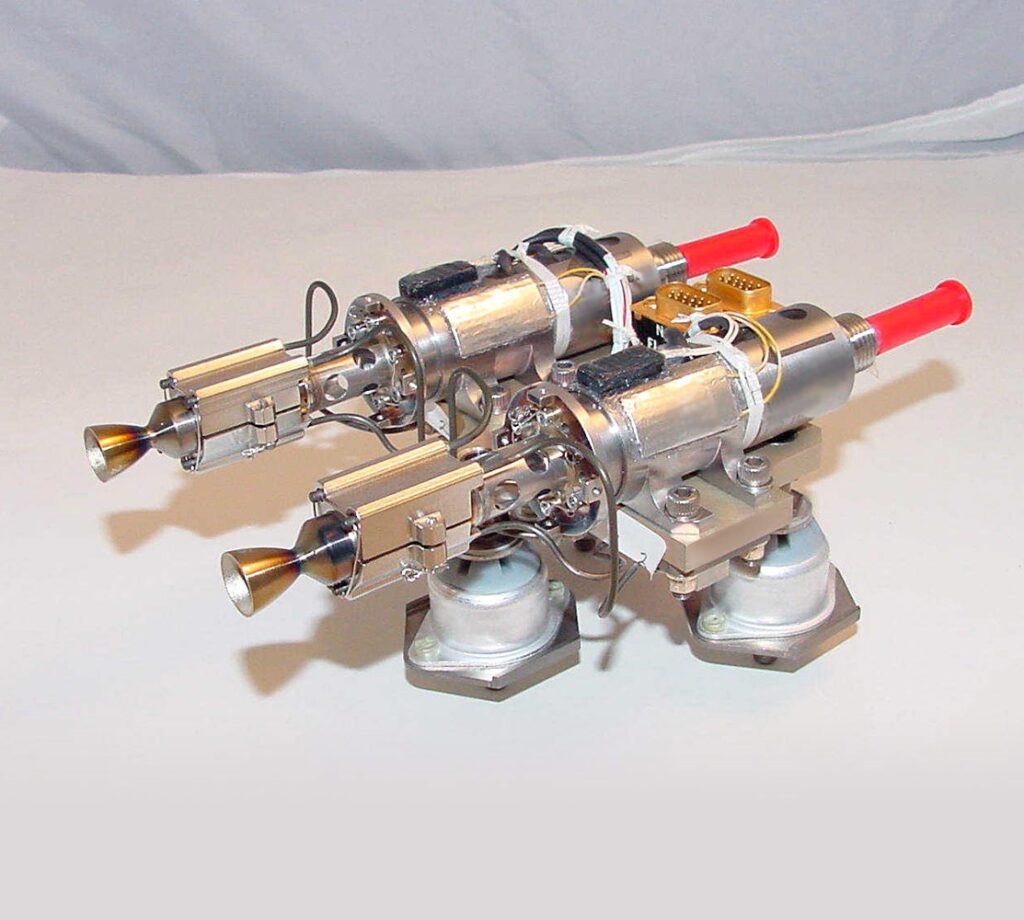
Northrop Grumman offers a comprehensive range of propulsion products and services, including flight-proven systems, bipropellant and monopropellant thrusters, and gel propulsion systems, backed by over four decades of flight experience.
Typed specifications6 values
Discloses 4 of 10 fields engineers filter by in this category (category median 3).
- Mass
- 800 g datasheet p.1
- Thrust
- 4 400 mN max · maximum operating pressure · datasheet p.1
- Envelope (L×W×H)
- 250mm x 38mm width x length · datasheet p.1
- Specific impulse
- 232 s steady state at 250 psia inlet pressure · datasheet p.1
- Propellant
- hydrazine product page
- Power consumption
- 19 W thrust valve at 28 Vdc · datasheet p.1
Each value is typed with its unit and measurement condition and cites the datasheet page it was taken from. Nothing is guessed: a field that is absent here has not been published by the manufacturer. machine-extracted ✓ checked by NewSpace Market ✓ manufacturer confirmed by the manufacturer.
As published by the supplier11 lines, in the manufacturer's own wording
- Mre-0.1 thrust
- 0.4 N @ 350 psia; Isp 216 sec; 0.5 kg; 180x38 mm
- Mre-1.0 thrust
- 4.4 N; Isp 220 sec; 0.5 kg; 190x38 mm
- Mre-4.0 thrust
- 18 N @ 600 psia; Isp 217 sec; 0.5 kg; 61x206 mm
- Mre-5.0 thrust
- 22 N @ 400 psia; Isp 232 sec; 0.8 kg; 250x38 mm
- Mre-15 thrust
- 86 N @ 400 psia; Isp 228 sec; 1.1 kg; 119x318 mm
- Propellant
- Hydrazine
- Mre-0.1 demonstrated life
- 34 kg throughput / 117,000 cycles
- Mre-1.0 demonstrated life
- 122 kg throughput / 421,000 cycles
- Mre-4.0 demonstrated life
- 249 kg throughput / 507,000 cycles
- Mre-5.0 demonstrated life
- 456 kg throughput / 340,000 cycles
- Mre-15 demonstrated life
- 970 kg throughput / 105,561 cycles
About
Northrop Grumman provides a complete range of propulsion products and services for developing and producing high-quality flight hardware. Their propulsion products have demonstrated exceptional reliability over four decades of flight experience, with no spacecraft, launcher, or missile failures attributed to a Northrop Grumman-built propulsion system. Specifically, their bipropellant or gel rocket engines have never suffered a flight failure across more than 100 separate missions for various programs. The current product line includes flight-proven systems, bipropellant engines and thrusters, monopropellant thrusters, and gel propulsion systems. They also offer a line of standard components designed to provide optimal performance, high reliability, and cost-effectiveness. Beyond hardware, Northrop Grumman’s propulsion-related services encompass engineering, fabrication, integration, testing, and documentation. Their experienced engineering staff specializes in the design, analysis, and testing of propulsion components and integrated systems, complemented by a chemistry technology capability that provides extensive analytical support for propellant and rocket materials development.
Documentation
- MRE-01_MonoProp_Thruster.pdf PDF source: www.northropgrumman.com ↗
- MRE-10_MonoProp_Thruster.pdf PDF source: www.northropgrumman.com ↗
- MRE-40_MonoProp_Thruster.pdf PDF source: www.northropgrumman.com ↗
- MRE-50_MonoProp_Thruster.pdf PDF source: www.northropgrumman.com ↗
- MRE-15_MonoProp_Thruster.pdf PDF source: www.northropgrumman.com ↗
Need the full ICD, test reports or a specific revision? Ask the supplier directly.