135W Dual Articulated Deployable Solar Array
 Pumpkin, Inc.
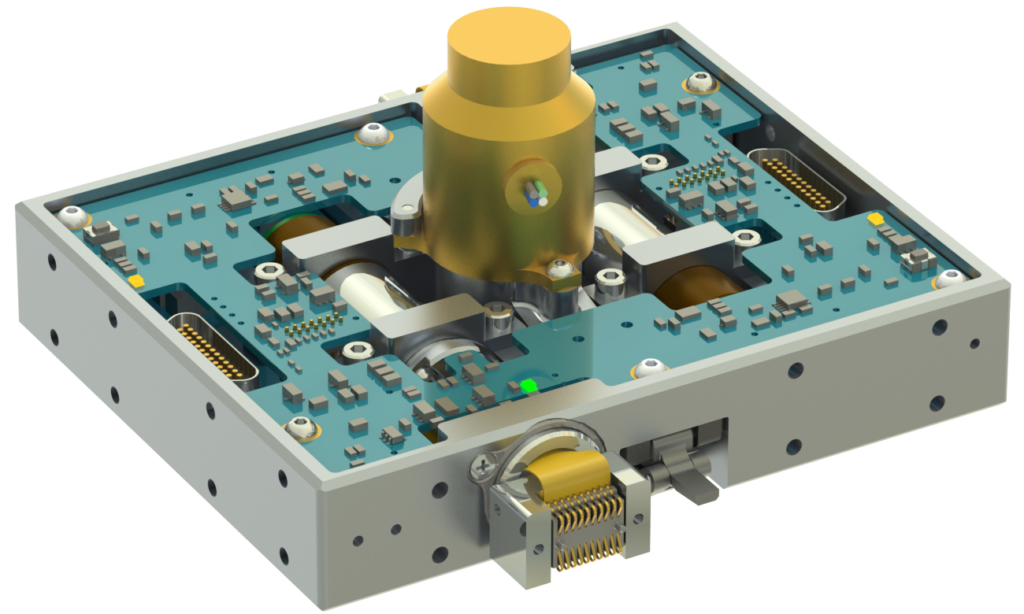
A compact, deployable 135W solar array with two single-motor Solar Array Drive Assemblies (SADAs) driving independently steerable 67W triple-panel solar arrays, compatible with Pumpkin's SUPERNOVA 12U structure.
Typed specifications6 values
Discloses 1 of 12 fields engineers filter by in this category (category median 3).
- Output power (BOL)
- 135 W product page 67 W
- Envelope (L×W×H)
- 227.3 cm x 36.5 cm x 23.9 cm product page
- Form factor (as printed)
- ~198812 cm^3 product page
- Power consumption
- 135 W product page 67 W
Each value is typed with its unit and measurement condition and cites the datasheet page it was taken from. Nothing is guessed: a field that is absent here has not been published by the manufacturer. machine-extracted ✓ checked by NewSpace Market ✓ manufacturer confirmed by the manufacturer.
As published by the supplier12 lines, in the manufacturer's own wording
- Mass of array and sadas
- ~4360 g (31 W/kg)
- Bounding volume (12U)
- ~198812 cm^3
- Bounding dimensions
- 227.3 cm x 36.5 cm x 23.9 cm
- Cog & moi
- Available on request
- String configuration option 1
- 3x 7S3P per half
- String configuration option 2
- 3x 21S1P per half
- Total power
- 135 W
- Power per half
- 67 W
- Range of motion
- +/-200 degrees
- Articulation speed range
- 0.15 deg/day to 25 deg/sec
- H-bridge
- JANS rad-hard H-bridge circuit designed by GSFC (optional)
- Compatible structure
- Pumpkin SUPERNOVA 12U structure / Maverick 12U dispenser tabbed structures
About
The 135W Deployable Articulated Solar Array (DASA) is flight-qualified, space-proven hardware providing a compact, deployable solar array with two single-motor SADAs, each driving an independently steerable 67W triple-panel solar array. It is compatible with the Pumpkin SUPERNOVA 12U structure designed for tabbed dispensers, and can be adapted to other structures.
The two halves of the array are completely independent. Each half’s three independent solar strings’ POS and RTN nodes are wired fully redundantly, pass through its SADA, and appear on MDM-style connectors inside the SADA body. The three strings per half are available in one of two configurations: 3x 7S3P or 3x 21S1P. Each solar array provides a temperature sensor embedded into each solar panel. The deployment mechanism is integrated into the SADA and uses a high-reliability resettable pin puller with redundant control activation.
Each SADA unit is independently responsible for releasing and articulating its connected three-solar-panel array. A hard internal stop prevents overrotation without exceeding the motor’s torque limit. Neither slip rings nor discrete wires are used for array wiring; despite +/-200 degrees of allowable rotation, there is minimal stress on the array POS and RTN signal feeds through the SADA’s rotating yoke. Array release and articulation are controlled via a diverse command set including Enable/Arm/Fire commands for the release mechanism, relative and absolute moves based on steps or angles, full- and quarter-stepping modes, hold and release modes, speeds from 0.15deg/day to 25deg/sec, a range of motion of +/-200 degrees, a homing command, and full telemetry of current position, status and solar panel temperatures. Each SADA is available with a JANS rad-hard H-bridge circuit designed by GSFC, and can be configured to permit ‘direct GPIO’ control of the H-bridge in addition to commanded control via the SADA’s SupMCU processor.
Includes two single-motor SADAs with release mechanisms (customer specifies desired configuration A-D), two three-panel deployable solar arrays (each in 3x 7S3P or 3x 21S1P string configurations), four small ‘goal post’ constraints to attach to structure opposite SADA locations, and a single flying-lead 25-pin harness per SADA. Does not include the 12U or other structure. Compatible with 12U tabbed structures designed for the Maverick 12U dispenser, and may be compatible with other 12U dispensers depending on available internal volume and dimensions. Pumpkin’s PMDSAS solar panel/solar array technology has a 100% success rate in LEO and GTO orbits. CAD models are available to customers under NDA.
Documentation
No public datasheet yet — request the datasheet / ICD from the supplier.