220W Deployable Clamshell Solar Array (DCSA)
 Pumpkin, Inc.
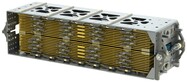
A compact 7U-stowed deployable solar array that unfolds into a 24-panel, 192-cell array delivering up to 220W of power for a wide range of spacecraft architectures.
Typed specifications26 values
Discloses 7 of 12 fields engineers filter by in this category (category median 3).
- Mass
- 5 100 g datasheet p.1 5 100 g 220W size
- Output power (BOL)
- 220 W max · datasheet p.1 110 W max · per side | 220 W max · whole array, 2 x 110W = 220W max
- Cell efficiency
- 32.2 % product page
- Envelope (L×W×H)
- 878 x 116 x 1390mm Deployed · datasheet p.1 439 x 116 x 136mm Stowed | 439 x 116 x 136mm (6.97l) stowed, 220W size
- Form factor (as printed)
- hinged clamshell halves datasheet p.1
- Deployable
- two wings datasheet p.1 yes automatic deployment
- Power consumption
- 220 W product page
- Array configuration
- other deployable clamshell: two hinged clamshell halves, dual N-pan… · datasheet p.1
- Fits satellite size
- 6U Pumpkin SUPERNOVA 6U/12U NanoSats · datasheet p.1 12U Pumpkin SUPERNOVA 6U/12U NanoSats
- Number of strings
- 12 per side, 8S12P + 8S12P · datasheet p.1
- Number of wings
- 2 dual N-panel configuration, 2 independent sides (clamshell ha… · datasheet p.1
- Flight heritage
- 100% success rate in LEO and GTO orbits (PMDSAS solar panel/array technology) product page
- Satellite class
- CubeSat datasheet p.1 nanosat 1-10 kg Applications: Nanosatellites
- Deployed size
- 878 x 116 x 1390mm 220W size · datasheet p.1
- End-of-life power
- 220 W datasheet p.1
- Cells per string
- 8 8S12P + 8S12P · datasheet p.1
- Deployment mechanism (as printed)
- Array captured within clamshell in stowed position; single customer-supplied release mechanism enables automatic deployment; mounting plate can be articulated on S/C datasheet p.1
- Hold-down and release
- customer supplied single customer-supplied release mechanism · datasheet p.1
Each value is typed with its unit and measurement condition and cites the datasheet page it was taken from. Nothing is guessed: a field that is absent here has not been published by the manufacturer. machine-extracted ✓ checked by NewSpace Market ✓ manufacturer confirmed by the manufacturer.
As published by the supplier16 lines, in the manufacturer's own wording
- Mass
- ~5050g (44W/kg)
- Bounding volume
- ~6970 cm^3
- Bounding dimensions
- 43.9 cm x 13.6 cm x 11.6 cm
- Cog & moi
- Available on request
- Stowed volume
- 7U
- Deployed configuration
- 24-panel, 192-cell, 2x 8S12P solar array in a single plane
- Solar cell BOL efficiency
- 32.2%
- Maximum peak power
- 220 W
- Electrical configuration option 1
- 8S12P & 8S12P (20V@5.5A & 20V&5.5A)
- Electrical configuration option 2
- 16S12P (40V @ 5.5A)
- Electrical configuration option 3
- 8S24P (20V @ 11A)
- Panel reduction increment
- 2 panels
- Status
- Flight Hardware | Flight Qualified | Space Proven
- Flight heritage
- 100% success rate in LEO and GTO orbits (PMDSAS solar panel/array technology)
- Includes
- Complete assembled DCSA unit in stowed configuration; redundant POS and RTN 400 mm flying leads for each half (eight wires total); solar array irradiance test results; transport case
- Excludes
- Release mechanism
About
The Deployable Clamshell Solar Array (DCSA) is flight-qualified, space-proven hardware from Pumpkin that stows in 7U of volume and deploys to a single-plane, 24-panel, 192-cell, 2x 8S12P solar array. Mechanical and electrical integration into a wide range of spacecraft architectures is simple and fast. The array uses 32.2% BoL solar cells to yield a maximum peak power of 220W. The two halves of the array are electrically independent, with each half’s solar string POS and RTN nodes wired fully redundantly and provided on flying leads; the two strings can be connected to the spacecraft’s EPS in one of three configurations: 8S12P & 8S12P, 16S12P, or 8S24P. In its stowed configuration, one of the two mirror-image clamshells is secured to the spacecraft body or a customer-supplied articulated plate, with the two clamshells secured together via a customer-supplied release mechanism (frangible bolts or pin pullers typically used) attached at the non-hinged end, which features a symmetric bolt/hole pattern. When the release mechanism is energized, the unsecured clamshell rotates through 180 degrees and the array then deploys outward. The number of solar panels can be reduced in increments of 2 if less power or mass is required. The array uses Pumpkin’s proprietary PMDSAS solar panel technology, where each solar cell incorporates an integral bypass diode, is bonded with extreme cell flatness to its panel, and each solar cell string has redundant current paths and redundant blocking diodes for paralleling. Each panel has redundant bleed resistors from the cell minus potential to chassis ground, undergoes a TVAC bakeout at over +60C for one hour, and is individually serialized and validated for solar irradiation performance. PMDSAS technology has a 100% success rate in LEO and GTO orbits. The array is completely electrically isolated from any release mechanism, which the customer must supply. Delivery includes the complete assembled DCSA unit in stowed configuration, redundant POS and RTN 400mm flying leads for each half (eight wires total), solar array irradiance test results, and a transport case; it does not include the release mechanism.
Documentation
Need the full ICD, test reports or a specific revision? Ask the supplier directly.