SRS-4
 Satlab A/S
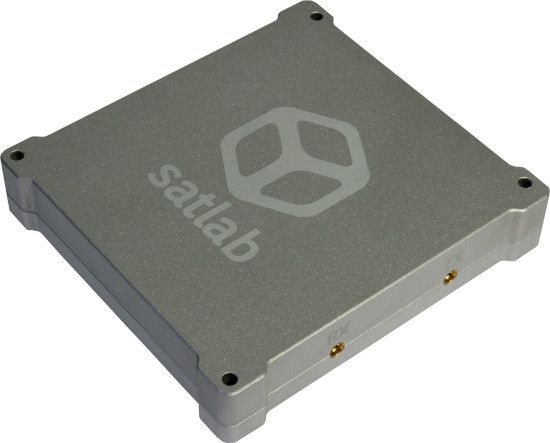
The Satlab SRS-4 is a full-duplex S-band transceiver for micro- and nano-satellites, supporting high-speed data transfer with BPSK, QPSK, and 8PSK modulation.
Typed specifications83 values
Discloses 12 of 13 fields engineers filter by in this category (category median 3).
- Frequency band
- S datasheet p.1
- Mass
- 253 g datasheet p.1
- Frequency range
- 2 025–2 110 MHz Receive · datasheet p.1 2 025–2 110 MHz RX | 2 200–2 290 MHz Transmit | 2 200–2 290 MHz TX
- Envelope (L×W×H)
- 93.0 mm × 87.2 mm × 18.0 mm datasheet p.1
- TX RF output power
- 0.1 W min · adjustable 20 dBm to 33 dBm · datasheet p.1 2 W max · adjustable 20 dBm to 33 dBm | 0.1–2 W | 0.1–2 W Adjustable output power
- Data rate
- 9 560 kbps theoretical throughput, QPSK 5 MBd, CRC only, 217-byte payload · datasheet p.15 14 340 kbps TX theoretical throughput, 8PSK 5 MBd, CRC only, 217-byte pay… | 5 000 kbps max · RX symbol rate, 100 kBd to 5000 kBd | 5 000 kbps max · TX symbol rate, 100 kBd to 5000 kBd
- RX sensitivity
- -122 dBm <1 % PER, 100 kBd BPSK · datasheet p.1 -112.5 dBm <1 % PER, BPSK 1000 kBd, CC+RS, 2067.5 MHz, 20 °C | -105.5 dBm <1 % PER, BPSK 5000 kBd, CC+RS, 2067.5 MHz, 20 °C | -100.5 dBm <1 % PER, QPSK 5000 kBd, CC, 2067.5 MHz, 20 °C
- Modulation
- BPSK/QPSK Receive · datasheet p.1 BPSK/QPSK/8PSK Transmit | BPSK TX and RX | 8PSK TX only | QPSK Receive +4
- Supply voltage
- 5.1–28.8 V datasheet p.1 5.1–28.8 V Input voltage
- Power consumption
- 1.5 W nom. · Idle · datasheet p.17 0.16 W Additional input power for Ethernet enabled | 0.06 W Additional input power for RS-422 enabled | 1.5 W Input power (Idle) | 1.5 W Input power (RX) +8
- Data interface
- CAN CAN-bus bitrate Up to 1 Mbit/s · datasheet p.1 UART Debug-UART (TTL), EGSE connector | Ethernet Ethernet bitrate 100 Mbit/s, full-duplex | LVDS prepared for future support | RS-422 RS-422 bitrate Up to 12.5 Mbit/s, full-duplex +2
- Operating temperature
- -40–85 °C Operating temperature RX · datasheet p.1 -40–70 °C Operating temperature TX | -40–85 °C RX / Idle
- TRL
- 9 product page
- Function
- transceiver datasheet p.1
- Link use
- payload data downlink high-speed data transfer · datasheet p.1
- Link protocol
- CSP CAN-bus and RS-422 interfaces · datasheet p.1 CCSDS CCSDS 131.0-B-3 TM Synchronization and Channel Coding | IP (Ethernet over RF) Ethernet interface | IP (Ethernet over RF) IP frames forwarded over the space link | CSP
- RF connector
- SMP RX, full detent · datasheet p.3 SMP TX and RX antennas | SMP TX, full detent
- Power draw, receive
- 1.5 W nom. · RX, 5 MBd, 6 V input, 20 °C · datasheet p.1
- Power draw, transmit
- 10.8 W nom. · TX, 5 MBd, 33 dBm output, 6 V input, 20 °C · datasheet p.1
- Connector
- P1-P3: Harwin Gecko latching connectors; RF: SMP (full detent) datasheet p.3
- Survival temperature
- -40–85 °C Storage · datasheet p.16
- Flight heritage
- since 2021 product page
- Satellite class
- CubeSat datasheet p.3 nanosat 1-10 kg micro- and nano-satellites | microsat 10-100 kg micro- and nano-satellites
- Duplex
- full datasheet p.1
- Channel coding (FEC)
- Reed-Solomon (255,223) · datasheet p.12 concatenated RS + convolutional CRC + RS + CC | convolutional (Viterbi) r=1/2, constraint length 7
- Encryption
- AES-256-GCM datasheet p.1
- Frequency tunable in orbit
- yes RX and TX local oscillators programmed independently; propert… · datasheet p.4
- Board format
- PC/104 PC/104 form factor aluminum enclosure · datasheet p.1
- Additional power (option)
- 0.16 W nom. · additional for Ethernet enabled · datasheet p.17 0.16 W Additional input power for Ethernet enabled | 0.06 W Additional input power for RS-422 enabled | 0.06 W nom. · additional for RS-422 enabled
Each value is typed with its unit and measurement condition and cites the datasheet page it was taken from. Nothing is guessed: a field that is absent here has not been published by the manufacturer. machine-extracted ✓ checked by NewSpace Market ✓ manufacturer confirmed by the manufacturer.
As published by the supplier13 lines, in the manufacturer's own wording
- Transmitter frequency
- 2200 to 2290 MHz
- Transmitter modulation
- BPSK/QPSK/8PSK, 100 kBd to 5 MBd
- Transmitter power
- 20 to 33 dBm
- Receiver frequency
- 2025 to 2110 MHz
- Receiver modulation
- BPSK/QPSK, 100 kBd to 5 MBd
- Receiver sensitivity
- -122 dBm (<1% PER, 100 kBd BPSK)
- Supply voltage
- 5.1 to 28.8 V
- Typical power consumption (6 V input, 20℃)
- RX: 1.5 W (5 MBd) RX+TX: 10.8 W (5 MBd, 33 dBm output)
- Operating temperature
- RX: -40℃ to +85℃ TX: -40℃ to +70℃
- Dimensions
- 93.0 mm × 87.2 mm × 17.5 mm
- Mass
- 253 g
- Flight heritage
- since 2021
- TRL
- 9
About
The Satlab SRS-4 is a full-duplex S-band transceiver specifically designed for high-speed data transfer applications on micro- and nano-satellites. It operates within the ITU space operations S-band frequencies and supports BPSK, QPSK, and 8PSK modulation schemes. The transceiver incorporates CCSDS recommended channel coding, which facilitates integration with both independent and commercial ground station networks. The SRS-4 has a proven flight heritage dating back to 2021, with over 100 units successfully delivered to customers globally for various space missions. It boasts a Technology Readiness Level (TRL) of 9, indicating it is fully qualified and operational in its intended environment. Custom hardware and software requests can often be accommodated.
Documentation
Need the full ICD, test reports or a specific revision? Ask the supplier directly.