ST-40 Hall Thruster
 Space Electric Thruster Systems (SETS)
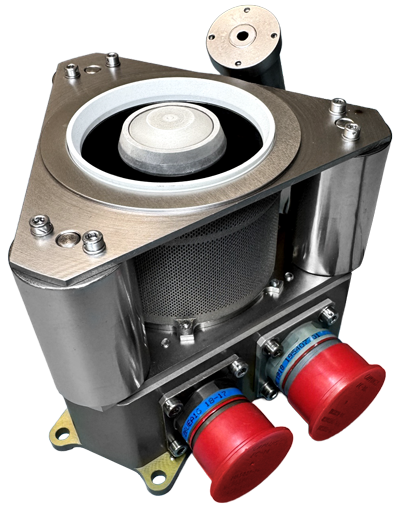
The ST-40 Hall Thruster is a low-cost, multi-propellant electric propulsion solution designed for LEO-GEO satellites and constellation missions, offering flexibility in thrust and specific impulse.
Typed specifications26 values
Discloses 9 of 10 fields engineers filter by in this category (category median 3).
- Propulsion family
- electric datasheet p.1
- Mass
- 1.4 kg including two cathodes · datasheet p.2
- Thrust
- 13 mN min · datasheet p.2 36 mN max | 13–36 mN | 36 mN max
- Envelope (L×W×H)
- 156 x 130 x 105 datasheet p.2
- Specific impulse
- 1 000 s min · datasheet p.2 1 750 s max | 1 000–1 750 s
- Total impulse
- 300 000 N·s max · datasheet p.2
- Propellant
- Xenon datasheet p.2 Krypton
- Power consumption
- 250 W min · datasheet p.1 600 W max | 250–600 W | 250–600 W
- TRL
- 9 previous configuration of the ST-40 launched into orbit in 2022 · datasheet p.1
- Thruster technology
- Hall effect datasheet p.1
- Power at thrust
- 250 W min · total power consumption · datasheet p.2 600 W max · total power consumption | 250–600 W total power consumption
- Satellite class
- microsat 10-100 kg LEO to GEO satellites · datasheet p.1 smallsat 100-500 kg LEO to GEO satellites | large >500 kg LEO to GEO satellites | GEO LEO to GEO satellites
Each value is typed with its unit and measurement condition and cites the datasheet page it was taken from. Nothing is guessed: a field that is absent here has not been published by the manufacturer. machine-extracted ✓ checked by NewSpace Market ✓ manufacturer confirmed by the manufacturer.
As published by the supplier11 lines, in the manufacturer's own wording
- Consumption power
- 250-600 W
- Thrust
- 13-36 mN (0.013-0.036 N)
- Specific impulse
- 1000-1750 s
- Efficiency
- Up to 46%
- Propellant
- Xenon, Krypton
- Power
- 250 – 600 W
- Total Impulse
- Up to 300 kN•s
- Mass
- 1.4 kg
- Dimensions
- 156 x 130 x 105 mm
- Cathode type
- Heated hollow cathode(s)
- TRL Level
- 9
About
The ST-40 Hall Thruster is engineered as a key component for propulsion systems in LEO-GEO satellites. Its design focuses on enabling mass manufacturing, positioning it as an economical choice for satellite constellations. A significant feature of the ST-40 is its multi-propellant capability, which allows it to be adapted for various satellite missions. This versatility extends to providing flexibility in both thrust and specific impulse, catering to diverse operational requirements in space. The thruster is part of a broader family of electric propulsion systems, including the SPS-100, SPS-40, SPS-25, ST-100, and ST-25, as well as power processing units like the PPU-500 and PPU-200, and the XFS mass flow controller, all designed for space applications.
Documentation
Need the full ICD, test reports or a specific revision? Ask the supplier directly.