MicroST
 Solar MEMS Technologies
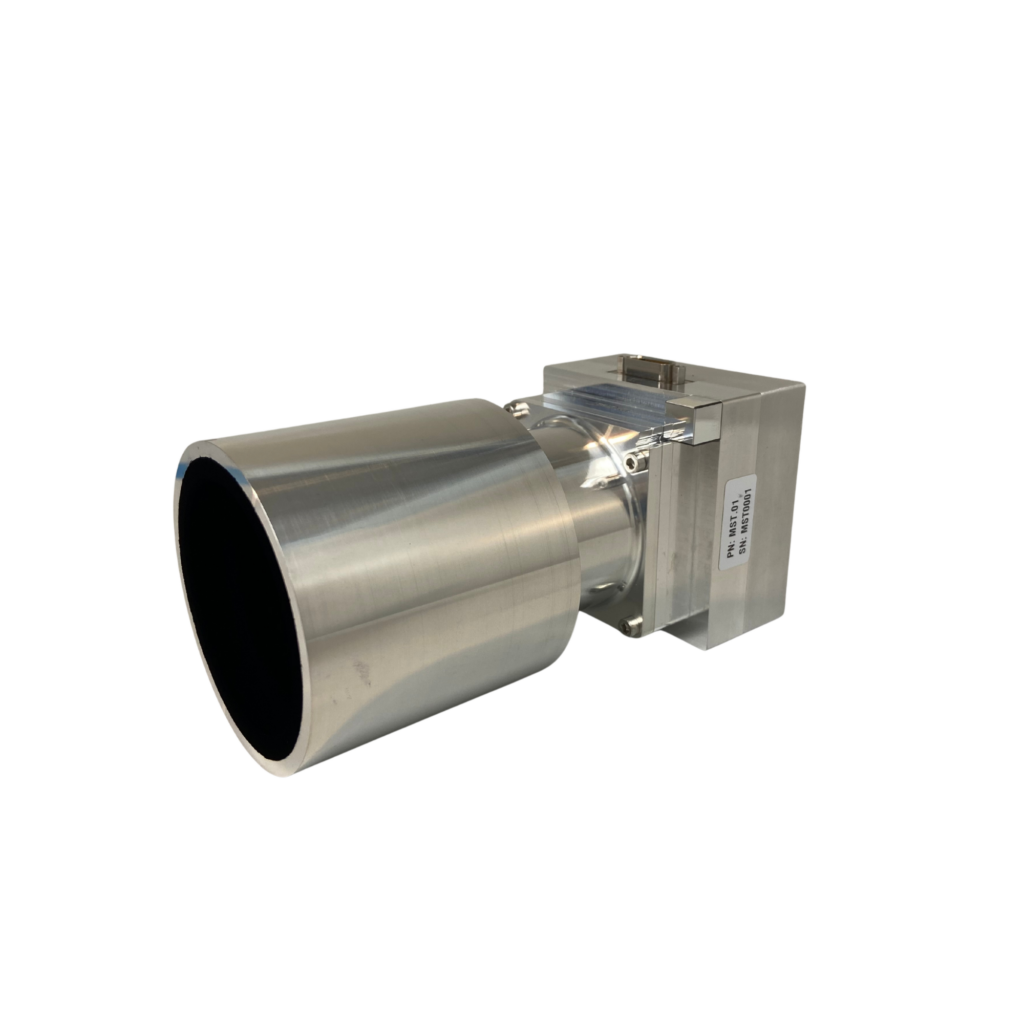
High-precision star tracker for microsatellites with <6 arcsec XY accuracy, multi-camera support and LEO/MEO/GEO qualification.
Typed specifications55 values
Discloses 10 of 12 fields engineers filter by in this category (category median 8).
- Accuracy, cross-boresight
- 6 arcsec datasheet p.1 6 arcsec max
- Mass
- 600 g datasheet p.1
- Accuracy, about boresight (roll)
- 48 arcsec datasheet p.1 48 arcsec max
- Envelope (L×W×H)
- 70 x 70 x 150 mm datasheet p.1 70 x 70 x 150 mm Volume
- Update rate
- 5 Hz datasheet p.1 5 Hz 5 Hz, 10 Hz | 10 Hz | 10 Hz 5 Hz, 10 Hz
- Max tracking rate
- 0.5 °/s Nominal · datasheet p.1 2.5 °/s Angular rate, Without LiS | 3.5 °/s Max | 2.5 °/s Without LiS | 3.5 °/s max · Angular rate, Max. +1
- Sun exclusion angle
- 36 ° datasheet p.1 36 ° < | 36 ° max · < 36 deg
- Lost-in-space acquisition time
- 2 s <, from LiS · datasheet p.1 2 s max · < 2 s from LiS
- Supply voltage
- 5 V nom. · datasheet p.1 5 V
- Power consumption
- 3.5 W Nominal · datasheet p.2 3.5 W
- Data interface
- CAN CAN bus (upon request) · datasheet p.1 RS-422 RS422 | RS422 upon request | CAN upon request | Ethernet upon request
- Operating temperature
- -30 °C Operating temperature · datasheet p.1 -30–50 °C | 50 °C Operating temperature
- Radiation tolerance (TID)
- 30 krad datasheet p.1 30 krad TID hardness EEE
- Design lifetime
- 12 years >, LEO · datasheet p.1 12 years min · > 12 years LEO
- TRL
- 8 CURRENT TRL of MICROST: 8; expected TRL 9 December 2026 · datasheet p.1
- Export status
- ITAR-free ITAR FREE · datasheet p.1
- Configuration
- single unit standalone configuration by default; star camera version with… · datasheet p.1
- Limiting star magnitude
- 6.5 Mv 6.5 - 7 · datasheet p.1 6.5 Mv Star magnitude limit 6.5 - 7 | 7 Mv 6.5 - 7 | 7 Mv Star magnitude limit 6.5 - 7
- Survival temperature
- -40 °C Qualification temperature · datasheet p.1 60 °C Qualification temperature
- Random vibration
- 20 g RMS datasheet p.1 20.1 g RMS
- Satellite class
- microsatellites datasheet p.1 microsat 10-100 kg Star tracker for microsatellites
- Shock qualification
- 1 500 g SRS @ 2000 Hz · datasheet p.1
- Detector
- CMOS datasheet p.1
- Volume (with baffle)
- 0.88 U datasheet p.2
- Earth exclusion angle
- 25 ° max · < 25 deg · datasheet p.1
Each value is typed with its unit and measurement condition and cites the datasheet page it was taken from. Nothing is guessed: a field that is absent here has not been published by the manufacturer. machine-extracted ✓ checked by NewSpace Market ✓ manufacturer confirmed by the manufacturer.
As published by the supplier13 lines, in the manufacturer's own wording
- Type
- Star tracker for microsatellites
- Interface
- Digital
- Model
- EM and FM
- Sun exclusion angle
- <32°
- Supply voltage
- 5 V, <6 W
- Temperature — qualification
- -30°C to +70°C
- Temperature — nominal
- -20°C to +50°C
- Temperature — survival
- -45°C to +85°C
- Vibration — sine
- 20 g @ 10–100 Hz
- Vibration — random
- 20.1 gRMS
- Vibration — shock
- 1500 g SRS @ 2 kHz
- Pointing accuracy
- XY (3σ): <6 arcsec; Z (3σ): <48 arcsec
- Communication
- RS422, CAN bus or Ethernet (upon request)
About
The MicroST is a high-precision attitude determination star tracker from Solar MEMS designed for microsatellite missions. It captures images of a star field using an internal CMOS sensor and identifies stars and constellations to determine satellite pointing with very high accuracy. Like all Solar MEMS star trackers, it is a plug-and-play system requiring no additional electronics. The modular architecture allows standalone and multi-camera configurations, making MicroST adaptable for a wide range of microsatellite missions in LEO, MEO and GEO. Its compact design, high refresh rate and autonomous operation enable precise Guidance, Navigation and Control (GNC) capabilities. Available as Engineering Model (EM) and Flight Model (FM), with RS422, CAN bus or Ethernet communications available on request.
Documentation
Need the full ICD, test reports or a specific revision? Ask the supplier directly.