Standard Micro Propulsion System (MiPS)
 VACCO Industries
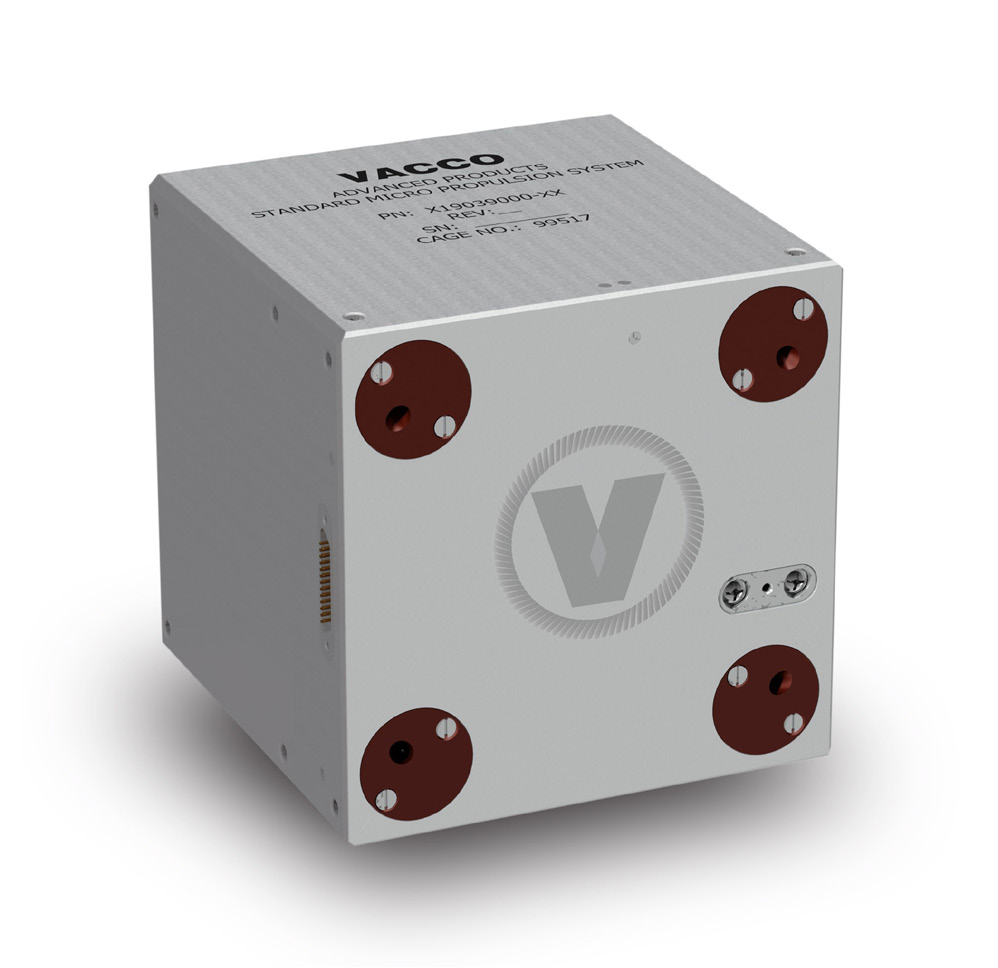
VACCO's Standard MiPS is a modular cold gas propulsion system providing attitude control and delta-V for CubeSats and SmallSats, flight-proven on the Mars Cube One (MarCO) mission.
Typed specifications57 values
Discloses 6 of 11 fields engineers filter by in this category (category median 3).
- Propulsion family
- cold-gas datasheet p.1
- Mass
- 639 g dry mass, X19039000-01 · datasheet p.2 799 g dry mass, X19039000-02 | 956 g dry mass, X19039000-03 | 1.14 kg dry mass, X19039000-04 | 639 g MiPS Dry Mass, X19039000-01 +3
- Thrust
- 25 mN each thruster · datasheet p.1 25 mN per thruster
- Envelope (L×W×H)
- 100 x 100 x 36 (X19039000-01) datasheet p.2 100 × 100 × 36 X19039000-01, system height 36 mm | 100 × 100 × 70 X19039000-02, system height 70 mm | 100 × 100 × 100 X19039000-03, system height 100 mm | 100 × 100 × 144 X19039000-04, system height 144 mm +3
- Total impulse
- 82 N·s X19039000-01 · datasheet p.2 219 N·s X19039000-02 | 336 N·s X19039000-03 | 515 N·s X19039000-04
- Propellant
- R236fa datasheet p.1
- Supply voltage
- 9–12.6 V Operating · datasheet p.1
- Power consumption
- 12 W peak · datasheet p.1 1 W Standby, Max. | 12 W Thruster Operating (4 thrusters), Max. | 12 W Warmup, Max. | 1 W max · communication and health monitoring +4
- Data interface
- RS-422 datasheet p.1
- Operating temperature
- -15–55 °C datasheet p.1
- Thruster technology
- cold gas datasheet p.1
- Thrusters in the unit
- 4 datasheet p.1
- Propellant mass (full load)
- 209 g X19039000-01 · datasheet p.2 209 g X19039000-01, R236fa liquid mass | 557 g X19039000-02 | 557 g X19039000-02, R236fa liquid mass | 857 g X19039000-03 +3
- Feed / tank pressure
- 6.89 bar MEOP/MDP · datasheet p.1 6.89 bar MEOP/MDP (100 psia)
- Power at thrust
- 12 W max · Thruster Operating Power (4 thrusters) · datasheet p.1
- Survival temperature
- -30–55 °C datasheet p.1 -30–55 °C non-operating
- Satellite class
- CubeSat datasheet p.1 microsat 10-100 kg
- Dry mass
- 639 g X19039000-01 · datasheet p.2 799 g X19039000-02 | 956 g X19039000-03 | 1.14 kg X19039000-04
Each value is typed with its unit and measurement condition and cites the datasheet page it was taken from. Nothing is guessed: a field that is absent here has not been published by the manufacturer. machine-extracted ✓ checked by NewSpace Market ✓ manufacturer confirmed by the manufacturer.
As published by the supplier15 lines, in the manufacturer's own wording
- Performance density
- 228 to 358 N-sec/L
- Thruster count
- Four 25 mN cold gas thrusters
- Total impulse (scalable)
- 82 to 515 N-sec
- Thrust angle ("B")
- 0° to 30°
- Max pressure
- <100 psia (Range Safety Friendly design)
- Pressure boundary
- Leak before burst
- Digital interface
- Integral Microcontroller with RS422 digital interface
- Radiation tolerance
- Radiation resistant components with integral shielding
- Software
- Robust, sophisticated flight-proven software
- Input power
- Accepts unregulated input power
- Power (comms/health monitoring)
- <1 W required for communication and health monitoring
- Peak power
- 12 W peak power
- Valves
- Frictionless space quality valves
- Structure
- All-welded, high strength structure
- Component integration
- Fully manifolded components (no tubing)
About
The Standard Micro Propulsion System (MiPS) is a highly reliable, intelligent, attitude and delta-V propulsion system developed by VACCO for CubeSat and SmallSat applications. It draws on components and manufacturing methods derived from 60 years of space experience, including two systems that powered the highly successful Mars Cube One (MarCO) CubeSats. The system features four 25mN cold gas thrusters, with bolt-on nozzles that facilitate a wide range of fixed thrust directions, including ‘B’ thrust angles from 0° to 30°. The modular design can be scaled from 82 to 515 N-sec Total Impulse, with custom versions also available, and achieves a performance density of 228 to 358 N-sec/Liter. The design is range safety friendly, operating below 100 psia, and incorporates a leak-before-burst pressure boundary. It includes an integral microcontroller with an RS422 digital interface, radiation resistant components with integral shielding, and robust, sophisticated flight-proven software. The system accepts unregulated input power, requiring less than 1W for communication and health monitoring and up to 12W peak power. Construction uses frictionless space quality valves, an all-welded high strength structure, and fully manifolded components with no tubing.
Documentation
Need the full ICD, test reports or a specific revision? Ask the supplier directly.