VACCO Check and Relief Valves
 VACCO Industries
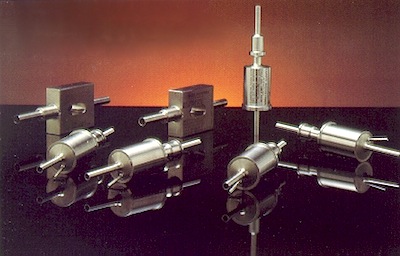
Propulsion check valves and non-propulsive relief valves providing over 40 years of flight-proven overpressure and backflow protection.
Typed specifications51 values
Discloses 3 of 8 fields engineers filter by in this category (category median 2).
- Mass
- 170 g V0D10840-01 1/4" low pressure check valve; 0.38 lbm · datasheet p.3 136 g V0E10495-01 1/4" series redundant check valve; 0.30 LB | 20 g V1D10856-02 3/8" low pressure check valve
- Max operating pressure (MEOP)
- 17.93 bar V0E10495-01 1/4" series redundant check valve; Operating Pres… · datasheet p.5 37.92 bar V1D10856-02 3/8" low pressure check valve; Operating Pressure… | 17.24 bar max · V0D10840-01 1/4" low pressure check valve; Operating Pressure… | 56.88 bar
- Material (wetted or shell)
- titanium (Ti-6Al-4V) V0D10840-01 1/4" low pressure check valve; features list: All… · datasheet p.3 stainless steel (304L or 316L) V0D10840-01 1/4" low pressure check valve; Stainless Steel Bo… | titanium (Ti-6Al-4V) V0E10495-01 1/4" series redundant check valve; All Titanium B… | titanium (Ti-6Al-4V) V1D10856-02 3/8" low pressure check valve; titanium welded unit
- Operating temperature
- 19–120 °C V0D10840-01 1/4" low pressure check valve · datasheet p.3 10–170 °C V0E10495-01 1/4" series redundant check valve | -170–45 °C V1D10856-02 3/8" low pressure check valve
- Component
- valve V0D10840-01 1/4" low pressure check valve · datasheet p.3 valve V0E10495-01 1/4" series redundant check valve | valve V1D10856-02 3/8" low pressure check valve | valve | valve
- Valve type
- check valve V0D10840-01 1/4" low pressure check valve · datasheet p.3 check valve V0E10495-01 1/4" series redundant check valve | check valve V1D10856-02 3/8" low pressure check valve
- Filtration rating (absolute)
- 40 µm V0D10840-01 1/4" low pressure check valve; Inlet Filter Rating · datasheet p.3
- Cycle life
- 5 000 V1D10856-02 3/8" low pressure check valve; poppet cycles · datasheet p.1
- Survival temperature
- -40–45 °C V1D10856-02 3/8" low pressure check valve; Non-operating Temp… · datasheet p.1
- Random vibration
- 12.1 g RMS V0D10840-01 1/4" low pressure check valve; Acceptance Level @… · datasheet p.3 17.1 g RMS V0D10840-01 1/4" low pressure check valve; Qualification Leve… | 14.4 g RMS V0E10495-01 1/4" series redundant check valve; Acceptance Lev… | 17.3 g RMS V0E10495-01 1/4" series redundant check valve; Qualification …
- Flight heritage
- V1D10856-02 3/8" low pressure check valve: 10 Years of Successful Flight Heritage; developed for the Mars Ascent program datasheet p.1
- Missions flown
- 10 datasheet p.1
- Proof pressure
- 56.88 bar datasheet p.1 25.86 bar V0D10840-01 1/4" low pressure check valve | 41.37 bar V0E10495-01 1/4" series redundant check valve | 56.88 bar V1D10856-02 3/8" low pressure check valve | 25.85 bar +1
- Burst pressure
- 75.84 bar datasheet p.1 68.95 bar V0D10840-01 1/4" low pressure check valve | 110.32 bar V0E10495-01 1/4" series redundant check valve | 75.84 bar V1D10856-02 3/8" low pressure check valve | 68.95 bar +1
- Port fitting
- V0E10495-01 1/4" series redundant check valve: 2X Ø .250-.253, .018-.022 WALL datasheet p.5
- External leak rate (as printed)
- V1D10856-02 3/8" low pressure check valve: External <1 X 10⁻⁶ sccs GHe; Internal 100 scch GHe @ 5 psid datasheet p.1 V0D10840-01 1/4" low pressure check valve: External <1 X 10⁻⁶ sccs GHe; Internal 8.3 X 10⁻⁶ sccs GHe | V0E10495-01 1/4" series redundant check valve: Internal @ 2 psid <10 scch GHe; External <1 x 10⁻⁶ sccs GHe
- Rated mass flow
- 0.7 mg/s V1D10856-02 3/8" low pressure check valve; GHe · datasheet p.1
- Pressure drop at rated flow
- 0.689 bar V1D10856-02 3/8" low pressure check valve · datasheet p.1 0.276 bar max · V0D10840-01 1/4" low pressure check valve; @ rated flow 1.87 … | 0.303 bar max · V0E10495-01 1/4" series redundant check valve; @ rated flow 2…
Each value is typed with its unit and measurement condition and cites the datasheet page it was taken from. Nothing is guessed: a field that is absent here has not been published by the manufacturer. machine-extracted ✓ checked by NewSpace Market ✓ manufacturer confirmed by the manufacturer.
As published by the supplier15 lines, in the manufacturer's own wording
- Configurations
- Single, parallel, series-redundant check valves; single-seat non-propulsive relief valves
- Application
- Bi-propellant and dual-mode propulsion systems
- Flight heritage
- Boeing HS601/HS702, Star-2, FS-1300, DS2000, GPS III, Cygnus, HTV, Solar Dynamics Observatory
- Operating Pressure
- 550 psia
- Operating temperature
- -170° to +45° C
- Lifetime
- 5,000 Poppet Cycles
- Proof Pressure
- 825 psia
- Burst Pressure
- 1,100 psia
- Flow
- .7 grams/second GHe
- Pressure Drop
- 10 psid
- Cracking Pressure
- 7.5 psid
- Reseat Pressure
- 1.0 psid
- External Leakage
- <1 X 10⁻⁶ sccs GHee
- Internal Leakage
- 100 scch GHe @ 5 psid
- Non-operating Temperature
- -40° to +45° C
About
For over 40 years VACCO check valves and relief valves have protected system performance on numerous commercial and scientific satellites. Check valves are offered in single, parallel, and series-redundant configurations for bi-propellant and dual-mode propulsion systems. Relief valves are single-seat, non-propulsive designs that have also been integrated with regulators to support human spaceflight. VACCO check valves are standard equipment on leading communications satellite platforms (Boeing HS601/HS702, Orbital Sciences Star-2, Space Systems/Loral FS-1300, Mitsubishi Electric DS2000) and fly on GPS III, NASA’s Solar Dynamics Observatory, the Orbital Sciences/NASA Cygnus resupply vehicle, and Japan’s H-II Transfer Vehicle.
Documentation
Need the full ICD, test reports or a specific revision? Ask the supplier directly.