ASAT II Gateway System
 SpaceBridge Inc.
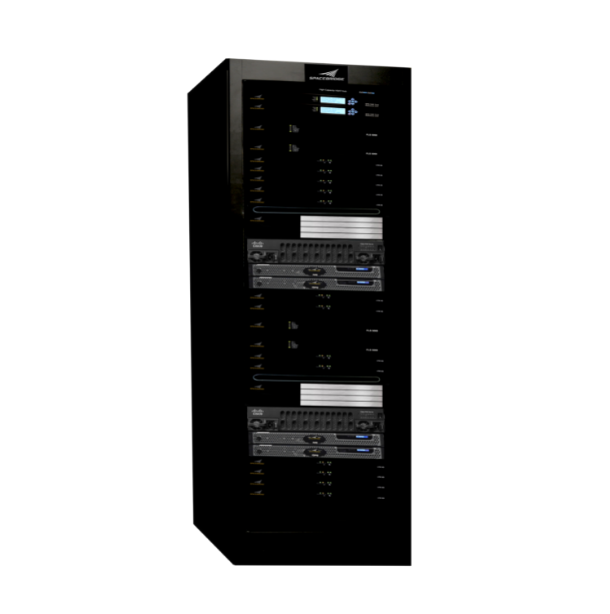
SpaceBridge's all-in-one, multi-service satellite ground gateway platform that unifies consumer VSAT, SOTM, high-capacity trunking, and tactical-defence services under one NMS with a shared bandwidth pool.
Technical specifications
- Architecture topologies
- Multi-gateway, multi-satellite / multi-beam support
- Forward link waveform
- DVB-S2/S2X ACM, GSE encapsulation, QPSK up to 256APSK LDPC/BCH, Annex M (Time Slicing) up to 32 TSNs
- Forward link channel rate
- Up to 500 MHz forward link carriers per cluster
- Forward link capacity
- Up to 2.5 Gbps per carrier (5% roll-off)
- Forward link channel spacing
- 5%, 10%, 20%, 25% or 35% roll-off factor
- Return link technology
- 3D BoD multi-waveform (MF-TDMA RLE encapsulation + bandwidth-on-demand DVB-S2X SCPC); terminal built-in ULPC and network-wide Power ACM; MF-TDMA mesh overlay option
- Return link bw capacity
- Up to 500 MHz return link BW capacity per cluster
- Mf-tdma channel rate
- 64Ksps up to 8Msps
- Mf-tdma waveform
- BPSK, QPSK, 8PSK, 16APSK
- Mf-tdma channel capacity
- Up to 25 Mbps per MF-TDMA return link channel
- Scpc return channel rate
- 500Ksps up to 25Msps
- Scpc return waveform
- DVB-S2X QPSK up to 64APSK
- Scpc return channel capacity
- Up to 100 Mbps each SCPC return link
- Scalability
- Extensible to hundreds of thousands of terminals (Virtual Network Operation)
- Outbound gateway (Multi Spot Beam HTS)
- DVB-S2X outbound carrier up to 500Msps, up to 4 feeder beams in one 42U rack, total 2Gsps from QPSK to 256APSK, total 14 Gbps
- Inbound gateway (Multi Spot Beam HTS)
- DVB-RCS2 RLE encapsulation, up to 4 clusters in one 42RU rack, each cluster hosting up to 6x32 MHz (~768 MHz), 2304 inbound carriers, 16QAM, 5% roll-off
- Nms capacity
- Supports up to 20,000 VSAT terminals in a single 42RU rack with M:N complete redundancy
- Security
- IPSec VPN tunnel strong encryption (availability in certain models, limited by export control regulations)
About
The ASAT II Gateway System is SpaceBridge’s all-in-one, multi-service ground platform built to orchestrate modern SATCOM networks, including high-throughput (HTS) and very-high-throughput (VHTS) multi-spot-beam satellites that must deliver links with vastly different speeds and SLAs. It lets operators manage every service class — from entry-level consumer VSATs and on-the-move (SoTM) terminals to high-capacity trunking and tactical-defence nodes — from a single network management system (NMS) while sharing a common bandwidth pool, optimizing spectrum utilization, simplifying operations, and lowering total cost of ownership. Built on DVB-S2X/S2 forward links and DVB-RCS2/RCS return links, ASAT II merges three return waveforms — MF-TDMA, ASCPC, and true SCPC — inside one dynamic bandwidth reservoir, letting networks instantly adapt to any SLA without rigid transponder partitioning. Key capabilities include a 3D BoD Scheduler that allocates capacity based on SLA, live traffic demand, and best-fit waveform efficiency; WaveSwitch hitless waveform switching; forward carriers up to 2.5 Gbps (5% roll-off) and up to 500 Msps wideband DVB-S2X with adaptive ACM/PowerACM; return-link options of MF-TDMA up to 16QAM, ASCPC burst mode, and dedicated SCPC up to 32APSK; scalability to 250,000 terminals per cluster; embedded acceleration and security (TCP/HTTP PEP, VLAN/VRF, multicast, IPSec); a mesh overlay option for direct VSAT-to-VSAT connectivity; rich APIs/REST interfaces for OSS/BSS integration; and geographically redundant, cloud-ready architecture for zero-touch failover. Use cases span consumer and residential broadband, SME/branch office connectivity, industrial IoT/M2M/SCADA, enterprise VPN and cloud access, trunk and cellular backhaul (2G-5G), broadcast contribution/SNG, mobility (land, maritime, airborne), and tactical defence/public-safety communications.
Documentation
No public datasheet yet — request the datasheet / ICD from the supplier.