FB-2 Component Gear Set
 Harmonic Drive
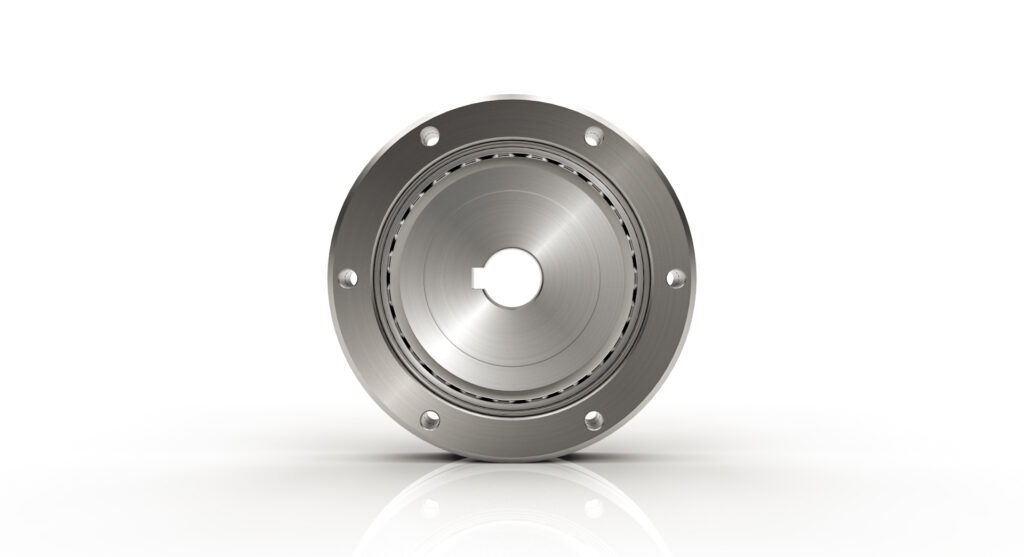
The FB-2 Component Gear Set offers high ratio, in-line mechanical power transmissions in extremely compact configurations, making it easier to use than conventional gearing.
Key figurescomparable across the catalogue
- Mass
- 0.1 kg
Normalised to common units so this product can be compared with others in its category. The supplier's own wording is below.
As published by the supplier
- Mass
- 0.1 kg
- Gear Backlash
- < 3 arc min
- Rated torque at 2000rpm (oil lubricant)
- 14 Nm
- Rated torque at 2000rpm (grease lubricant)
- 18 Nm
- Max. Repeated Peak Torque (oil lubricant)
- 18 Nm
- Max. Repeated Peak Torque (grease lubricant)
- 18 Nm
- Max. Load Torque
- 34 Nm
- Max. Momentary input Torque
- 3.5 kgfm
- Max. rotational speed
- 2000 rpm
- Max. Input Speed (Limit for Average Input Speed)
- 6000 rpm
- Moment of Inertia (I)
- 0.135 x10⁻⁴kgm2
- Moment of Inertia (J)
- 0.138 x10⁻⁵kgfms2
- Lost motion
- 40.0 arc min
- Spring constant
- 0.35 kgfm/arc min
About
The FB-2 Component Gear Set is designed for applications requiring high ratio, in-line mechanical power transmissions within extremely compact configurations. These pancake component sets simplify integration compared to conventional gearing, requiring only suitable bearing support for the input and output shafts, and a method to fix the circular spline against rotation. Key features include a flat shape, high positioning and rotational accuracies, and low axial width, allowing for easy adaptation to customer-supplied assemblies. The FB component set comprises four essential elements: a Wave Generator (an elliptical bearing assembly), a Flexspline (a non-rigid ring with external teeth), a Circular Spline (a rigid internal gear), and a Dynamic Spline (another rigid internal gear). The rotation of the Wave Generator imparts a rotating elliptical shape to the Flexspline, causing progressive engagement of its external teeth with the internal teeth of both the Circular Spline and the Dynamic Spline. The fixed Circular Spline has two more teeth than the Flexspline, which results in relative rotation of the Flexspline at a reduction ratio determined by the tooth difference. Conversely, the Dynamic Spline, having the same number of teeth as the Flexspline, rotates synchronously with it.
Documentation
Need the full ICD, test reports or a specific revision? Ask the supplier directly.