Monopropellant Tank with Stiff-Plastic Separation Device (Diaphragm)
 Glavkosmos
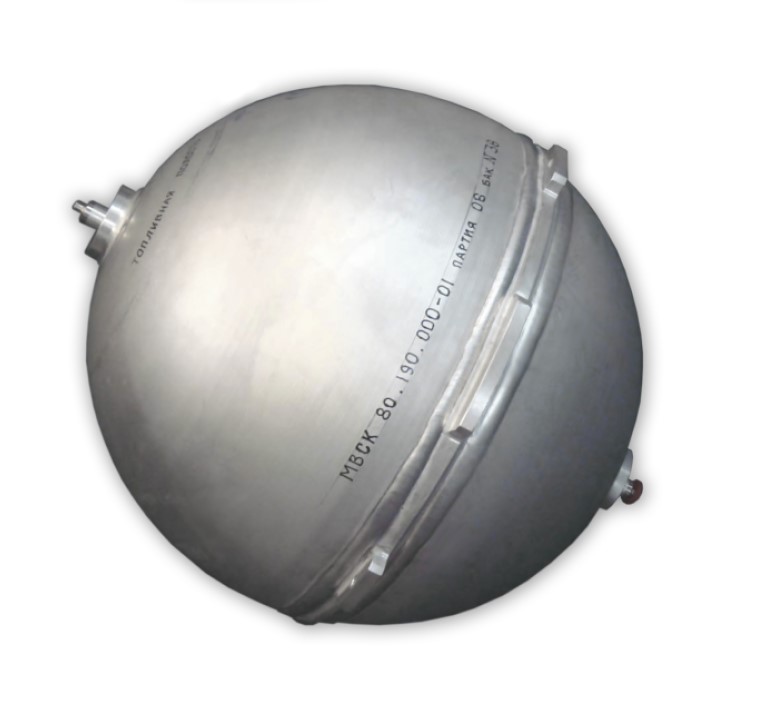
A monopropellant tank with a stiff-plastic separation device (diaphragm) designed for spacecraft propulsion systems, capable of storing and feeding UDMH and NTO propellants.
Key figurescomparable across the catalogue
- Mass
- 5.2 kg
- Design life
- 15 years
- TRL
- 9
Normalised to common units so this product can be compared with others in its category. The supplier's own wording is below.
As published by the supplier
- Purpose
- Phobos Sample Return Mission - International Program: Return Spacecraft Propulsion System.
- Year of release
- 2011
- Flight qualification of the product
- Letter "O", flight use
- Possibility to adapt the product to customer requirements
- Yes
- Propellant
- UDMH, NTO
- Operating pressure, not over
- 1.67 MPa
- Mass
- 5.2 kg
- Volume of propellant compartment
- 30.8 dm³
- Unused propellant residue after expulsions, not over
- 0.65 dm³
- Allowable helium leak during leakage test, l·μm of he /s, not over
- 1 · 10ˉ³
- Allowable leak rate throughout service life, l·μm of he /s, not over
- 2.33 · 10ˉ²
- Inner compartment cleanness
- Russia State Standard GOST 17216, Class 5
- Design life
- 15 years
About
This monopropellant tank features a stiff-plastic separation device (diaphragm) and is designed for the storage and feed of liquid propellants, specifically UDMH and NTO, to liquid propellant thrusters. It was released in 2011 and has flight qualification with a letter “O” for flight use. The product is adaptable to customer requirements. Key specifications include an operating pressure not exceeding 1.67 MPa, a mass of 5.2 kg, and a propellant compartment volume of 30.8 dm³. It ensures an unused propellant residue after expulsions of not more than 0.65 dm³. The tank maintains high cleanness with an inner compartment cleanness meeting Russia State Standard GOST 17216, Class 5. It has a guaranteed service life of 15 years and strict allowable helium leak rates during leakage tests and throughout its service life.
Documentation
No public datasheet yet — request the datasheet / ICD from the supplier.