Pressure Stabilization Unit
 Glavkosmos
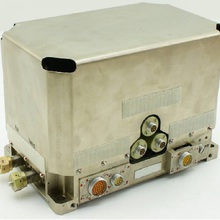
The Pressure Stabilization Unit (PSU) is a flight-qualified component designed to maintain stable propellant pressure for spacecraft propulsion systems, utilizing hydrazine propellant.
Key figurescomparable across the catalogue
- Mass
- 4.5 kg
- Power
- 5 W
- Largest dimension
- 304 mm
- Design life
- 10 years
- Lead time
- 12 months
Normalised to common units so this product can be compared with others in its category. The supplier's own wording is below.
As published by the supplier
- Purpose
- Pressure Stabilization
- Year of release
- 2009
- Design life
- 10 years
- Lead time
- 12 months
- Flight qualification of the product
- Yes
- Possibility to adapt the product to customer requirements
- Yes
- Propellant inlet pressure
- (206 - 883) kPa
- Propellant inlet pressure (2)
- (167 - 187) kPa
- Heater unit power consumption
- 5 W
- Overall dimensions
- 304 × 162 × 166 mm
- Mass (without detachable elements)
- 4.50 ± 0.14 kg
- Mass (with detachable elements)
- ≤ 5 kg
About
The Pressure Stabilization Unit (PSU) is a flight-qualified component, released in 2009, with a guaranteed service life of 10 years. Its primary purpose is pressure stabilization within a spacecraft’s propulsion system. The unit is designed to work with hydrazine propellant and consists of two pressure stabilizers, six small-size solenoid valves for propellant supply to the thruster, and two pressure transducers for monitoring propellant pressure. Thermal management is ensured by four heaters (two main and two redundant), a radiator, and a set of Multi-Layer Insulation (MLI). Four temperature sensors monitor the unit’s temperature. The product can be adapted to customer requirements. Estimated production and delivery time is 12 months, not including material procurement (4 months) and procured parts/components (6 months).
Documentation
No public datasheet yet — request the datasheet / ICD from the supplier.