NST20-G3 Star Tracker
 TY-Space Technology
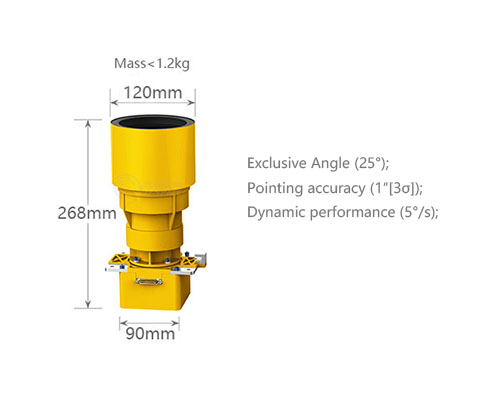
The NST20-G3 is an upgraded, fully autonomous, high-precision, and high-dynamic attitude star tracker designed for spacecraft navigation.
Typed specifications51 values
Discloses 8 of 12 fields engineers filter by in this category (category median 8).
- Accuracy, cross-boresight
- 1 arcsec datasheet p.1 2 arcsec 3σ, @0.1°/s-0.5% (Pointing) | 5 arcsec 3σ, @0.5°/s-1.2% (Pointing) | 1 arcsec pointing, 3 sigma | 2 arcsec max · 0.1°/s-0.5%, pointing, 3 sigma, <=2 arcsec +1
- Mass
- 1 200 g nom. · datasheet p.2 1 200 g device weight 1.2+-0.2kg
- Accuracy, about boresight (roll)
- 6 arcsec datasheet p.1 16 arcsec 3σ, @0.1°/s-0.5% (Roll) | 30 arcsec 3σ, @0.5°/s-1.2% (Roll) | 6 arcsec roll, 3 sigma | 16 arcsec max · 0.1°/s-0.5%, roll, 3 sigma, <=16 arcsec +1
- Envelope (L×W×H)
- L: 140±0.5 B: 120±0.2 H: 272±2 datasheet p.2 L: 140±0.5, B: 120±0.2, H: 272±2 envelope size
- Update rate
- 10 Hz datasheet p.1 10 Hz min · >=10Hz
- Sun exclusion angle
- 30 ° Sun · datasheet p.1 30 ° min · Sun: better than 30°
- Lost-in-space acquisition time
- 2 s Max. · datasheet p.1 2 s max · acquisition rate, max. <=2s | 5 s max · start-up time, better than 5s
- Supply voltage
- 28 V nom. · datasheet p.6 27 V min | 29 V max | 28 V as published, mode unspecified | 27–29 V VIN+, X2 +1
- Power consumption
- 4 W nom. · Operating Mode · datasheet p.6 4 W operating state, 4.0+-0.5 W per device | 4 W nom. · Operating State
- Data interface
- RS-422 datasheet p.1 RS-422 RS422
- Operating temperature
- -30 °C min · Operating Temperature Range · datasheet p.4 40 °C max · Operating Temperature Range | -30–50 °C as published, mode unspecified | 15–25 °C best operating temperature range, 20+-5 | -30–40 °C operating temperature range
- Radiation tolerance (TID)
- 100 krad as published, mode unspecified · vendor page (catalogue a
- Design lifetime
- 7 years 1000km Orbit · datasheet p.1
- Configuration
- single unit datasheet p.3
- Connector
- X1 (communication): J30J-37ZKN-J; X2 (power): J30J-15ZKN-J datasheet p.8 J30J-37ZKN-J X1 Communication Interface | J30J-15ZKN-J X2 Power Interface
- Survival temperature
- -30 °C min · Storage Temperature Range · datasheet p.4 40 °C max · Storage Temperature Range | -30–40 °C storage temperature range
- Baffle
- integrated inner surface of the baffle is ultra black coating · datasheet p.5
- Earth exclusion angle
- 20 ° min · Earth: better than 20° · datasheet p.2
- Time-sync (PPS) input
- yes PPS differential input; SYNC pulse · datasheet p.13
Each value is typed with its unit and measurement condition and cites the datasheet page it was taken from. Nothing is guessed: a field that is absent here has not been published by the manufacturer. machine-extracted ✓ checked by NewSpace Market ✓ manufacturer confirmed by the manufacturer.
As published by the supplier19 lines, in the manufacturer's own wording
- Dimensions
- Sensor+Baffle 90×100×268(mm³)
- Mass
- Sensor+Baffle 1200 g
- Optical design
- Lens refracitive
- Environmental vibration (FM)
- sine 13 g, random 12 grms
- Vibration (Qualification)
- sine 16 g, random 18 grms
- Working temperature
- -30~50(℃)
- Radiation resistance
- 100 Krad [Si]
- Performance field of view
- 15°×15°[effective]
- Attitude accuracy (pointing/rolling)
- <1″[3σ]
- Attitude accuracy (pointing/rolling) (2)
- <6″[3σ]
- Update rate
- 10 Hz
- Dynamic performance
- 5°/s
- Sensitivity
- 5.8Mv,Go.Ref star
- Exclusive angle sun
- < 25°
- Exclusive angle earth
- < 20°
- Data interface
- RS422/CAN
- Power consumption
- 4 W
- Supply voltage
- 28 V
- Design life
- 7years
About
The NST20-G3 star tracker is an upgraded version of the NST10-G1, offering enhanced performance for spacecraft attitude determination. It is a fully autonomous, highly reliable, high-precision, and high-dynamic attitude star tracker. It boasts an attitude determination accuracy of less than 1 arcsecond (3σ) and a dynamic performance of up to 5 degrees per second. The device features a refractive optical design and is built to withstand harsh space environments, with specified vibration tolerances for both flight and qualification, a working temperature range of -30 to 50 degrees Celsius, and radiation resistance up to 100 Krad [Si]. It has a field of view of 15°×15° (effective) and an update rate of 10 Hz. The star tracker also specifies exclusive angles for the Sun (less than 25°) and Earth (less than 20°) to avoid interference. Data communication is handled via RS422/CAN interfaces, and it operates on 28V input voltage with a power consumption of 4W, designed for a 7-year lifetime.
Documentation
Need the full ICD, test reports or a specific revision? Ask the supplier directly.