SmallSat PCDU – STARBUCK-Mini MCC
 AAC Clyde Space
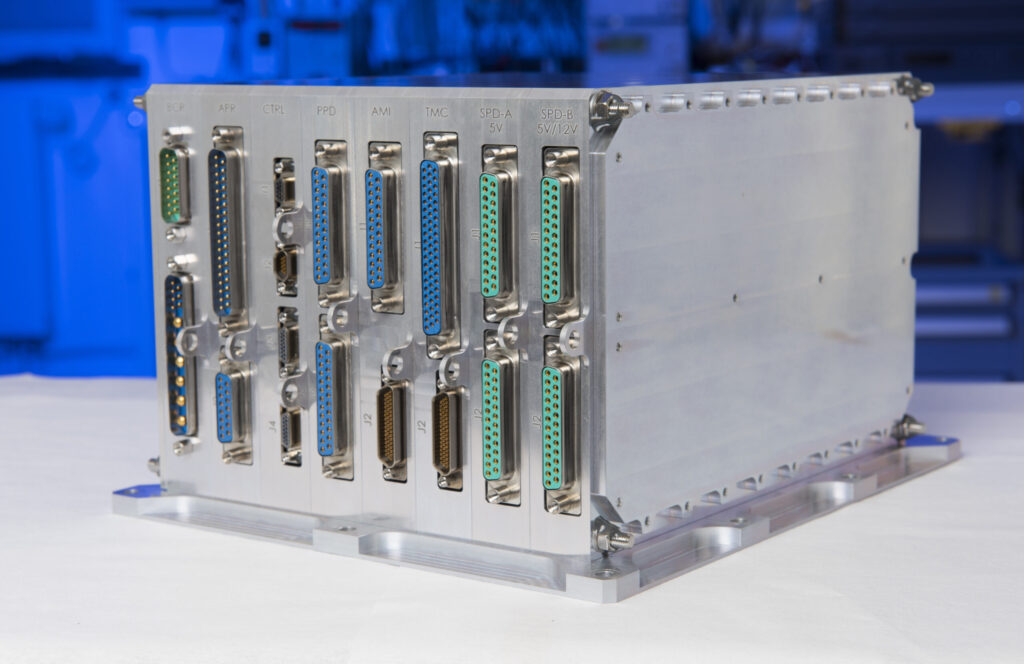
An advanced SmallSat PCDU with an integrated Mission Control Computer, combining power management and satellite OBC functions into a single unit for streamlined satellite architecture.
Typed specifications50 values
Discloses 7 of 14 fields engineers filter by in this category (category median 7).
- Mass
- 400 g nom. · PCBA+mech · datasheet p.2 3 900 g | 400 g ~400 grams (PCBA+mech) | 11 800 g
- Total output power
- 80 W max · each mm motor power · datasheet p.2 80 W max · motor power 0-80 W each
- Envelope (L×W×H)
- 22 x 249 x 147 mm length x width x height · datasheet p.2
- Supply voltage
- 28 V nom. · Input Voltage · datasheet p.2 28 V input voltage | 21 V min · Motor drive voltage | 34 V max · Battery Voltage | 34 V max · Motor drive voltage +6
- Power consumption
- 2.5 W product page 10 W
- Data interface
- CAN command interface, 2 redundant, CAN 2.0b isolated · datasheet p.2 SPI internal/ext comm | CAN
- Operating temperature
- -30 °C product page -30 °C min | 60 °C max | -30–60 °C
- Radiation tolerance (TID)
- 30 krad qualified >30 kRAD, Si · datasheet p.2 20 krad min
- Design lifetime
- 5 years min · design life 5-7 years in LEO · datasheet p.2 7 years max · design life 5-7 years in LEO | 5–7 years
- TRL
- 9 product page
- Lead time
- 6 months product page 10 months
- Unit type
- PCDU Starbuck-mini PCDU with MCC motor controller module · datasheet p.1
- Regulated output voltages
- 28 V nom. · motor drive voltage, 28V nom (21-34V) · datasheet p.2 28V nom Motor drive voltage | 28 V Motor drive voltage nom | 21 V min · Motor drive voltage | 34 V max · Motor drive voltage +1
- Switchable outputs
- 6 Motor phase output · datasheet p.2
- Protections
- over-current (LCL) all motor drivers are LCL protected · datasheet p.1
- Survival temperature
- -50 °C min · Storage Temperature · datasheet p.2 100 °C max · Storage Temperature | -50–100 °C storage temperature
- Satellite class
- microsat 10-100 kg datasheet p.1
- Battery voltage range accepted
- Max. Battery Voltage datasheet p.2 34 V max · Max. Battery Voltage
Each value is typed with its unit and measurement condition and cites the datasheet page it was taken from. Nothing is guessed: a field that is absent here has not been published by the manufacturer. machine-extracted ✓ checked by NewSpace Market ✓ manufacturer confirmed by the manufacturer.
As published by the supplier21 lines, in the manufacturer's own wording
- Design life
- 5-7 years in LEO
- System power
- 2.5 kW
- Primary bus voltage
- 22-34 V
- Solar power regulation
- MPPT or S3R
- Battery charge regulation
- CC-CV
- Idle power consumption range
- 10 W Typically
- Operating temperature
- -30°C to +60°C
- Radiation tolerance (TiD)
- 20 kRAD (qualified >30 kRAD Si)
- Mass (5 Module Configuration)
- 3.9 kg
- Mass (15 Module Configuration)
- 11.8 kg
- Width (5 Module Configuration)
- 142 mm
- Width (15 Module Configuration)
- 361 mm
- Height
- 147 mm
- Depth
- 249 mm
- 500 w solar array configuration
- 20 x 28 V LCLs - 6 x 5 V LCLs - 6 x 12 V LCLs
- 2.5 kw solar array configuration
- 100 x 28 V LCLs - 1.2 kW 50 V output for electric propulsion
- TRL level
- 9
- Em lead time
- 6 months
- Fm lead time
- 10 months
- Flight status
- Flown 2024
- Mcc integration
- Mission Control Computer integrated
About
The STARBUCK-Mini MCC is an evolution of the STARBUCK-Mini PCDU that integrates a Mission Control Computer (MCC) directly into the power management unit. This combined system handles both power conditioning/distribution and on-board computing functions, reducing system complexity, mass, and volume while simplifying interfaces. The MCC element provides processing and data handling capabilities typical of an OBC, enabling a more integrated satellite architecture. The system maintains all the STARBUCK-Mini PCDU features including 2.5 kW solar input power, modular scalable architecture, MPPT or S3R solar power regulation, and radiation-tolerant components, while adding the computing layer for mission control tasks.
Documentation
Need the full ICD, test reports or a specific revision? Ask the supplier directly.