QUASAR-STRX
 AAC Clyde Space
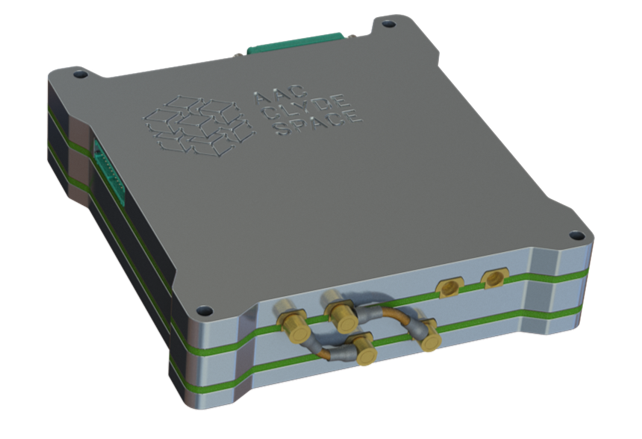
The QUASAR-STRX is a software-defined radio (SDR) transceiver designed for small satellites and CubeSats, offering a complete plug-and-play TMTC solution.
Typed specifications74 values
Discloses 6 of 13 fields engineers filter by in this category (category median 5).
- Mass
- 250 g max · datasheet p.2
- Link protocols and waveforms
- CCSDS CCSDS 131.0-B-3, 132.0-B-3, 231.0-B-4, 232.0-B-4 · datasheet p.2 TC Synchronization and Channel Coding (CCSDS 231.0-B-4) RX | CCSDS TC Space Data Link Protocol (CCSDS 232.0 B 4) | CCSDS TC Synchronization and Channel Coding (CCSDS 231.0-B-4) | CCSDS TM Space Data Link Protocol (CCSDS 132.0 B 3) +8
- Frequency range
- 2 025 MHz min · Receiver · datasheet p.6 2 200 MHz min · Transmitter | 2 110 MHz max · Receiver | 2 290 MHz max · Transmitter | 2 025–2 110 MHz RX +2
- Envelope (L×W×H)
- 93 x 88 x 24 mm datasheet p.2 93 x 88 x 24 height including enclosure
- TX RF output power
- 0.501 W datasheet p.2 0.501 W option | 1 W | 1 W option | 2 W +1
- Data rate
- 32 kbps RX BPSK · datasheet p.3 32 kbps RX BPSK (32 kSps) | 64 kbps RX QPSK | 64 kbps RX QPSK (32 kSps) | 1 024 kbps max · TX +1
- RX sensitivity
- -150 + 10*log(symbol rate) dBm datasheet p.3
- Modulation
- QPSK Filtered (O)QPSK · datasheet p.5 BPSK Filtered BPSK | Filtered BPSK RX | BPSK RX, filtered (CCSDS) | Filtered (O)QPSK TX +4
- Power consumption
- 3.4 W receive mode (always on) · datasheet p.2 3.4 W Receiver | 3.4 W RX | 9 W Transmitter | 9 W TX
- Data interface
- I2C currently supported · datasheet p.2 CAN under development | SPI under development
- Operating temperature
- -25–55 °C datasheet p.2
- Design lifetime
- 3 years datasheet p.2 3 years min | 5 years max | 3–5 years
- Function
- SDR transceiver datasheet p.1
- Link use
- TT&C datasheet p.1
- Frequency band
- S datasheet p.1
- RF connector
- SMP datasheet p.1
- Power draw, receive
- 3.4 W receive mode (always on) · datasheet p.2
- Power draw, transmit
- 9 W transmitter · datasheet p.2
- Connector
- SMP datasheet p.2
- Survival temperature
- -40–85 °C storage · datasheet p.2
- Flight heritage
- transceiver line-up has flight heritage datasheet p.1
- Satellite class
- CubeSat datasheet p.1 smallsat 100-500 kg
- Max RX input level
- -30 dBm dynamic range upper level · datasheet p.4
- Channel coding (FEC)
- BCH RX · datasheet p.4 convolutional (Viterbi) TX | Reed-Solomon TX | concatenated RS + convolutional TX
Each value is typed with its unit and measurement condition and cites the datasheet page it was taken from. Nothing is guessed: a field that is absent here has not been published by the manufacturer. machine-extracted ✓ checked by NewSpace Market ✓ manufacturer confirmed by the manufacturer.
As published by the supplier16 lines, in the manufacturer's own wording
- Temperature
- -25 to +60 C
- Mass
- 270 g
- Control and data interfaces
- CAN, SPI, I2C
- Power consumption
- 3.5 W receive mode
- Tx frequency
- 2.200-2.290 GHz
- RF output power
- -10 to 33 dBm in 0.25 dB steps
- Tx modulation
- Filtered OQPSK or QPSK CCSDS
- Tx symbol rate
- Up to 5 MSps
- Tx channel coding
- Convolutional/Reed-Solomon/Concatenated
- Rx frequency
- 2.025-2.110 GHz
- Rx symbol rate
- 64 kSps to 2 MSps
- Rx noise figure
- <2 dB
- Rx modulation
- Filtered BPSK CCSDS
- Rx channel coding
- BCH
- Dimensions
- 96 x 90 x 23 mm
- Design life
- 3-5 years
About
The QUASAR-STRX is a software-defined radio (SDR) transceiver specifically designed for SmallSats and CubeSats. It is intended to provide a complete plug-and-play Telemetry, Tracking, and Command (TMTC) solution for next-generation satellite missions. The product is highlighted as being able to be paired with the Quasar-WSANT, a compact, wideband S-band antenna, to form a comprehensive communication system. While the provided text does not offer extensive details on its internal workings or specific features beyond being an SDR transceiver for TMTC, its application in CubeSats and SmallSats indicates its role in enabling reliable communication links for these spacecraft.
Documentation
Need the full ICD, test reports or a specific revision? Ask the supplier directly.