PG400 Gyroscope
 AAC Clyde Space
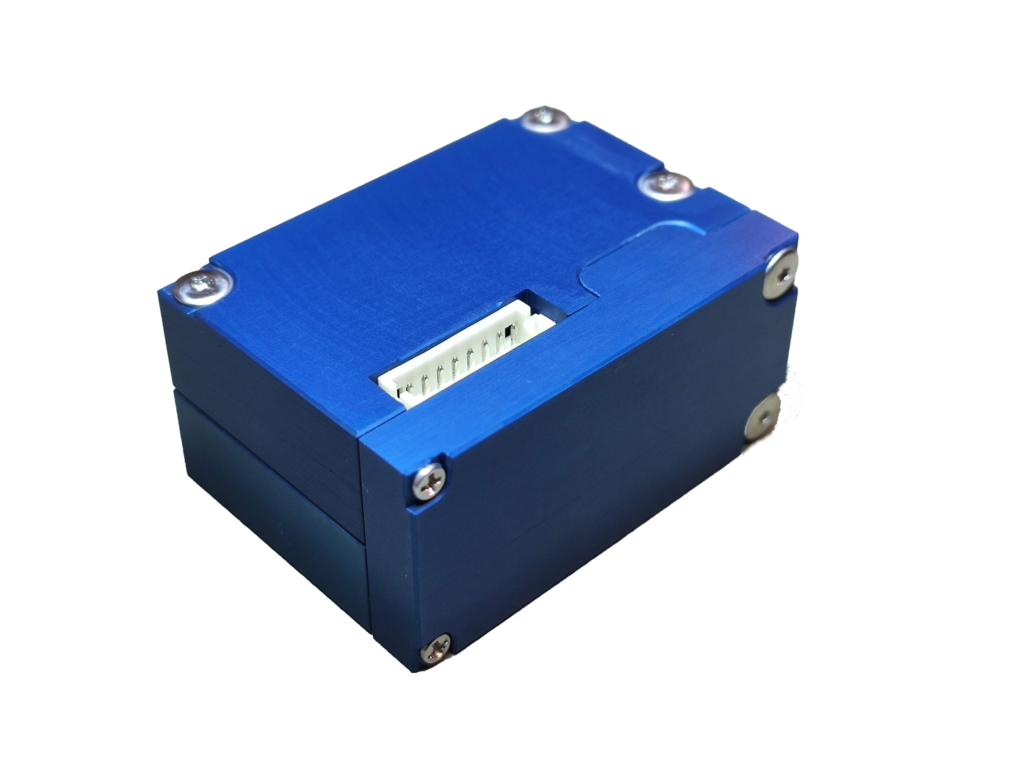
The PG400 is a flight-proven, high-performance standalone gyroscope designed for CubeSat and SmallSat attitude determination, offering low power consumption and a compact form factor.
Typed specifications29 values
Discloses 9 of 11 fields engineers filter by in this category (category median 3).
- Gyro range
- -125–125 °/s min · Gyroscope Range · datasheet p.2 125 °/s max | 125 °/s max · Gyroscope Range
- Bias instability
- 1 °/h nom. · offset short term bias stability, typ. · datasheet p.2 1 °/h
- Envelope (L×W×H)
- 30.8 x 25.7 x 17mm datasheet p.1
- Angle random walk
- 0.23 °/√h nom. · typ. · datasheet p.2 0.23 °/√h | 0.3 °/√h max
- Supply voltage
- 5 V nom. · typ. · datasheet p.2 3.65 V min | 5.5 V max | 3.65–5.5 V supply voltage min-max
- Power consumption
- 0.28 W product page
- Data interface
- RS-422 datasheet p.1 RS-422 full duplex RS422
- Operating temperature
- -40 °C min · datasheet p.2 85 °C max | -40–85 °C operational temperature range
- TRL
- 9 product page
- Lead time
- 16 months product page
- Unit type
- gyroscope (rate sensor) datasheet p.1
- Gyro technology
- MEMS datasheet p.1
- Axes
- 3 datasheet p.1
- Flight heritage
- successfully-flown on orbit and it based on the design heritage of the internal IMU used in our reliable and flight proven attitude determination and control system iADCS solutions. datasheet p.1
- Satellite class
- CubeSat datasheet p.1 microsat 10-100 kg
- Missions flown
- 1 datasheet p.1
- Accelerometers included
- no datasheet p.1
Each value is typed with its unit and measurement condition and cites the datasheet page it was taken from. Nothing is guessed: a field that is absent here has not been published by the manufacturer. machine-extracted ✓ checked by NewSpace Market ✓ manufacturer confirmed by the manufacturer.
As published by the supplier18 lines, in the manufacturer's own wording
- Gyroscope range
- -125 to 125 °/s
- Zero rate offset
- -1 to 1 °/s
- Offset temperature drift
- 0.002 to 0.01 °/s/°C
- Offset short term bias stability
- 1 °/h
- Angular random walk
- 0.23 to 0.3 °/√h
- Supply voltage
- 3.65 to 5.5 V
- Supply current
- 75 to 100 mA
- RS422 input signal levels
- +/- 0.2 to +/- 5 V
- RS422 output signal levels
- +/- 3 V
- Operational temperature range
- -40 to 85 °C
- TRL
- 9
- Lead time
- 16 Week
- Flown since
- 2023
- Power consumption
- 280 mW
- Range
- +/- 125 deg/s
- Rad tested
- up to 50 kRad TID
- Designed for
- 5 years in LEO
- Dimensions
- 30.8 x 25.7 x 17 mm
About
The PG400 gyroscope is a flight-proven, high-performance standalone unit specifically engineered for CubeSat and SmallSat applications. It provides a plug-and-play solution for satellite attitude determination, optimized for maximum on-orbit stability while demanding low power. The device features an Angular Random Walk of 0.23 deg/sqrt(Hz) and a bias instability of 1 deg/hr. It utilizes an RS422 interface with a request-based protocol for command and data handling, ensuring seamless integration with various platform designs. This compact, precision-engineered gyroscope is suitable for attitude determination across a range of applications, including communications and earth observation. The PG400’s design benefits from the heritage of AAC Clyde Space’s iADCS solutions and is compatible with the iADCS 200 and 400 Attitude Determination & Control Systems. It operates on the unified AAC Hyperion Protocol, simplifying driver development. The gyroscope has successfully flown on orbit since 2023 and is based on the internal IMU design used in the flight-proven iADCS solutions. It has a TRL of 9, a lead time of 16 weeks, and is designed for 5 years in LEO. The unit has been radiation tested up to 50 kRad TID.
Documentation
Need the full ICD, test reports or a specific revision? Ask the supplier directly.