TRX-U
 AAC Clyde Space
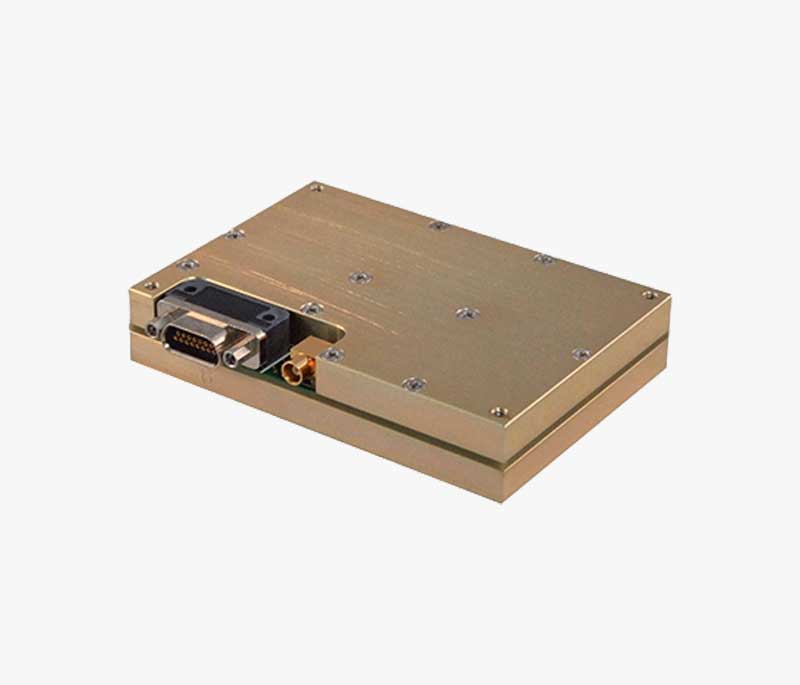
The TRX-U is a space-qualified transceiver designed for reliable uplink and downlink communication in space missions. It can also serve as a robust lower data-rate backup radio.
Typed specifications46 values
Discloses 12 of 13 fields engineers filter by in this category (category median 3).
- Frequency band
- UHF Uplink & Downlink · datasheet p.2
- Mass
- 125 g datasheet p.3
- Frequency range
- 370–470 MHz datasheet p.3
- Envelope (L×W×H)
- 83 mm x 57 mm x 16 mm datasheet p.3
- TX RF output power
- 0.25 W min · datasheet p.2 5 W max · RF output | 0.25–5 W
- Data rate
- 2.4–19.2 kbps Receive · datasheet p.3 2.4–19.2 kbps receive, customer defined | 2.4–19.2 kbps Transmit | 2.4–19.2 kbps transmit, customer defined
- RX sensitivity
- -108 dBm nominal, BER 10-4, at 19.2 Kbps · datasheet p.2 -108 dBm @ 19.2 Kbps | -113 dBm @ 9600 bps | -113 dBm nominal, BER 10-4, at 9600 bps
- Modulation
- FSK, GFSK datasheet p.3 other FSK | GFSK
- Supply voltage
- 3.3–42 V datasheet p.3
- Power consumption
- 0.23 W RX · datasheet p.3 8 W TX: for >5W RF Output with 6V Input
- Data interface
- 15 Pin Micro-D Socket datasheet p.2 other Clock and Data Output
- Operating temperature
- -35–80 °C datasheet p.3
- Radiation tolerance (TID)
- 10 krad product page
- TRL
- 9 product page
- Function
- transceiver datasheet p.1
- Link use
- TT&C satellite TT&C radio or narrow band communication payload · datasheet p.1
- Link protocol
- proprietary datasheet p.0
- RF connector
- MCX MCX socket · datasheet p.2
- Power draw, receive
- 0.23 W RX · datasheet p.2
- Power draw, transmit
- 8 W TX, for >5 W RF output with 6 V input · datasheet p.2
- Connector
- 15 Pin Micro-D Socket (power and data) datasheet p.2 15 Pin Micro-D Socket Power and Data | MCX Socket RF
- Survival temperature
- -35–80 °C datasheet p.3 -35–80 °C storage
- Random vibration
- 14.1 g RMS 20-2000 Hz per GEVS NASA Std · datasheet p.2
- Flight heritage
- Space Qualified (Multiple Units On Orbit) datasheet p.2 in use by clients around the world. They have been deployed on orbit in various configurations for two decades of successful operations.
- Satellite class
- CubeSat datasheet p.1 microsat 10-100 kg
- Missions flown
- 20 datasheet p.0
- Quasi-static load
- 14.1 g datasheet p.2
- Channel bandwidth
- 1 kHz datasheet p.2
- Noise figure
- 1.3 dB max · front-end, with built in LNA and filter · datasheet p.2
Each value is typed with its unit and measurement condition and cites the datasheet page it was taken from. Nothing is guessed: a field that is absent here has not been published by the manufacturer. machine-extracted ✓ checked by NewSpace Market ✓ manufacturer confirmed by the manufacturer.
As published by the supplier23 lines, in the manufacturer's own wording
- Tx frequency range
- 400-450 MHz (UHF)
- Rx frequency range
- 130-175 MHz (VHF)
- Tx output power
- Up to 2 W
- Rx sensitivity
- <-118 dBm
- Data rate
- 1.2 to 38.4 kbps (uplink/downlink)
- Modulation
- GMSK, FSK, BPSK (configurable)
- Duplex mode
- Half-duplex / Full-duplex
- Interface
- RS-232 / I2C
- Supply voltage
- 5 V / 3.3 V
- Power consumption (TX)
- ~4 W
- Power consumption (RX)
- ~0.5 W
- Operating temperature
- -40°C to +85°C
- Mass
- ~110 g
- Dimensions
- ~90 x 90 x 15 mm
- Radiation tolerance
- 10 KRad
- TRL level
- 9
- Protocol support
- AX.25, custom framing
- Frequency tuning step
- 1 kHz
- Frequency stability
- <±2 ppm
- Channel filters
- Programmable
- Agc
- Yes
- Rssi output
- Yes
- Error correction
- FEC (optional)
About
The PULSAR-UTRX transceivers (referred to as TRX-U on the product page) are designed for space missions requiring reliable uplink and downlink communication. These transceivers are versatile and can be utilized as a robust lower data-rate backup radio for missions employing higher data-rate communication systems. While the page text mentions ‘PULSAR-UTRX’ and ‘Pulsar-VUTRX’ in the related products section, the main product ‘TRX-U’ is implied to be a variant or the same product as PULSAR-UTRX given the datasheet link. The description highlights its suitability for space applications where consistent communication is critical.
Documentation
Need the full ICD, test reports or a specific revision? Ask the supplier directly.